Healthy Living in Bochum: Yoga, Courses & Retreat
Healthy Living in Bochum: Courses, Yoga & Retreats (Outlook on Upcoming Offers 2026/2027)
This overview focuses on future dates and formats related to yoga, mindfulness, nutrition, and retreats in Bochum and the surrounding area – with practical criteria for selection, quality features (e.g., ZPP), and reputable points of contact.
Important: This article exclusively lists future opportunities and orientation points. Specific dates and spots may change; please check the current information with the respective provider.
Yoga in Bochum 2026/2027: Course Formats & Selection
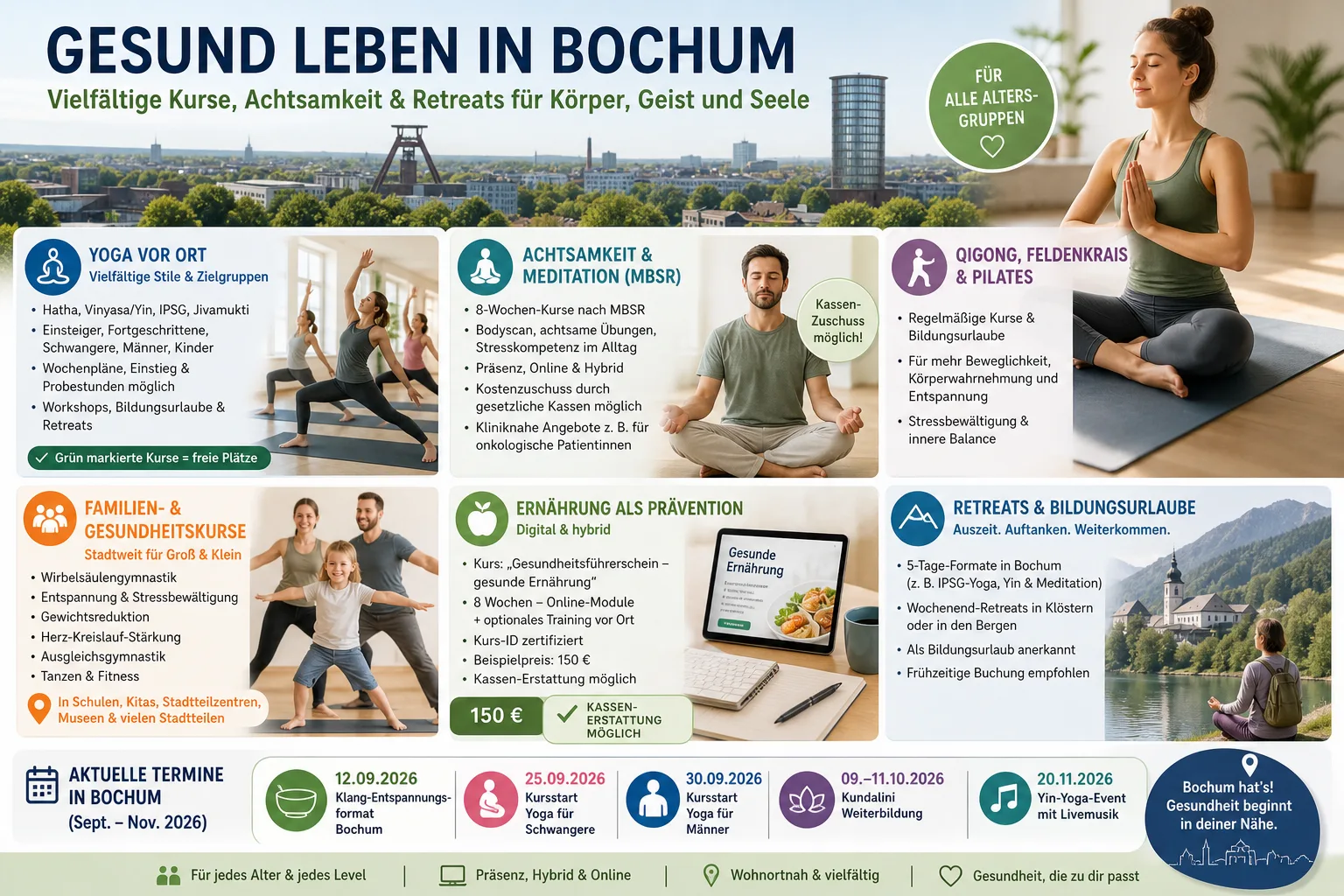
For the coming months (fall/winter 2026 as well as planning for 2027), many studios, educational providers, and course instructors are announcing new course blocks. Typical are weekly schedules with recurring dates, as well as individual weekend workshops and thematic intensive days. If you are just starting out, trial classes or beginner series are usually the best entry point before committing to a longer block.
Which yoga styles are likely to be offered?
In Bochum, the following formats are frequently advertised for upcoming programs (names may vary by provider):
- Hatha-oriented courses (calm, fundamentals-focused)
- Vinyasa (more dynamic, flowing structure)
- Yin (long-held positions, regenerative focus)
- Prevention-oriented back/posture formats (often in course blocks)
- Breath and relaxation components (e.g., pranayama, guided relaxation phases)
Who are the different course types suitable for?
- Beginners: The course description should explicitly mention “basics/level 1” and explain alternatives for physical limitations.
- Advanced: Look for clear level indications and whether more challenging variations are truly optional.
- Pregnant/Postnatal: Only choose formats that are explicitly designated for this; clarify medical questions with your doctor in advance.
- Children/Adolescents: Age-appropriate groups with playful elements and short concentration exercises are sensible.
Quality check for date selection: Reputable providers state level, duration, course block length, maximum group or room size, as well as the instructor’s qualifications. If “prevention course” is advertised, there should be a ZPP recognition or a traceable course ID/assignment (see details under Nutrition/Prevention).
Mindfulness & Meditation: MBSR and Beginner Formats
For 2026/2027, many cities – and typically also Bochum – are announcing eight-week course formats for stress management, including programs based on the MBSR approach (Mindfulness-Based Stress Reduction). Such courses combine group meetings with exercises for at home. If you want to book a course in the future, it is helpful to pay attention to structure and learning objectives already in the announcement.
What is usually included in MBSR-like courses?
- Bodyscan (systematic body awareness)
- Sitting and walking meditation (attention and dealing with distraction)
- Mindful movement (often gentle, sometimes with yoga elements)
- Everyday transfer (practice impulses for work, family, commuting times)
Online, hybrid or on-site – what fits best in 2026/2027?
- On-site: sensible if you benefit from a fixed routine and group atmosphere.
- Online: practical for shift work, caregiving duties, or long distances; important are data protection, clear instructions, and good audio quality.
- Hybrid: helpful if you don’t want to drop out of the course due to illness or scheduling pressure.
Note on cost reimbursement: Whether a course is subsidized depends in practice on the course concept and the criteria of your health insurance. For future bookings, it is worth checking recognition via the Central Prevention Testing Office (ZPP) and your insurer’s reimbursement conditions (see sources).
Neighborhood Courses: Exercise & Relaxation Close to Home
For upcoming program booklets and semester starts (typically: fall/winter blocks and spring blocks), neighborhood centers, sports clubs, family education centers, and educational providers often plan courses that take place directly in the neighborhood. For Bochum, this means you can also expect to find offers in 2026/2027 that require no long travel and are suitable for everyday life.
Typical course types that will be advertised for the next blocks
- Back/spinal gymnastics (moderate intensity, functional focus)
- Flexibility & mobility (gentle strengthening, stretching, balance)
- Relaxation techniques (e.g., breathwork, progressive muscle relaxation – depending on provider)
- Family formats (exercise with children, parent-child offers, age-appropriate groups)
What to look for in future announcements: Course location (accessibility), target group (e.g., “for beginners”), necessary prior knowledge, and notes on health suitability. If you are unsure, clarify medical questions with your doctor or physiotherapist before booking – especially if you have acute complaints.
Nutrition Courses as Prevention: ZPP, Digital & Hybrid
For 2026/2027, new nutrition and prevention courses are regularly advertised – some on-site, some digital or hybrid. Many people choose these formats because they are plannable (e.g., 6–10 sessions) and practically address everyday situations: shopping, cooking, snack breaks, eating rhythm, portion sizes, and long-term habits.
This is how you can recognize reputable prevention offers in the future
- Transparent course objectives (e.g., “practical, balanced nutrition” instead of quick promises).
- Traceable qualification of the course instructor (e.g., nutrition professionals – depending on the course format).
- ZPP orientation: If a course is advertised as eligible for reimbursement, recognition/assignment and conditions should be clearly explained.
- No extreme diets: Beware of blanket healing promises or very one-sided diets without medical supervision.
Digital & hybrid: If you book an online course for 2026/2027, look for fixed live dates or well-structured modules, clear handling of data/privacy, and realistic implementation tasks (e.g., weekly plans, shopping lists, recipe variations).
Retreats & Educational Leave 2026/2027: How to Plan Sensibly
For 2026/2027, retreats and intensive formats are also being announced around Bochum – often as weekends or multi-day time-outs. In terms of content, they often combine yoga, meditation, time in nature, and structured relaxation. If you are planning to participate, it is worth taking a sober look at the framework conditions so that the time-out is truly relieving.
Typical formats that will be advertised for the next season
- Weekend retreats (2–3 days) with several sessions per day
- Multi-day events (e.g., 4–6 days) focusing on regeneration, deepening practice, and everyday transfer
- Themed retreats (e.g., Yin & Silence, Stress Competence, Mindfulness in Movement)
Educational leave: check realistically
If a retreat is advertised as educational leave, check in advance whether the recognition is valid for NRW (and your employment status) and which proofs are required. The information from the responsible authorities and the organizer’s documents are binding. Early planning (several months in advance) increases the chance that the date, leave approval, and spots will fit together.
Practical criteria for a safe booking decision
- Program: daily schedule, intensity, breaks, rest periods, and optional sessions.
- Health suitability: Are there alternatives for limitations? Are boundaries respected?
- Transparent costs: price components (course, accommodation, meals), cancellation rules, minimum number of participants.
- Leadership & responsibility: qualification, experience, clear safety and communication rules.
Practical Guide: How to Find Suitable Dates in Bochum
Since this article deliberately does not mention any already expired dates, the best way to find concrete future offers is a systematic approach. This is how you can quickly find suitable courses and retreats for Bochum 2026/2027:
-
Set a time frame (e.g., “from October 2026” or “spring 2027”). This way you can filter course schedules and avoid fully booked or outdated entries.
-
Choose a format: weekly course, 8-week program, weekend workshop, or retreat. Plan realistically for travel, family/work times, and recovery.
-
Check quality: level information, course objective, instructor, group size, and (for prevention) notes on ZPP/reimbursement eligibility.
-
Clarify financing: If subsidies are possible, check with your health insurance before booking which conditions apply (e.g., recognition, minimum participation).
-
Start with an introductory date: A trial class or introductory evening is often more sensible than immediately choosing an intensive format – especially if you don’t know any style yet.
Reminder for 2026/2027: The more specifically you define your needs (exercise, relaxation, nutrition, stress competence) and your calendar (fixed times, flexible slots), the easier it is to find offers in Bochum that are sustainable in the long term.
Sources
- Central Prevention Testing Office (ZPP) — Information on prevention offers and quality criteria (accessed 2026-09-09)
- Social Code Book (SGB V) § 20 Primary Prevention and Health Promotion — Legal framework for prevention funding (accessed 2026-09-09)
- Center for Mindfulness (CFM), University of Massachusetts Medical School – MBSR — Background on the MBSR program (accessed 2026-09-09)
- Ministry of Labor, Health and Social Affairs of the State of North Rhine-Westphalia: Educational Leave — Overview and information on use in NRW (accessed 2026-09-09)