Interreligious Events and Festivals in Bochum
Interreligious Events & Cultural Festivals in Bochum (Outlook)
Which interreligious formats, open sacred spaces, and educational offerings you can expect in Bochum in the future – including practical tips for planning, respectful participation, and reliable sources of information.
Bochum in Dialogue: Why More Interreligious Formats Will Emerge in the Coming Years
In Bochum, religious diversity is increasingly understood as part of the city's cultural and educational life. In the coming years, it can be expected that interreligious events (dialogue evenings, music and cultural programs, open house days) as well as cultural festivals with religious references will become more visible – not as a replacement for religious practice, but as opportunities for encounter for people with and without religious affiliation.
Drivers of this development include collaborations between religious communities, cultural institutions, educational providers, and the urban society. Formats that clearly explain what is being celebrated, who is inviting, and how guests can participate respectfully are particularly in demand.
Open Sacred Spaces: What Events to Expect in Churches, Mosques & Other Houses of Worship in the Future
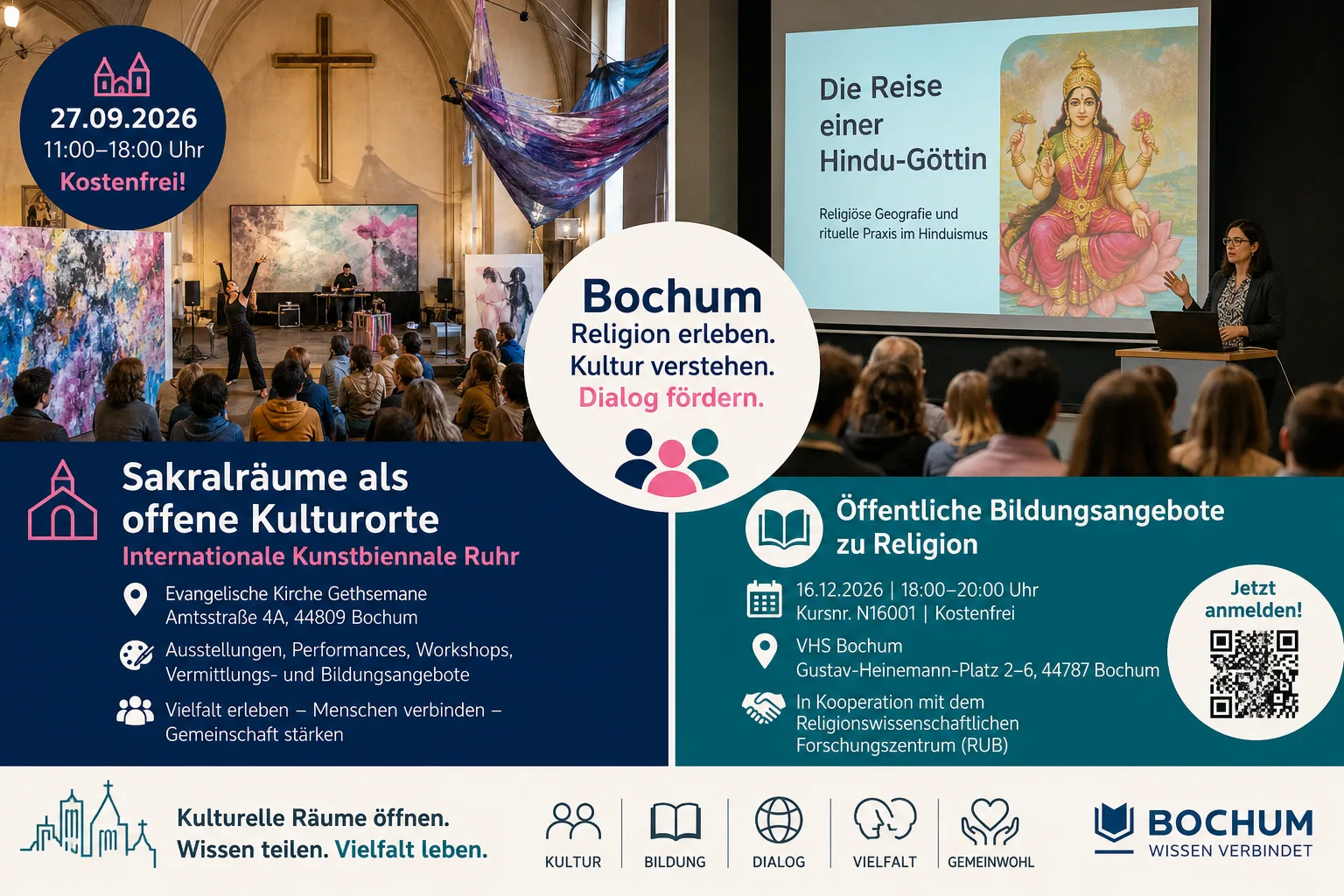
Sacred spaces in large cities are increasingly being used as public cultural and learning venues. For Bochum, the following types of events can especially be expected in the coming seasons:
- Open house days (guided tours, conversation islands, music, insights into architecture and community work)
- Concert and sound formats (choirs, organ/instrumental music, intercultural ensembles)
- Exhibitions and performances dealing with topics such as culture of remembrance, migration, spirituality, or social cohesion
- Dialogue evenings on everyday questions of religious diversity (holidays, rituals, life transitions, mourning culture)
What Visitors Should Pay Attention to in the Future
- Framework and rules: Some program points are cultural, others have a ritual character. Pay attention to the organizers' instructions (e.g., photo rules, seating arrangements, quiet phases).
- Clothing & behavior: In houses of worship, respectful, rather modest clothing and a quiet manner are often desired. If unsure: ask briefly on site.
- Accessibility: If you depend on step-free access, induction loops, or quiet areas, check the information in the announcement or ask the organizer.
- Classification: Good events explain terms and contexts. If not, it is worth taking a look at accompanying information materials (program booklet, website, introductory lecture).
Education on Religion: Which Course and Lecture Formats You Will Find in Bochum in the Future
In parallel with cultural programs, Bochum is expected to offer more low-threshold educational opportunities on religion, worldviews, and cultural practices. Typical formats you can expect in the coming semesters and series are:
- Introductory courses on religions (e.g., basic concepts, festivals, rituals, historical development)
- Urban society & religion (religion in everyday life, in schools/workplaces, in care and volunteering)
- Academic lectures (religious studies, sociology, cultural studies) followed by discussion
- Encounter formats (moderated discussion groups, interreligious panels, thematic workshops)
For participants, the benefit is often very concrete: Those who know the basics can reduce misunderstandings in everyday life, better classify holidays, and communicate more sensitively. In the coming years, such offerings will likely become even more important – not least because many institutions (schools, clubs, cultural institutions) are increasingly working interculturally.
How to Reliably Find Future Interreligious Events & Festivals in Bochum
Since programs can change at short notice, the source is crucial for future dates. Prefer to rely on official organizer pages and established calendars:
- Municipal event calendars and cultural portals (for current date and location information)
- Websites of educational providers (e.g., adult education center/municipal continuing education) for course starts, lecturers, and registration methods
- Pages of religious communities (program, house rules, information on participation and accessibility)
- Newsletters from cultural institutions or dialogue initiatives if you want to be informed early about new series
Checklist for Planning (Future Dates)
- Check date status: Is there a current status (date, time, admission, possibly registration)?
- Clarify format: Cultural program, dialogue, workshop, or ritual context?
- Costs & access: Free entry/donation/ticket? Are there capacity limits?
- Participation notes: Photo permission, seating arrangement, language(s), dress code, safety/house rules.
- Arrival & accessibility: Public transport, parking, step-free access, sanitary infrastructure.
Why Attending Future Formats Is Worthwhile (for Bochum Residents & Guests)
Interreligious events and cultural festivals in Bochum can achieve three things at once in the future: orientation (knowledge instead of clichés), encounter (conversations in a moderated setting), and culture (music, art, city history). For guests, such formats are often a direct access to lived everyday culture; for residents, an opportunity to experience their own city from new perspectives.
Transparency is important: Serious organizers clearly state goals and boundaries (e.g., dialogue instead of mission, respectful interaction, protection of personal data in photos). These standards are a strong quality feature for future programs.
Note on Timeliness
This overview describes expected event formats and provides guidance for planning. Specific dates, content, and participation conditions are determined by the respective organizers and may change. Therefore, always check the current announcement from the official source before attending.