
Die Sterntaler
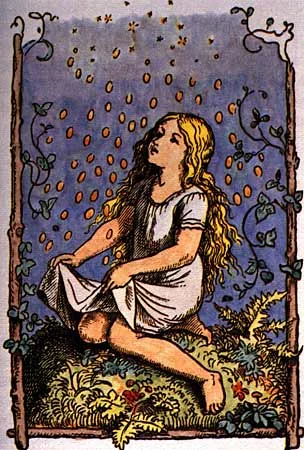
Image from Wikipedia
Image from Wikipedia
The Star Money: The Grimm Tale of Loss, Giving, and Heavenly Riches
A Fairy Tale That Shines to This Day
“The Star Money” is one of the most well-known and simultaneously brief fairy tales by the Brothers Grimm. The text has been listed as KHM 153 in the Children's and Household Tales since the second edition of 1819; it was previously categorized under the title “The Poor Girl.” The fairy tale is partially based on Achim von Arnim's novella “The Three Lovely Sisters and the Happy Dyer” and carries the older spelling “Die Sternthaler” in the Grimm version. ([de.wikipedia.org](https://de.wikipedia.org/wiki/Die_Sterntaler?utm_source=openai))
Its brevity gives the tale a unique power: an abandoned, impoverished figure gradually gives away everything she possesses and experiences a miraculous reward at the end. This condensation into a few images, a few gestures, and a strong final vision makes “The Star Money” one of the most striking texts in the Grimms' collection. The narration thrives on its clear moral core and the poetic imagination that continues to resonate with readers of all ages today. ([de.wikipedia.org](https://de.wikipedia.org/wiki/Die_Sterntaler?utm_source=openai))
The Literary Origin and Classification
The fairy tale is classified under the Aarne-Thompson-Uther type ATU 779H*, placing it within an international folklore tradition that speaks of reward, need, and miraculous turns. In the Grimm version, a poor orphan girl sets out into the world with only bread, yet does not cling to possessions. Instead, the text follows an almost liturgical rhythm of giving, which transforms scarcity into an ethical magnitude. ([de.wikipedia.org](https://de.wikipedia.org/wiki/Die_Sterntaler?utm_source=openai))
The Brothers Grimm here compress an entire worldview into a brief, calm sequence of actions. As the Wikipedia summary emphasizes, the fairy tale seems to push the Grimms’ development towards short, concise texts to the limit, as it hardly includes a subplot. Its effect arises not from dramatic branching but from the ascetic concentration on a single destiny. ([de.wikipedia.org](https://de.wikipedia.org/wiki/Die_Sterntaler?utm_source=openai))
Content: Poverty, Mercy, and Transformation
At the center is a child who has lost both parents and lives in extreme poverty. Along the way, it encounters those in need and gives away bread, cap, bodice, skirt, and finally the little shirt. This radical self-denial forms the emotional core of the fairy tale and lends the story remarkable intensity. ([grimmstories.com](https://www.grimmstories.com/de/grimm_maerchen/die_sterntaler?utm_source=openai))
Then follows the famous image change: stars fall from the sky, and the heavenly light becomes silver. Wealth emerges from nothing, but this wealth possesses not an economic but a moral and symbolic character. The child gathers the star money in a new, fine linen shirt and remains provided for for the rest of its life, according to the logic of the fairy tale. ([de.wikipedia.org](https://de.wikipedia.org/wiki/Die_Sterntaler?utm_source=openai))
Style and Narrative Art: Small Form, Great Impact
“The Star Money” exemplifies how strongly the Brothers Grimm work with concise language, archetypal characters, and clear imagery. The text forgoes psychological embellishment and instead relies on action symbols: bread, clothing, cold, sky, silver. This reduction creates the immediacy that makes the fairy tale so open to interpretations. ([de.wikipedia.org](https://de.wikipedia.org/wiki/Die_Sterntaler?utm_source=openai))
The final scene is repeatedly depicted in tradition, underscoring the iconic status of the tale. It is not the movement of the action that remains in memory, but the moment of transformation: Heaven responds to human kindness. Thus, the fairy tale acquires an almost sacred imagery that intertwines religious, ethical, and poetic levels. ([de.wikipedia.org](https://de.wikipedia.org/wiki/Die_Sterntaler?utm_source=openai))
Interpretations: Christian Allegory and Spiritual Dimension
In research, “The Star Money” is often read as an allegory of an exemplary Christian person who gives mercifully, even though in the end, they seemingly possess nothing. The Wikipedia summary emphasizes this interpretation as a lived attitude that is rewarded “from Heaven” in heavenly currency. The fairy tale thus connects moral ethics and transcendent hope in a form that remains understandable to this day. ([de.wikipedia.org](https://de.wikipedia.org/wiki/Die_Sterntaler?utm_source=openai))
Other interpretations see in the story a mystical transformation of worldly shells or a cosmic security for humanity. The child's journey into open space, the gradual relinquishment of possessions, and the heavenly counter-image of the stars create a symbolic movement from earthly need to spiritual abundance. Thus, simple narration evolves into a multifaceted cultural asset with religious and philosophical radiance. ([de.wikipedia.org](https://de.wikipedia.org/wiki/Die_Sterntaler?utm_source=openai))
Cultural Influence and Ongoing Presence
The lasting impact of the fairy tale is also evident in adaptations and repeated interpretations. Wikipedia mentions a television production from 2011 as part of “Six for One” based on the fairy tale, created by Bavaria Film on behalf of the Southwest Broadcasting Corporation. Such adaptations demonstrate that the story finds a lasting audience not only in literature but also in audiovisual formats. ([de.wikipedia.org](https://de.wikipedia.org/wiki/Die_Sterntaler?utm_source=openai))
The cultural resonance extends beyond children's literature into educational media, audiobook formats, and collections of illustrations. The contrast between external poverty and internal wealth makes the fairy tale attractive for modern readings, as it touches on themes of solidarity, social justice, and the search for meaning. Thus, “The Star Money” remains a text that not only tells but also interprets and challenges. ([de.wikipedia.org](https://de.wikipedia.org/wiki/Die_Sterntaler?utm_source=openai))
Discography? No Musical Work, But a Clear Reception History
There is, of course, no classical discography for “The Star Money,” but the reception history of the fairy tale is remarkably stable. The narrative has been documented and passed down in various media forms, including as an audiobook and film. This media presence, in a sense, replaces the “discography” in the literary context: it shows how a short text takes on new forms across generations. ([de.wikipedia.org](https://de.wikipedia.org/wiki/Die_Sterntaler?utm_source=openai))
A look at its digital availability also shows the ongoing relevance of the fairy tale. Online editions and translations keep the text internationally present, making it accessible to new readerships. Thus, “The Star Money” remains a classic whose impact is not tied to a single medium but continually renews itself. ([grimmstories.com](https://www.grimmstories.com/de/grimm_maerchen/die_sterntaler?utm_source=openai))
Conclusion: Why “The Star Money” Continues to Fascinate Today
“The Star Money” fascinates because the fairy tale constructs an entire ethics in just a few sentences: Giving instead of hoarding, trust instead of fear, dignity instead of possession. The story unites poetic simplicity with existential depth, and that is precisely why it is so powerful. Those who engage with this text discover a fairy tale of remarkable modernity that still moves, comforts, and provokes thought today. ([de.wikipedia.org](https://de.wikipedia.org/wiki/Die_Sterntaler?utm_source=openai))
Its place in the cultural memory is secured because it tells one of the oldest and clearest forms of hope: that goodness does not go lost but returns transformed. In this lies the enduring tension of the fairy tale, which readers can rediscover time and again. Those wishing to experience classic fairy tales in their full symbolic power should definitely take hold of “The Star Money” or explore its cinematic adaptations. ([de.wikipedia.org](https://de.wikipedia.org/wiki/Die_Sterntaler?utm_source=openai))
Official Channels of The Star Money:
- Instagram: no official profile found
- Facebook: no official profile found
- YouTube: no official profile found
- Spotify: no official profile found
- TikTok: no official profile found
Sources:
Upcoming Events
HEIMATEN Photo Exhibition
Photography meets the question of home: In the Karlskirche Kassel, HEIMATEN opens a quiet space for memory, identity, and new perspectives. Entry free. #Art
HEIMATEN Photo Exhibition
HEIMATEN invites you to the Karlskirche Kassel: touching photo works on belonging and memory. Starting 10.08.2026, free entry. #Kassel #Photography
Sterntaler: Lost & Found: What Disappears
A gentle family concert at the Tonhalle Düsseldorf: Music, imagination, and a poetic play with disappearance. 12.10.2026 at 4:00 PM. #Düsseldorf
The Star Money
A magical theater afternoon in Augsburg: The Star Money combines music, feeling, and Christmas sparkle. On November 21, 2026, at 3 PM, tickets from 15 Euros. #Augsburg #Children'sTheater