
Honk!
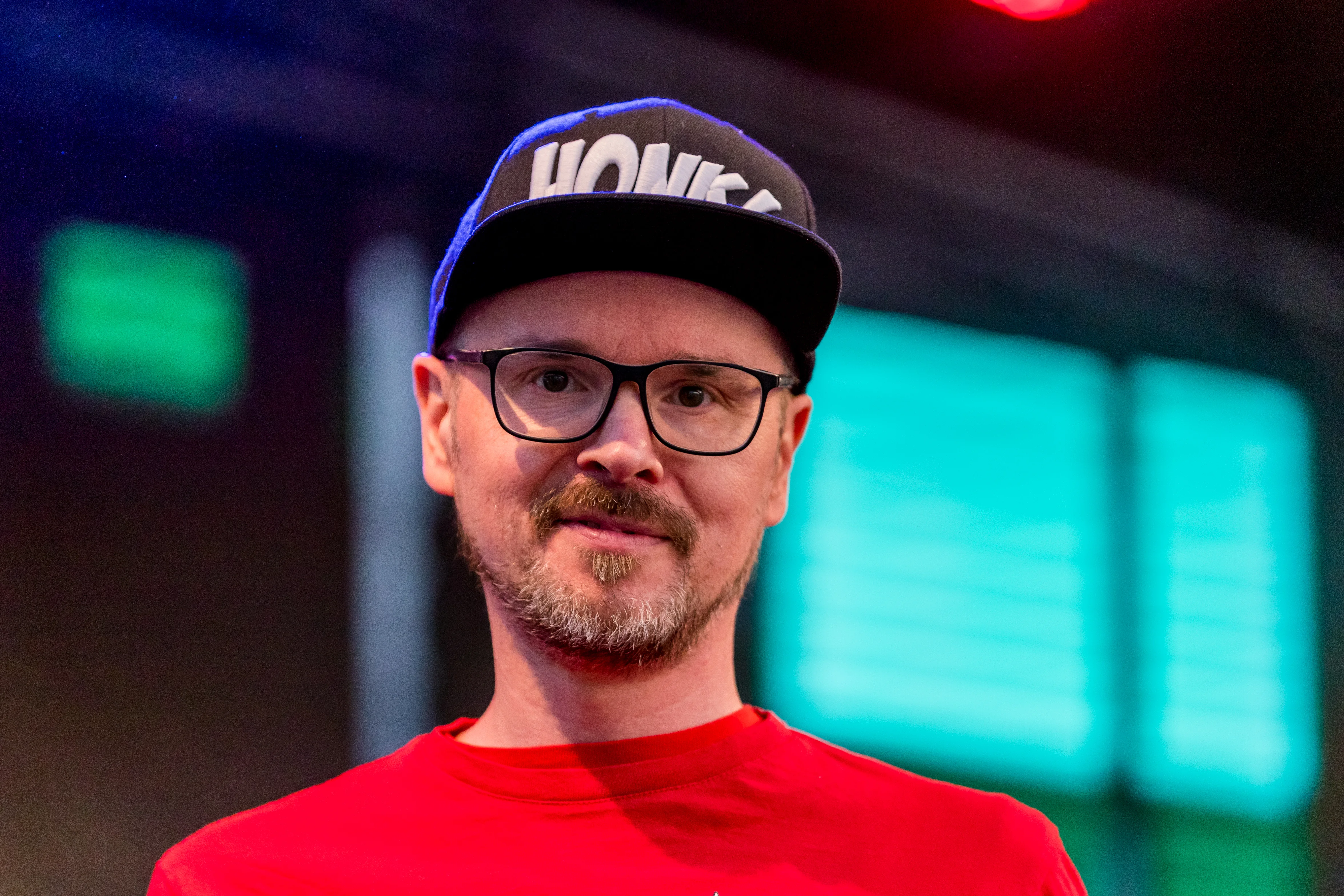
Image from Wikipedia
Image from Wikipedia
Honk! – Jürgen Kadel between Party Schlager, Techno Instinct, and Pop Art
An Artist Figure at the Intersection of Ballermann, House, and Color Rush
Honk!, born Jürgen Kadel, is one of the most prominent figures in German party schlager. He initially gained fame as part of the techno and party music duo Finger & Kadel, before debuting as a solo artist under the name Honk! in 2017 and simultaneously repositioning himself as a painter and pop art artist. His career blends club culture, Mallorca aesthetics, and a deliberately exaggerated stage persona into a trademark that is instantly recognizable in German-language entertainment pop. ([de.wikipedia.org](https://de.wikipedia.org/wiki/Honk%21))
Biography: From a Farm in Wetterau to Party Music Icon
Early Influences and Musical Breakthrough
Jürgen Kadel grew up on his parents' farm in Södel in the Wetterau district. At the age of eleven, Depeche Mode’s “People Are People” had a significant impact on him, and for his 13th birthday, he received a keyboard. At 14, he began programming on a synthesizer. After playing in school bands and participating in various projects, he discovered techno in the 1990s; he dropped out of a business administration program at Justus Liebig University Gießen in favor of music. ([de.wikipedia.org](https://de.wikipedia.org/wiki/Honk%21))
This background explains much of Kadel's later style: craftsmanship, melody-oriented, rhythm-driven, and unafraid of clear hooks. The path did not go through the classic singer-songwriter universe but rather through production, club experience, and a sense for audience-friendly sharpness. This blend later made him highly adaptable within party schlager. ([de.wikipedia.org](https://de.wikipedia.org/wiki/Honk%21))
Finger & Kadel and the Step into Pop Culture Mainstream
In the mid-1990s, Kadel co-founded the project Hacienda with Marcus Finger, which later evolved into Finger & Kadel; parallel to this, F&K also existed. The big breakthrough came in 2007 with “Die mit dem roten Halsband,” a house track based on a porn film soundtrack that became a surprise hit. This was followed by other successful tracks such as “Wahnsinn” and “Hoch die Hände – Wochenende (#sotrue)” with Hans Entertainment, before the duo announced their breakup on May 14, 2020. ([de.wikipedia.org](https://de.wikipedia.org/wiki/Honk%21))
For Kadel, this phase was more than just a nightlife success: it established him as a musician who combines catchy club music with humor, boundary-pushing, and mass appeal. Finger & Kadel provided the blueprint for a career where irony and catchy melodies were never in conflict. ([de.wikipedia.org](https://de.wikipedia.org/wiki/Honk%21))
The Start as Honk! and the Mallorca Factor
With “Hallo Helmut,” Kadel co-wrote a song with Matthias Distel, known as Ikke Hüftgold, which was initially played on a trial basis at Ballermann starting in August 2016. The music video was released on April 19, 2017, marking his first appearance under the artist name Honk!, which deliberately refers to the derogatory term “Honk.” From then on, he performed solo in Mallorca and party locations, where he quickly became a fixture with his white shirt, bow tie, and caricature-like exuberance. ([de.wikipedia.org](https://de.wikipedia.org/wiki/Honk%21))
The figure of Honk! operates like a musical masquerade: loud, direct, self-ironic, and entirely focused on collective celebration moments. This is where the strength of his stage presence lies, not setting up distance but instead engaging the audience directly and ensuring maximum sing-along potential. ([mallorcazeitung.es](https://www.mallorcazeitung.es/boulevard/2017/08/02/der-honk-sich-selbst-nicht-54153268.html?utm_source=openai))
Current Projects, New Successes, and Artistic Expansion
From New Songs to Pop Art
During the COVID-19 pandemic, Honk! shifted a part of his energy into painting and developed a second career path with Honk!Art. According to reports, some of his pop art works achieved four-digit sale prices; in November 2021, the first group exhibition under this name took place. In parallel, Kadel stated in 2021 that several songs were already completed and awaiting release while he focused on painting. ([de.wikipedia.org](https://de.wikipedia.org/wiki/Honk%21))
This dual strategy of music and visual art gives his career an unusual breadth. Honk! does not limit himself to pure party music but shapes a recognizable total work of art from language, image, and stage, a feat rarely executed so consistently in German entertainment pop. ([de.wikipedia.org](https://de.wikipedia.org/wiki/Honk%21))
“Delfin,” Gold, and the Continuation of Party Anthems
A central current success is “Delfin” with Isi Glück: the song reached number 67 in the German single charts and was later awarded gold by ROBA Music Publishing. ROBA indicates that the title achieved gold status in Germany, with over 53 million Spotify streams and 13 million YouTube streams. Thus, “Delfin” stands out as one of the most notable recent hits in Honk!'s universe and confirms his relevance in the Mallorca and party schlager scene. ([de.wikipedia.org](https://de.wikipedia.org/wiki/Honk%21))
The musical collaboration with other scene figures has also been significant. In 2023, Honk! released the single “Frische Erdbeeren” with Heino, followed by “Regenbogen” with Isi Glück and Felix Harrer in 2024. These collaborations demonstrate an artist who continues to evolve his brand through features, strong cover art, and clear hooklines. ([de.wikipedia.org](https://de.wikipedia.org/wiki/Honk%21))
Discography and Reception: Between Hit Recycling, Buzzwords, and Chart Impact
Key Singles and Musical Signature
As Honk!, his selection of singles includes “Hallo Helmut (Andere Farbe),” “Hallo I Bims 1 Bätman,” “Wochenende, Saufen, Geil,” “Klauhurensong,” “Alle Blau (Bella Ciao),” “So geil auf Malle,” “Anna-Lena,” “Suffia,” “Der heiße Micha,” “Ballerina (Mallorca wo die Liebe begann),” “Geile Mucke braucht das Land,” “Dorflove,” “Delfin,” “Frische Erdbeeren,” and “Regenbogen.” The titles rely on wordplay, recognizability, and quick access to party codes while not hiding their origins in house, techno, and schlager. ([de.wikipedia.org](https://de.wikipedia.org/wiki/Honk%21))
This mix of ironic exaggeration and simplified celebration logic constitutes the core of Kadel's work. He employs clear choruses, direct imagery, and production aimed at collective movement rather than subtle album dramaturgy. This is party music as a conscious format: low-threshold, but not arbitrary. ([de.wikipedia.org](https://de.wikipedia.org/wiki/Honk%21))
Critical Perception and Cultural Context
The reception of Honk! naturally hovers between entertainment, provocation, and ironic sharpness. For instance, in 2022 the song “Anna-Lena” became embroiled in the sexism debate surrounding “Layla,” as the line “Geiler Arsch, geiler Blick, geiles Stück, Anna-Lena” was publicly discussed. This positions Honk! as emblematic of a party schlager that aims not only to celebrate but also consistently raises debates about language, taste, and boundary-pushing. ([de.wikipedia.org](https://de.wikipedia.org/wiki/Honk%21))
At the same time, he has been characterized in reports and portraits as an artist who does not take himself too seriously, which contributes to his impact. The combination of humorous exaggeration, Mallorca stage routine, and willingness to crossover genres gives him a firm position in German party culture. ([mallorcazeitung.es](https://www.mallorcazeitung.es/boulevard/2017/08/02/der-honk-sich-selbst-nicht-54153268.html?utm_source=openai))
Style, Stage Presence, and Artistic Development
Between Techno Roots and Party Schlager
Honk! brings experience from techno and house into a party schlager context that heavily relies on speed, directness, and audience reaction. His career showcases a remarkably clear continuum: from synthesizer teenager to club producer to the Ballermann figure with his unique visual language. This evolution explains why his songs, despite their lightness, showcase a distinct production signature. ([de.wikipedia.org](https://de.wikipedia.org/wiki/Honk%21))
The fusion of music and art is also part of his identity. Honk!Art does not stand apart from his music career but expands it: both areas utilize irony, color strength, and pointed symbolism. This results in an artist image that appears unusually cohesive in the German pop business. ([de.wikipedia.org](https://de.wikipedia.org/wiki/Honk%21))
Why Honk! Remains Interesting for Fans and the Scene
For music lovers, the fascination with Honk! lies in the tension between calculated party suitability and genuine career instinct. He knows how to craft a catchy tune, how to get an audience moving, and how to cement a stage persona in memory. At the same time, he demonstrates through his art that entertainment pop can also be a space for self-staging, color, and media recognizability. ([de.wikipedia.org](https://de.wikipedia.org/wiki/Honk%21))
Those who experience Honk! live do not see a distant perfectionist but an entertainer with a clear mission: to create atmosphere, celebrate accessibility, and dissolve the boundaries between song, joke, and show. This is where his unique strength lies within German party schlager. ([mallorcazeitung.es](https://www.mallorcazeitung.es/boulevard/2017/08/02/der-honk-sich-selbst-nicht-54153268.html?utm_source=openai))
Conclusion: Honk! is far more than just a name associated with Mallorca. Jürgen Kadel has forged a unique artistic identity from techno experience, party schlager energy, and pop art impulse, defined through hits, controversies, and visual recognizability. To truly grasp the full impact of his music, one must experience him live, where his stage presence, hooklines, and irony converge most powerfully. ([de.wikipedia.org](https://de.wikipedia.org/wiki/Honk%21))
Official Channels of Honk!:
- Instagram: https://www.instagram.com/honk_offiziell/
- Facebook: https://www.facebook.com/honkmusik
- YouTube: no official profile found
- Spotify: https://open.spotify.com/artist/24UmQq4ccfSLpXXurb40ig?si=F2nG0hdXS6uajfIRA6ObdQ
- TikTok: no official profile found
Sources:
Upcoming Events
HONK! - Different from the Rest.
A musical evening full of feeling and imagination in Munich: HONK! tells about the courage to be different. 17.05.2026, from 14 €. Discover now! #Theater
One Night In Malle with HONK! -live-
Bochum dances Mallorca: HONK! brings party Schlager, club feeling, and live energy to the Prater on 26.06.2026. From 10 euros, starting at 10:00 PM. #MallorcaParty #Bochum