Manifesta 16 Ruhr in the Gethsemane Church Bochum: Art in the Space of Memory
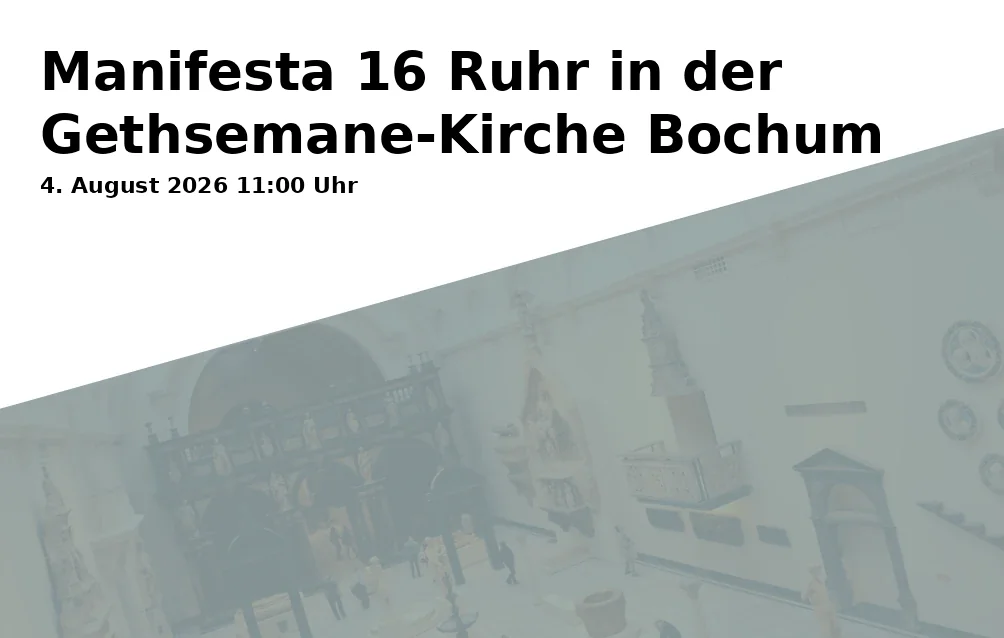
Date and Time
Location
Price
About this Event
Mood
Venue Type
Manifesta 16 Ruhr: Art, Architecture and Memory in the Gethsemane Church
With the Manifesta 16 Ruhr, the Gethsemane Church in Bochum opens as an extraordinary place for contemporary art, cultural education, and aesthetic experience. The European nomadic biennial transforms the historical church space into a parcours of artwork observation, spatial perception, and societal reflection.
A place with history, read anew
The Gethsemane Church is a remarkable example of Protestant emergency church architecture. Built between 1947 and 1950 according to plans by Otto Bartning, it was constructed on the foundations of a parish house destroyed in World War II. This layering of reconstruction, debris material, and sacred use makes the location a striking stage for an exhibition that deals with change, community, and memory.
Curatorial handwriting and artistic perspectives
Anda Rottenberg and Krzysztof Kosciuczuk are responsible for the creative mediation at the Bochum location. The program of Manifesta 16 Ruhr is designed as a dialogical biennial: Art emerges here in exchange between international and local positions, between the architectural peculiarities of the place and the present of the Ruhr area. In the Gethsemane Church, works by Mirosław Bałka, Mehtap Baydu, Zuza Golińska, Miedya Mahmod, Marina Naprushkina, Julia Nitschke, Mikołaj Sobczak, and Cassidy Toner are announced.
Space, light, and artwork observation
The church space brings a quiet, focused exhibition atmosphere. Light, wall surfaces, and historical substance draw attention to materiality, scale, and resonance. Those who engage with this exhibition experience not a distanced viewing, but an art experience that brings sculpture, installation, text, voice, and performative settings into a sensitive dialogue with the space.
Mediation, education, and participation
Manifesta 16 Ruhr expressly sees itself as a platform for cultural education. The program includes walks, workshops, family offerings, and other mediation formats. Especially in the Gethsemane Church, it becomes evident how an exhibition can be explored together rather than just viewed. Access points for school classes and groups emerge that connect art history, urban history, and societal questions.
Free admission and barrier-free access
Visiting Manifesta 16 Ruhr is free and does not require a ticket. The Gethsemane Church is wheelchair accessible; a ramp facilitates entry. However, a barrier-free toilet is not available at this location. The opening hours of the venue during the biennial are from Tuesday to Thursday and Sunday from 11:00 AM to 6:00 PM, and from Friday to Saturday from 11:00 AM to 7:00 PM.
Conclusion: Why a visit is worthwhile
Manifesta 16 Ruhr in the Gethsemane Church Bochum connects contemporary art with historical depth, international biennale perspectives with local memory, and architectural aura with lively mediation. Those who understand art as a sensory and intellectual encounter will find a place that goes far beyond the classic exhibition visit. A live visit is definitely worthwhile.
Official channels of Manifesta 16 Ruhr:
- Instagram: https://www.instagram.com/manifestabiennial/
- Facebook: no official profile found
- YouTube: no official profile found
- Website: https://www.manifesta16.org