
Dortmund
Westenhellweg, Nähe Hbf, Petrikirchhof 1, 44137 Dortmund, Deutschland
Ev. City Church St. Peter Dortmund | Opening Hours & Altar
The Ev. City Church St. Peter Dortmund is located on Westenhellweg directly opposite the main train station, making it one of the most central church addresses in the city center. Those searching for city church St. Peter Dortmund, golden miracle, opening hours, directions, parking, or photos will find much more than just a short sightseeing spot here: St. Peter is a city church, cultural space, spiritual meeting point, and a historical place that tells the history of the city of Dortmund in an exceptionally clear and bright spatial effect. The official site describes the building as part of the city's society, guided by the principle of seeking the best for the city. This is precisely where the special charm of this church lies: it is open, inviting, and historically significant, without being confined to a single function. Between its Gothic origins, post-war reconstruction, modern renovation, and vibrant event program, a space has emerged that serves equally for worship, tours, concerts, lectures, and quiet visits. Those who enter St. Peter experience a building that consciously mediates between past and present, making it exciting for visitors from Dortmund and far beyond. ([sankt-petri-do.de](https://www.sankt-petri-do.de/petri-kirche/geschichte?iccaldate=2018-7-1))
History of the Gothic City Church and Reconstruction in Dortmund
St. Peter is one of the four medieval city churches in Dortmund and was built at the beginning of the 14th century, in the year 1322, as a Gothic hall church. The official historical account emphasizes that only the baptismal font from the early construction period has been preserved. At the same time, it becomes clear how strongly natural events have shaped the building over the centuries: earthquakes, storms, and lightning strikes repeatedly caused damage to the tower and nave. This makes St. Peter a church with layers of history, where not just one era is visible, but many upheavals overlap. Particularly interesting is that despite these destructions, the church has been restored in its original architectural style. It exemplifies the city center of Dortmund, where historical continuity and new beginnings are closely intertwined. The Protestant city church work uses this special atmosphere of the historical church space to connect spiritual and social themes. Thus, St. Peter is not only a monument but a place where city history, faith, and the present come together in close proximity. ([sankt-petri-do.de](https://www.sankt-petri-do.de/petri-kirche/geschichte?iccaldate=2018-7-1))
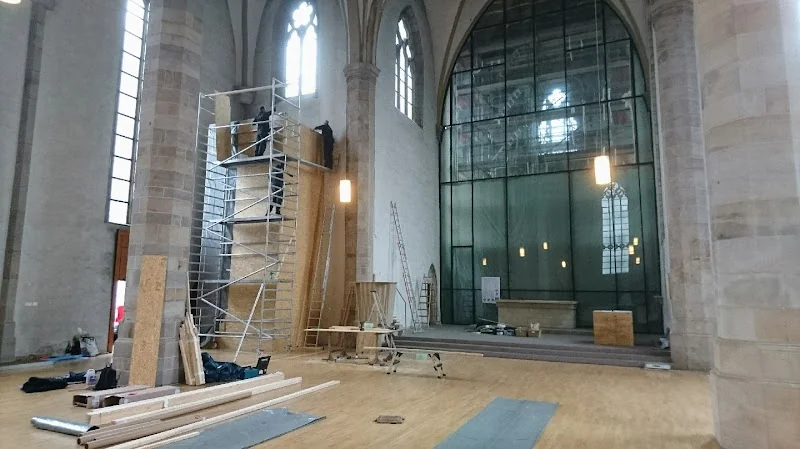
The further construction history is as impressive as it is moving. After total destruction, St. Peter was rebuilt in 1759 and received baroque-classical elements and galleries. It was only during this phase that the Flemish carved altar from the Dortmund Franciscan monastery was brought into the church and became the new altar of the city church. In 1943, St. Peter was again destroyed down to its foundations during an air raid on Dortmund, but the altar was preserved due to its relocation. Between 1954 and 1966, the reconstruction took place, in 1967 the altar was reinstalled in the space, and in 1981 the tower helmet was completed. Later measures have also shaped its current appearance: in 2008, a glass wall was installed for climatic protection of the altar, in 2015 the new Schulte organ was added, and in 2023 the lighting concept was renewed, emphasizing the Gothic character of the space once again. This construction history explains why St. Peter today appears so clear, bright, and historically rich. It is a building that has not been preserved like a quiet museum but has been newly prepared for its role in the city after each interruption. ([sankt-petri-do.de](https://www.sankt-petri-do.de/petri-kirche/geschichte?iccaldate=2018-7-1))
The Golden Miracle: Altarpiece, Transformations, and Art History
The probably most famous element of the Ev. City Church St. Peter Dortmund is the Golden Miracle, namely the Antwerp altarpiece, which is described in the official presentation as the most imposing medieval artwork in the city. With an open width of 7.4 meters and a height of 5.6 meters, it is one of the largest Antwerp carved altarpieces ever. It was commissioned in 1522 by Dortmund Franciscans and resulted from a combination of carving and painting, making the altar one of the most pictorially rich sculptural artworks in Europe. The texts of the church emphasize that it is one of the largest and most precious surviving Antwerp retables. The altar is significant not only because of its size but also due to its artistic conception: more than one pair of wings was needed, thus the retable can be shown in three different transformations. This makes it a work that reveals itself differently throughout the year and functions liturgically at the same time. For visitors, this is a great attraction, as here one sees not only a magnificent altar but a movable image program that intertwines history, faith, and art. ([sankt-petri-do.de](https://www.sankt-petri-do.de/petri-kirche/fluegelaltar?utm_source=openai))
Particularly fascinating is the changing visibility of the different sides of the altar. In the original everyday view, it shows the closed version, which becomes visible during the Passion season and at the latest by Holy Week. The painted side, intended as the Sunday view, appears in St. Peter in summer. The festive side, the famous Golden Miracle, is shown from autumn until the Passion season and from Easter to Pentecost. The official description explicitly mentions that the transformations of the altarpiece are publicly visible as part of church tours, services, lectures, or city events such as the Day of Open Monuments or the Museum Night. Its preservation also has its own history: in 1943, the retable was relocated to Möllenbeck and thus preserved from destruction, it returned to the choir area after the reconstruction in 1967, and in 2008 it was climatically protected by a glass partition. Thus, when visiting St. Peter, one experiences not only a work of art but also a piece of living monument preservation. The altarpiece is the strong center of the church and one of the main reasons why St. Peter is considered a cultural attraction in Dortmund and far beyond. ([sankt-petri-do.de](https://www.sankt-petri-do.de/petri-kirche/fluegelaltar?utm_source=openai))
Opening Hours, Directions, and Parking at the Ev. City Church St. Peter
For practical visits, the information about the location is particularly important. The official contact page lists the address as Westenhellweg and Petrikirchhof, directly opposite the main train station. The postal address is Petrikirchhof 7, 44137 Dortmund. The church is open from Tuesday to Friday from 11 a.m. to 5 p.m. and on Saturdays from 10 a.m. to 4 p.m.; additionally, it is open for events and services. Groups can request church tours through the city church office, which is reachable on weekdays from 9 a.m. to 11 a.m. These opening hours make it clear that St. Peter is well-suited not only for spontaneous visits but also for planned city stops. Especially because the church is so centrally located, it is often associated with a city center stroll, an appointment at the train station, or a cultural visit. For inquiries such as opening hours, directions, or planning a visit, the official website is therefore the most reliable orientation. Its presence in the midst of urban daily life also fits its self-understanding as a city church: it is not a closed place on the edge but a house in the flow of the city center. ([sankt-petri-do.de](https://www.sankt-petri-do.de/kontakt?iccaldate=2026-5-1))
Also regarding accessibility and parking, the church provides clear, honest information. St. Peter has barrier-free access but points out that there are no barrier-free toilets. Equally important for arrival: there are no parking spaces at the church itself. Instead, the website refers to parking garages nearby. The easiest way to reach the church is via public transport through Dortmund Hbf or the subway station Kampstraße. This combination is typical for a city center location but particularly helpful for visitors as it avoids unnecessary detours. Therefore, those arriving by car should plan for a parking space in the vicinity in advance. Those arriving by train, bus, or subway can visit St. Peter very conveniently. This location is part of its strength: the church is located in the pedestrian and shopping zone, right where many people are already on the move. For a spontaneous photo, a quiet visit, a tour, or a concert evening, it is particularly easily accessible. ([sankt-petri-do.de](https://www.sankt-petri-do.de/kontakt?iccaldate=2026-5-1))
Events, Services, and Church Tours at St. Peter
Since the 1990s, a pronounced city church and city church work has developed at St. Peter. The official history describes that the church invites to services, events, as well as spiritual, artistic, and adult education formats, independent of religious, confessional, or community ties. This makes it clear that St. Peter does not only function as a Sunday church but as an open place for the city society. The spectrum is broad: the menu structure of the website lists spiritual and services, church tours, concerts, and lectures or seminars. This is complemented by the open church and a lively event overview. Regularly recurring formats include music at noon, healing and power songs, as well as thematic devotions and special services. For visitors, this means: St. Peter is interesting not only because of its building but also because of a program that develops from the heart of the city. The combination of a historical church and contemporary program makes the place attractive for different target groups. ([sankt-petri-do.de](https://www.sankt-petri-do.de/petri-kirche/geschichte?iccaldate=2018-7-1))
Particularly exciting is how broad the profile is actually laid out. The website features not only classic services and concerts but also city pilgrim tours, including tours in Russian. One of these tours explicitly describes that in St. Peter, not only an evangelical church space but also a Catholic altar and an Orthodox icon can be seen. This shows how consciously the church deals with religious diversity and city history. Additionally, there are public altar transformations, those moments when the Antwerp altar is flipped to another view. These formats are a special attraction for many guests because here liturgy, art history, and mediation come together directly. Therefore, those searching for events, church tours, or programs will discover not a rigid calendar house but a place with changing themes, special perspectives, and a very open understanding of culture. Collaborations with other communities and choirs are also part of it, such as when guests from the Greek Orthodox community come to the city. St. Peter thus acts like a resonance space where faith, music, education, and city life intertwine. ([sankt-petri-do.de](https://www.sankt-petri-do.de/stadtpilgertouren/touren/301-sankt-petri-in-dortmund?utm_source=openai))
Spatial Experience, Organ, and Photos: St. Peter as a Modern Church Space
The interior of St. Peter remarkably combines historical substance with modern elements. The official historical account describes a clear, bright space that appears modern due to a monumental protective wall made of glass and metal struts, the new organ from 2015, and flexible seating. At the same time, in 2023, the lighting concept was redesigned, further emphasizing the Gothic character of the church space. This combination of old and new also makes St. Peter photographically interesting, as medieval architecture, post-war reconstruction, and contemporary interior design come together here. Those searching for photos or a virtual tour will find both in the menu on the website. This is practical for everyone who wants to get to know the church in advance but also for those who want to study the architectural details consciously. The space lives not only from its altar but from contrasts: from the warm gold of the retable and the factual clarity of the interior, from the historical hall and the modern furnishings, from silence and sound. It is precisely this tension that ensures that St. Peter remains exciting for architecture enthusiasts, culture lovers, and spontaneous city center visitors alike. ([sankt-petri-do.de](https://www.sankt-petri-do.de/petri-kirche/geschichte?iccaldate=2018-7-1))
The church also has a distinct musical profile. The new Schulte organ was inaugurated in 2015 and has since been regularly used for music at noon, services, and concerts. The website explains that the previous organ could not fill the space musically sufficiently, and therefore a new construction with an English pipework was realized. The result is an instrument with a warm, room-filling sound that acoustically carries the open church space. After the interior renovation, St. Peter also received a newly designed Ibach grand piano as a permanent loan from TU Dortmund. This shows that the church has been consciously developed not only in monument preservation but also in cultural use. For visitors, this means a particularly rich experience: a quiet church and art place during the day, a music space at noon, and a concert or event venue in the evening. Those who want to gain an impression of the space can use the gallery and the virtual tour or visit the church directly during one of its open times. Especially in combination with the Golden Miracle, this creates a visitor experience that is unique in Dortmund: historically deep, architecturally clear, and culturally very vibrant. ([sankt-petri-do.de](https://www.sankt-petri-do.de/petri-kirche/orgel?utm_source=openai))
Sources:
Mehr anzeigenWeniger anzeigen
Ev. City Church St. Peter Dortmund | Opening Hours & Altar
The Ev. City Church St. Peter Dortmund is located on Westenhellweg directly opposite the main train station, making it one of the most central church addresses in the city center. Those searching for city church St. Peter Dortmund, golden miracle, opening hours, directions, parking, or photos will find much more than just a short sightseeing spot here: St. Peter is a city church, cultural space, spiritual meeting point, and a historical place that tells the history of the city of Dortmund in an exceptionally clear and bright spatial effect. The official site describes the building as part of the city's society, guided by the principle of seeking the best for the city. This is precisely where the special charm of this church lies: it is open, inviting, and historically significant, without being confined to a single function. Between its Gothic origins, post-war reconstruction, modern renovation, and vibrant event program, a space has emerged that serves equally for worship, tours, concerts, lectures, and quiet visits. Those who enter St. Peter experience a building that consciously mediates between past and present, making it exciting for visitors from Dortmund and far beyond. ([sankt-petri-do.de](https://www.sankt-petri-do.de/petri-kirche/geschichte?iccaldate=2018-7-1))
History of the Gothic City Church and Reconstruction in Dortmund
St. Peter is one of the four medieval city churches in Dortmund and was built at the beginning of the 14th century, in the year 1322, as a Gothic hall church. The official historical account emphasizes that only the baptismal font from the early construction period has been preserved. At the same time, it becomes clear how strongly natural events have shaped the building over the centuries: earthquakes, storms, and lightning strikes repeatedly caused damage to the tower and nave. This makes St. Peter a church with layers of history, where not just one era is visible, but many upheavals overlap. Particularly interesting is that despite these destructions, the church has been restored in its original architectural style. It exemplifies the city center of Dortmund, where historical continuity and new beginnings are closely intertwined. The Protestant city church work uses this special atmosphere of the historical church space to connect spiritual and social themes. Thus, St. Peter is not only a monument but a place where city history, faith, and the present come together in close proximity. ([sankt-petri-do.de](https://www.sankt-petri-do.de/petri-kirche/geschichte?iccaldate=2018-7-1))
The further construction history is as impressive as it is moving. After total destruction, St. Peter was rebuilt in 1759 and received baroque-classical elements and galleries. It was only during this phase that the Flemish carved altar from the Dortmund Franciscan monastery was brought into the church and became the new altar of the city church. In 1943, St. Peter was again destroyed down to its foundations during an air raid on Dortmund, but the altar was preserved due to its relocation. Between 1954 and 1966, the reconstruction took place, in 1967 the altar was reinstalled in the space, and in 1981 the tower helmet was completed. Later measures have also shaped its current appearance: in 2008, a glass wall was installed for climatic protection of the altar, in 2015 the new Schulte organ was added, and in 2023 the lighting concept was renewed, emphasizing the Gothic character of the space once again. This construction history explains why St. Peter today appears so clear, bright, and historically rich. It is a building that has not been preserved like a quiet museum but has been newly prepared for its role in the city after each interruption. ([sankt-petri-do.de](https://www.sankt-petri-do.de/petri-kirche/geschichte?iccaldate=2018-7-1))
The Golden Miracle: Altarpiece, Transformations, and Art History
The probably most famous element of the Ev. City Church St. Peter Dortmund is the Golden Miracle, namely the Antwerp altarpiece, which is described in the official presentation as the most imposing medieval artwork in the city. With an open width of 7.4 meters and a height of 5.6 meters, it is one of the largest Antwerp carved altarpieces ever. It was commissioned in 1522 by Dortmund Franciscans and resulted from a combination of carving and painting, making the altar one of the most pictorially rich sculptural artworks in Europe. The texts of the church emphasize that it is one of the largest and most precious surviving Antwerp retables. The altar is significant not only because of its size but also due to its artistic conception: more than one pair of wings was needed, thus the retable can be shown in three different transformations. This makes it a work that reveals itself differently throughout the year and functions liturgically at the same time. For visitors, this is a great attraction, as here one sees not only a magnificent altar but a movable image program that intertwines history, faith, and art. ([sankt-petri-do.de](https://www.sankt-petri-do.de/petri-kirche/fluegelaltar?utm_source=openai))
Particularly fascinating is the changing visibility of the different sides of the altar. In the original everyday view, it shows the closed version, which becomes visible during the Passion season and at the latest by Holy Week. The painted side, intended as the Sunday view, appears in St. Peter in summer. The festive side, the famous Golden Miracle, is shown from autumn until the Passion season and from Easter to Pentecost. The official description explicitly mentions that the transformations of the altarpiece are publicly visible as part of church tours, services, lectures, or city events such as the Day of Open Monuments or the Museum Night. Its preservation also has its own history: in 1943, the retable was relocated to Möllenbeck and thus preserved from destruction, it returned to the choir area after the reconstruction in 1967, and in 2008 it was climatically protected by a glass partition. Thus, when visiting St. Peter, one experiences not only a work of art but also a piece of living monument preservation. The altarpiece is the strong center of the church and one of the main reasons why St. Peter is considered a cultural attraction in Dortmund and far beyond. ([sankt-petri-do.de](https://www.sankt-petri-do.de/petri-kirche/fluegelaltar?utm_source=openai))
Opening Hours, Directions, and Parking at the Ev. City Church St. Peter
For practical visits, the information about the location is particularly important. The official contact page lists the address as Westenhellweg and Petrikirchhof, directly opposite the main train station. The postal address is Petrikirchhof 7, 44137 Dortmund. The church is open from Tuesday to Friday from 11 a.m. to 5 p.m. and on Saturdays from 10 a.m. to 4 p.m.; additionally, it is open for events and services. Groups can request church tours through the city church office, which is reachable on weekdays from 9 a.m. to 11 a.m. These opening hours make it clear that St. Peter is well-suited not only for spontaneous visits but also for planned city stops. Especially because the church is so centrally located, it is often associated with a city center stroll, an appointment at the train station, or a cultural visit. For inquiries such as opening hours, directions, or planning a visit, the official website is therefore the most reliable orientation. Its presence in the midst of urban daily life also fits its self-understanding as a city church: it is not a closed place on the edge but a house in the flow of the city center. ([sankt-petri-do.de](https://www.sankt-petri-do.de/kontakt?iccaldate=2026-5-1))
Also regarding accessibility and parking, the church provides clear, honest information. St. Peter has barrier-free access but points out that there are no barrier-free toilets. Equally important for arrival: there are no parking spaces at the church itself. Instead, the website refers to parking garages nearby. The easiest way to reach the church is via public transport through Dortmund Hbf or the subway station Kampstraße. This combination is typical for a city center location but particularly helpful for visitors as it avoids unnecessary detours. Therefore, those arriving by car should plan for a parking space in the vicinity in advance. Those arriving by train, bus, or subway can visit St. Peter very conveniently. This location is part of its strength: the church is located in the pedestrian and shopping zone, right where many people are already on the move. For a spontaneous photo, a quiet visit, a tour, or a concert evening, it is particularly easily accessible. ([sankt-petri-do.de](https://www.sankt-petri-do.de/kontakt?iccaldate=2026-5-1))
Events, Services, and Church Tours at St. Peter
Since the 1990s, a pronounced city church and city church work has developed at St. Peter. The official history describes that the church invites to services, events, as well as spiritual, artistic, and adult education formats, independent of religious, confessional, or community ties. This makes it clear that St. Peter does not only function as a Sunday church but as an open place for the city society. The spectrum is broad: the menu structure of the website lists spiritual and services, church tours, concerts, and lectures or seminars. This is complemented by the open church and a lively event overview. Regularly recurring formats include music at noon, healing and power songs, as well as thematic devotions and special services. For visitors, this means: St. Peter is interesting not only because of its building but also because of a program that develops from the heart of the city. The combination of a historical church and contemporary program makes the place attractive for different target groups. ([sankt-petri-do.de](https://www.sankt-petri-do.de/petri-kirche/geschichte?iccaldate=2018-7-1))
Particularly exciting is how broad the profile is actually laid out. The website features not only classic services and concerts but also city pilgrim tours, including tours in Russian. One of these tours explicitly describes that in St. Peter, not only an evangelical church space but also a Catholic altar and an Orthodox icon can be seen. This shows how consciously the church deals with religious diversity and city history. Additionally, there are public altar transformations, those moments when the Antwerp altar is flipped to another view. These formats are a special attraction for many guests because here liturgy, art history, and mediation come together directly. Therefore, those searching for events, church tours, or programs will discover not a rigid calendar house but a place with changing themes, special perspectives, and a very open understanding of culture. Collaborations with other communities and choirs are also part of it, such as when guests from the Greek Orthodox community come to the city. St. Peter thus acts like a resonance space where faith, music, education, and city life intertwine. ([sankt-petri-do.de](https://www.sankt-petri-do.de/stadtpilgertouren/touren/301-sankt-petri-in-dortmund?utm_source=openai))
Spatial Experience, Organ, and Photos: St. Peter as a Modern Church Space
The interior of St. Peter remarkably combines historical substance with modern elements. The official historical account describes a clear, bright space that appears modern due to a monumental protective wall made of glass and metal struts, the new organ from 2015, and flexible seating. At the same time, in 2023, the lighting concept was redesigned, further emphasizing the Gothic character of the church space. This combination of old and new also makes St. Peter photographically interesting, as medieval architecture, post-war reconstruction, and contemporary interior design come together here. Those searching for photos or a virtual tour will find both in the menu on the website. This is practical for everyone who wants to get to know the church in advance but also for those who want to study the architectural details consciously. The space lives not only from its altar but from contrasts: from the warm gold of the retable and the factual clarity of the interior, from the historical hall and the modern furnishings, from silence and sound. It is precisely this tension that ensures that St. Peter remains exciting for architecture enthusiasts, culture lovers, and spontaneous city center visitors alike. ([sankt-petri-do.de](https://www.sankt-petri-do.de/petri-kirche/geschichte?iccaldate=2018-7-1))
The church also has a distinct musical profile. The new Schulte organ was inaugurated in 2015 and has since been regularly used for music at noon, services, and concerts. The website explains that the previous organ could not fill the space musically sufficiently, and therefore a new construction with an English pipework was realized. The result is an instrument with a warm, room-filling sound that acoustically carries the open church space. After the interior renovation, St. Peter also received a newly designed Ibach grand piano as a permanent loan from TU Dortmund. This shows that the church has been consciously developed not only in monument preservation but also in cultural use. For visitors, this means a particularly rich experience: a quiet church and art place during the day, a music space at noon, and a concert or event venue in the evening. Those who want to gain an impression of the space can use the gallery and the virtual tour or visit the church directly during one of its open times. Especially in combination with the Golden Miracle, this creates a visitor experience that is unique in Dortmund: historically deep, architecturally clear, and culturally very vibrant. ([sankt-petri-do.de](https://www.sankt-petri-do.de/petri-kirche/orgel?utm_source=openai))
Sources:
Ev. City Church St. Peter Dortmund | Opening Hours & Altar
The Ev. City Church St. Peter Dortmund is located on Westenhellweg directly opposite the main train station, making it one of the most central church addresses in the city center. Those searching for city church St. Peter Dortmund, golden miracle, opening hours, directions, parking, or photos will find much more than just a short sightseeing spot here: St. Peter is a city church, cultural space, spiritual meeting point, and a historical place that tells the history of the city of Dortmund in an exceptionally clear and bright spatial effect. The official site describes the building as part of the city's society, guided by the principle of seeking the best for the city. This is precisely where the special charm of this church lies: it is open, inviting, and historically significant, without being confined to a single function. Between its Gothic origins, post-war reconstruction, modern renovation, and vibrant event program, a space has emerged that serves equally for worship, tours, concerts, lectures, and quiet visits. Those who enter St. Peter experience a building that consciously mediates between past and present, making it exciting for visitors from Dortmund and far beyond. ([sankt-petri-do.de](https://www.sankt-petri-do.de/petri-kirche/geschichte?iccaldate=2018-7-1))
History of the Gothic City Church and Reconstruction in Dortmund
St. Peter is one of the four medieval city churches in Dortmund and was built at the beginning of the 14th century, in the year 1322, as a Gothic hall church. The official historical account emphasizes that only the baptismal font from the early construction period has been preserved. At the same time, it becomes clear how strongly natural events have shaped the building over the centuries: earthquakes, storms, and lightning strikes repeatedly caused damage to the tower and nave. This makes St. Peter a church with layers of history, where not just one era is visible, but many upheavals overlap. Particularly interesting is that despite these destructions, the church has been restored in its original architectural style. It exemplifies the city center of Dortmund, where historical continuity and new beginnings are closely intertwined. The Protestant city church work uses this special atmosphere of the historical church space to connect spiritual and social themes. Thus, St. Peter is not only a monument but a place where city history, faith, and the present come together in close proximity. ([sankt-petri-do.de](https://www.sankt-petri-do.de/petri-kirche/geschichte?iccaldate=2018-7-1))
The further construction history is as impressive as it is moving. After total destruction, St. Peter was rebuilt in 1759 and received baroque-classical elements and galleries. It was only during this phase that the Flemish carved altar from the Dortmund Franciscan monastery was brought into the church and became the new altar of the city church. In 1943, St. Peter was again destroyed down to its foundations during an air raid on Dortmund, but the altar was preserved due to its relocation. Between 1954 and 1966, the reconstruction took place, in 1967 the altar was reinstalled in the space, and in 1981 the tower helmet was completed. Later measures have also shaped its current appearance: in 2008, a glass wall was installed for climatic protection of the altar, in 2015 the new Schulte organ was added, and in 2023 the lighting concept was renewed, emphasizing the Gothic character of the space once again. This construction history explains why St. Peter today appears so clear, bright, and historically rich. It is a building that has not been preserved like a quiet museum but has been newly prepared for its role in the city after each interruption. ([sankt-petri-do.de](https://www.sankt-petri-do.de/petri-kirche/geschichte?iccaldate=2018-7-1))
The Golden Miracle: Altarpiece, Transformations, and Art History
The probably most famous element of the Ev. City Church St. Peter Dortmund is the Golden Miracle, namely the Antwerp altarpiece, which is described in the official presentation as the most imposing medieval artwork in the city. With an open width of 7.4 meters and a height of 5.6 meters, it is one of the largest Antwerp carved altarpieces ever. It was commissioned in 1522 by Dortmund Franciscans and resulted from a combination of carving and painting, making the altar one of the most pictorially rich sculptural artworks in Europe. The texts of the church emphasize that it is one of the largest and most precious surviving Antwerp retables. The altar is significant not only because of its size but also due to its artistic conception: more than one pair of wings was needed, thus the retable can be shown in three different transformations. This makes it a work that reveals itself differently throughout the year and functions liturgically at the same time. For visitors, this is a great attraction, as here one sees not only a magnificent altar but a movable image program that intertwines history, faith, and art. ([sankt-petri-do.de](https://www.sankt-petri-do.de/petri-kirche/fluegelaltar?utm_source=openai))
Particularly fascinating is the changing visibility of the different sides of the altar. In the original everyday view, it shows the closed version, which becomes visible during the Passion season and at the latest by Holy Week. The painted side, intended as the Sunday view, appears in St. Peter in summer. The festive side, the famous Golden Miracle, is shown from autumn until the Passion season and from Easter to Pentecost. The official description explicitly mentions that the transformations of the altarpiece are publicly visible as part of church tours, services, lectures, or city events such as the Day of Open Monuments or the Museum Night. Its preservation also has its own history: in 1943, the retable was relocated to Möllenbeck and thus preserved from destruction, it returned to the choir area after the reconstruction in 1967, and in 2008 it was climatically protected by a glass partition. Thus, when visiting St. Peter, one experiences not only a work of art but also a piece of living monument preservation. The altarpiece is the strong center of the church and one of the main reasons why St. Peter is considered a cultural attraction in Dortmund and far beyond. ([sankt-petri-do.de](https://www.sankt-petri-do.de/petri-kirche/fluegelaltar?utm_source=openai))
Opening Hours, Directions, and Parking at the Ev. City Church St. Peter
For practical visits, the information about the location is particularly important. The official contact page lists the address as Westenhellweg and Petrikirchhof, directly opposite the main train station. The postal address is Petrikirchhof 7, 44137 Dortmund. The church is open from Tuesday to Friday from 11 a.m. to 5 p.m. and on Saturdays from 10 a.m. to 4 p.m.; additionally, it is open for events and services. Groups can request church tours through the city church office, which is reachable on weekdays from 9 a.m. to 11 a.m. These opening hours make it clear that St. Peter is well-suited not only for spontaneous visits but also for planned city stops. Especially because the church is so centrally located, it is often associated with a city center stroll, an appointment at the train station, or a cultural visit. For inquiries such as opening hours, directions, or planning a visit, the official website is therefore the most reliable orientation. Its presence in the midst of urban daily life also fits its self-understanding as a city church: it is not a closed place on the edge but a house in the flow of the city center. ([sankt-petri-do.de](https://www.sankt-petri-do.de/kontakt?iccaldate=2026-5-1))
Also regarding accessibility and parking, the church provides clear, honest information. St. Peter has barrier-free access but points out that there are no barrier-free toilets. Equally important for arrival: there are no parking spaces at the church itself. Instead, the website refers to parking garages nearby. The easiest way to reach the church is via public transport through Dortmund Hbf or the subway station Kampstraße. This combination is typical for a city center location but particularly helpful for visitors as it avoids unnecessary detours. Therefore, those arriving by car should plan for a parking space in the vicinity in advance. Those arriving by train, bus, or subway can visit St. Peter very conveniently. This location is part of its strength: the church is located in the pedestrian and shopping zone, right where many people are already on the move. For a spontaneous photo, a quiet visit, a tour, or a concert evening, it is particularly easily accessible. ([sankt-petri-do.de](https://www.sankt-petri-do.de/kontakt?iccaldate=2026-5-1))
Events, Services, and Church Tours at St. Peter
Since the 1990s, a pronounced city church and city church work has developed at St. Peter. The official history describes that the church invites to services, events, as well as spiritual, artistic, and adult education formats, independent of religious, confessional, or community ties. This makes it clear that St. Peter does not only function as a Sunday church but as an open place for the city society. The spectrum is broad: the menu structure of the website lists spiritual and services, church tours, concerts, and lectures or seminars. This is complemented by the open church and a lively event overview. Regularly recurring formats include music at noon, healing and power songs, as well as thematic devotions and special services. For visitors, this means: St. Peter is interesting not only because of its building but also because of a program that develops from the heart of the city. The combination of a historical church and contemporary program makes the place attractive for different target groups. ([sankt-petri-do.de](https://www.sankt-petri-do.de/petri-kirche/geschichte?iccaldate=2018-7-1))
Particularly exciting is how broad the profile is actually laid out. The website features not only classic services and concerts but also city pilgrim tours, including tours in Russian. One of these tours explicitly describes that in St. Peter, not only an evangelical church space but also a Catholic altar and an Orthodox icon can be seen. This shows how consciously the church deals with religious diversity and city history. Additionally, there are public altar transformations, those moments when the Antwerp altar is flipped to another view. These formats are a special attraction for many guests because here liturgy, art history, and mediation come together directly. Therefore, those searching for events, church tours, or programs will discover not a rigid calendar house but a place with changing themes, special perspectives, and a very open understanding of culture. Collaborations with other communities and choirs are also part of it, such as when guests from the Greek Orthodox community come to the city. St. Peter thus acts like a resonance space where faith, music, education, and city life intertwine. ([sankt-petri-do.de](https://www.sankt-petri-do.de/stadtpilgertouren/touren/301-sankt-petri-in-dortmund?utm_source=openai))
Spatial Experience, Organ, and Photos: St. Peter as a Modern Church Space
The interior of St. Peter remarkably combines historical substance with modern elements. The official historical account describes a clear, bright space that appears modern due to a monumental protective wall made of glass and metal struts, the new organ from 2015, and flexible seating. At the same time, in 2023, the lighting concept was redesigned, further emphasizing the Gothic character of the church space. This combination of old and new also makes St. Peter photographically interesting, as medieval architecture, post-war reconstruction, and contemporary interior design come together here. Those searching for photos or a virtual tour will find both in the menu on the website. This is practical for everyone who wants to get to know the church in advance but also for those who want to study the architectural details consciously. The space lives not only from its altar but from contrasts: from the warm gold of the retable and the factual clarity of the interior, from the historical hall and the modern furnishings, from silence and sound. It is precisely this tension that ensures that St. Peter remains exciting for architecture enthusiasts, culture lovers, and spontaneous city center visitors alike. ([sankt-petri-do.de](https://www.sankt-petri-do.de/petri-kirche/geschichte?iccaldate=2018-7-1))
The church also has a distinct musical profile. The new Schulte organ was inaugurated in 2015 and has since been regularly used for music at noon, services, and concerts. The website explains that the previous organ could not fill the space musically sufficiently, and therefore a new construction with an English pipework was realized. The result is an instrument with a warm, room-filling sound that acoustically carries the open church space. After the interior renovation, St. Peter also received a newly designed Ibach grand piano as a permanent loan from TU Dortmund. This shows that the church has been consciously developed not only in monument preservation but also in cultural use. For visitors, this means a particularly rich experience: a quiet church and art place during the day, a music space at noon, and a concert or event venue in the evening. Those who want to gain an impression of the space can use the gallery and the virtual tour or visit the church directly during one of its open times. Especially in combination with the Golden Miracle, this creates a visitor experience that is unique in Dortmund: historically deep, architecturally clear, and culturally very vibrant. ([sankt-petri-do.de](https://www.sankt-petri-do.de/petri-kirche/orgel?utm_source=openai))
Sources:
Frequently Asked Questions
Reviews
Atiq Massan
13. June 2021
Simple elegant towering structure of church. Well kept area. Excellent place to go in evening as there are many doner shops around and a medium sized open area on both sides. Twice wanted to go in but it was closed due to pandemic. The doors have beautiful ornation but simple yet reminding.
Wish Master
11. January 2020
If you want some self meditation and healing in the middle of a hustling Dortmund city then is the best place... This church was constructed during 14th century and twice destroyed since its construction. It's so silent and calm inside the church though it's situated near the busy shopping centres... Best place to have a chat with our Almighty God. If you go the website of the church you can check latest programs happening in church.
Chris Voehl
3. August 2024
The pictures don’t really do this place justice. It’s a nice place for reflection during a busy day of shopping and sightseeing.
Jozef Mrkva
29. June 2023
Closed till August, from outside it looks decent.
James Smith
19. December 2023
Beautiful church with an impressive organ and interesting windows, and you are able to simply walk in anytime.