
Bochum
Bochum-Innenstadt, 44787 Bochum, Germany
Bell at the Town Hall | History & Parking
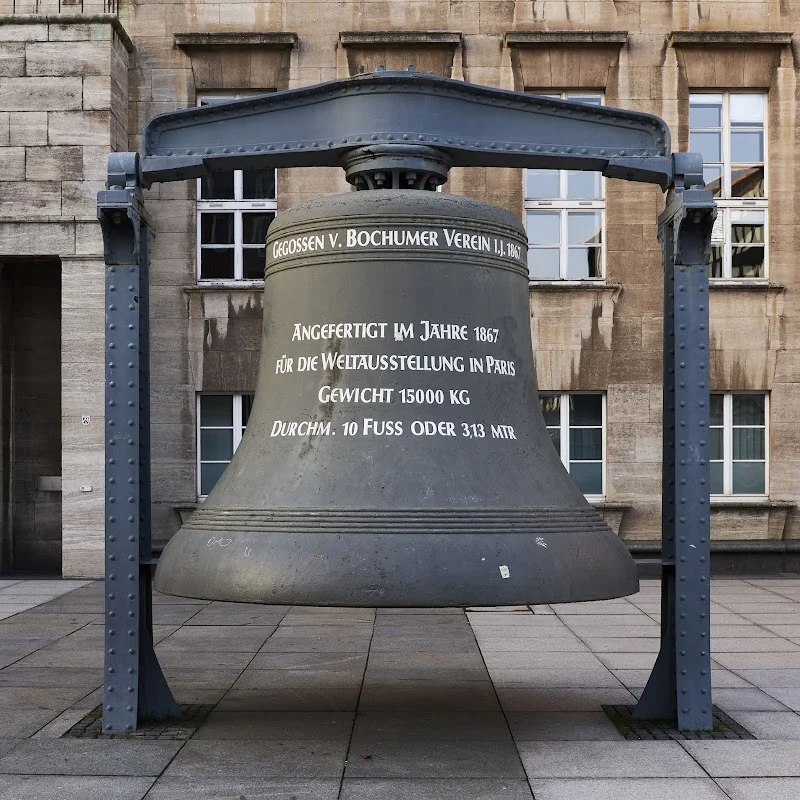
The bell at the Town Hall in Bochum is much more than a striking object in a central square. It represents a piece of industrial history, pride in Bochum's steel and casting expertise, and the connection between past and present in the heart of the city. Today, it is a prominent landmark in front of the Town Hall, a popular meeting point for city tours, and a photo opportunity that visitors immediately associate with Bochum. Therefore, those searching for the bell at the Town Hall are not just looking for a monument, but a symbol of the city's development from an industrial site to a modern administrative and cultural location. The official description characterizes the bell as a 15-ton cast steel landmark with a diameter of 3.13 meters, cast in 1867 for the Paris World Exhibition. Since 1979, it has stood in front of the Town Hall, but due to war damage and the missing clapper, it can no longer ring. This blend of size, history, and uniqueness is what makes it so appealing. ([bochum-tourismus.de](https://www.bochum-tourismus.de/bochum-entdecken/kirchen-und-besondere-orte/rathaus-bochum.html))
Bell of Superlatives: History, World Exhibition, and Industrial Heritage
The story of the bell begins at a time when Bochum was growing rapidly as an industrial city, and the Bochum Association was one of the defining companies in the region. The large cast steel bell was cast in 1867 for the World Exhibition in Paris and was rung at the opening. From the very beginning, it stood not only for craftsmanship and technical achievement but also for public wonder and international attention. The official tourism description reminds us that cast steel bells were not always immediately admired; during an earlier appearance of such a bell in Paris in 1855, its authenticity was questioned because many people believed it impossible to produce such a size in cast steel. This tension between skepticism and engineering makes the Bochum bell a particularly fascinating monument. It is not just a decorative object but a testament to how the industry of the 19th century experimented with large forms, new materials, and technical precision. The bell was created for an international stage and later returned to Bochum, where it regained its significance: as a visible relic of the city's history and a reminder that Bochum set global standards with steel and casting. The fact that the city today explains how the bell came to stand in front of the Town Hall with a child-friendly brochure and guided tours shows how firmly it is anchored in the local memory culture. ([bochum-tourismus.de](https://www.bochum-tourismus.de/bochum-entdecken/kirchen-und-besondere-orte/rathaus-bochum.html))
The materiality of the bell also impressively continues this story. The official description states a diameter of 3.13 meters and a weight of 15,000 kilograms. Thus, the object is among the outstanding examples of its kind and is an experience in itself due to its sheer size. The technical dimension is not the only crucial aspect; the symbolic value is also significant: The bell stands today where many people see it in their daily lives, in front of an administrative building that is itself an important piece of city history. This creates a dialogue between the industrial heritage of the Bochum Association and the political center of the city. Therefore, when one looks at the bell, one sees not just metal but a material archive of Bochum's development. The fact that it can no longer ring due to war damage adds to this historical depth: it is not present as a functioning sound object but as a monument that tells of a bygone era. For this reason, the bell at the Town Hall is often the subject of city tours, school projects, and local publications. It serves as a visible entry point into Bochum's history and makes industrial modernity tangible in public space. ([bochum-tourismus.de](https://www.bochum-tourismus.de/bochum-entdecken/kirchen-und-besondere-orte/rathaus-bochum.html))
The Town Hall Bochum: Architecture, Courtyard, and Urban Context
The bell at the Town Hall can only be fully understood when one also considers the building behind it. The Bochum Town Hall was designed by the Darmstadt architect Karl Roth and built between 1926 and 1931. The official description characterizes it as one of the most important representative buildings in the Ruhr area. Stylistically, it is inspired by the ornamentless Spanish Renaissance or the El Escorial monastery. The building appears strictly symmetrical, with a large courtyard and a comparatively simple facade, which is primarily accentuated by the entrance portal and a two-story projection. This clear form language makes the Town Hall itself a significant architectural landmark. It is a house of administration, but at the same time, a building with a consciously representative claim. The fact that part of the city administration is housed there today underscores the dual function of the place: it is both a workplace and a point of identification. Official sources also emphasize that the Town Hall is a protected monument and that a functional paternoster is preserved inside, which is one of the few of its kind in Bochum. This transforms an administrative building into a place with high experiential and recognition value. The bell in front of the building enhances this impression because it visibly carries the historical character of the square outward. ([bochum-tourismus.de](https://www.bochum-tourismus.de/bochum-entdecken/kirchen-und-besondere-orte/rathaus-bochum.html))
The architectural context is also important because several historical elements come together in front of the Town Hall and in the courtyard. The official POI page mentions the cast steel carillon in the courtyard as well as the fountains of beauty and luck by August Vogel. In front of the building stands the large bell, which was made for the World Exhibition in 1867. This creates an ensemble that consists not only of a monument but of several layers of Bochum's city history. At the same time, the city points out that the building has been expanded and remodeled over time, and the historical part was completely renovated between 2000 and 2021. Today, the main entrance is located under the balcony. This development shows that the Town Hall has remained a lively place despite its historical appearance. Visitors encounter a mix of historical architecture, functioning administration, and public use. This is precisely why the bell at the Town Hall is also so effective in urban planning: it anchors the grand form of the Town Hall in public space and gives the square a clear identity. Anyone arriving at Willy-Brandt-Platz for the first time immediately recognizes that it is a central place with historical depth. ([pages.bochum-tourismus.de](https://pages.bochum-tourismus.de/de/bochum-tourismus/streaming/detail/POI/p_100169489/rathaus-bochum))
Directions to the Bell at the Town Hall: Public Transport, Address, and Orientation
Finding the bell at the Town Hall is very easy, as it stands in a central location on the Town Hall square. The official address is Willy-Brandt-Platz 2-6, 44787 Bochum. For those arriving by public transport, the official site mentions very good connections: The U35 as well as trams 302, 306, 316, and 305 stop at BO Rathaus Nord; various bus lines also serve the area around Bochum Town Hall. This makes the bell a destination that can be easily reached without a car. This is especially practical for short city visits, photo stops, or a walk through the city center, as the square is directly connected to the historical and administrative center of the city. The city also describes the place as a meeting point for tours and events, so one often experiences the bell not just as a single monument but as a starting point for further discoveries in Bochum. For those interested in the combination of landmark, Town Hall, and city center, this is an ideal entry point. ([bochum-tourismus.de](https://www.bochum-tourismus.de/bochum-entdecken/kirchen-und-besondere-orte/rathaus-bochum.html))
The practical side is also clearly organized. The city’s information page mentions available parking spaces, and the Town Hall tours explicitly point to the parking garage P3 at the Town Hall or the Education and Administration Center. This is particularly interesting for visitors arriving by car or looking for a more accessible parking solution. The Town Hall square is also a place where official tours can begin: The city of Bochum explicitly names the bell as a meeting point for tours, such as during events by the adult education center or special city tours. Thus, it is not only a beautiful photo opportunity but also a logistical hub in urban everyday life. Therefore, those searching for the bell at the Town Hall should not look for a hidden sightseeing tip but head directly to the square. The monument is hard to miss there, and the surroundings provide the appropriate context with the Town Hall, courtyard, and city center. For all those specifically looking for directions, parking, or public transport, the ensemble is particularly uncomplicated: central location, clear signage, and good accessibility come together here. ([bochum.de](https://www.bochum.de/Referat-fuer-politische-Gremien-Buergerbeteiligung-und-Kommunikation/Dienstleistungen-und-Infos/Rathausfuehrungen-fuer-Kinder?utm_source=openai))
Parking at the Town Hall Bochum and Visiting Tips for the Square
When it comes to parking at the Town Hall Bochum, the most important detail is the parking garage P3 under the Town Hall or the Education and Administration Center. This is the solution the city Bochum recommends for visitors of Town Hall tours. Additionally, the official POI page points out that car parking spaces are available. For a spontaneous visit to the bell at the Town Hall, this is helpful, as it allows for a good combination of the stay with an appointment in the city center, a walk across Willy-Brandt-Platz, or a detour to the Town Hall itself. The surroundings are urban, central, and designed for short distances. Those wishing to photograph the monument benefit from the fact that the bell stands freely in the square, and its steel construction contrasts well with the Town Hall. The official tourism description emphasizes this impression: The bell has been beautifully presentable since its installation in front of the Town Hall and is well-suited for photography due to its distinctive shape and steel frame. For use as a photo spot, no ticket or elaborate preparation is needed, just a good perspective and some time. ([bochum.de](https://www.bochum.de/Referat-fuer-politische-Gremien-Buergerbeteiligung-und-Kommunikation/Dienstleistungen-und-Infos/Rathausfuehrungen-fuer-Kinder?utm_source=openai))
Another practical note concerns the role of the square in urban everyday life. The city of Bochum names the area around the bell not only as an arrival point but also as a starting point for bus tours and walks. Thus, the square is not just a backdrop but an active part of Bochum's visitor logistics. Therefore, when searching for the bell at the Town Hall, it is worthwhile to combine the visit with a walk through the city center. This way, the other elements of the square become clearer: the Town Hall as an administrative building, the courtyard with the cast steel carillon, and the pathways connecting Willy-Brandt-Platz with other places in the city. Those looking for images will also find here the strong visual combination that frequently appears in search queries: a historical large bell, a representative Town Hall, and an urban space that appears both open and concentrated. For many visitors, this mix is precisely why they do not just see the place once but return again. ([bochum.de](https://www.bochum.de/Pressemeldungen/26-Februar-2026/Rundgang-der-Volkshochschule--Das-Bochumer-Rathaus-und-die-Gleichstellung-?utm_source=openai))
Town Hall Clubbing, Tours, and the Current Role as Bochum's Stage
The bell at the Town Hall is today not only a monument but part of a lively place. This is particularly evident in the format of Town Hall Clubbing, which has been taking place in the Town Hall since 2021. The city of Bochum describes the project as a series of cultural events that regularly transform the Town Hall into a concert hall, club, or stage. Among other things, readings, concerts, DJ events, theater, and electronic music are mentioned. This is remarkable because a building that many initially perceive only as an administrative place gains a new public role through this. The official text emphasizes that the Town Hall, as one of the most important representative buildings in the city, has enough space for cultural experiments. Thus, the historical substance is not museum-frozen but integrated into the cultural everyday life of the city. The bell in front of the entrance symbolically marks the threshold between memory and present: it marks the place where Bochum's history and contemporary culture meet directly. ([bochum.de](https://www.bochum.de/Die-Bochum-Strategie/Die-Kompetenzen-der-Strategie/Hotspot-der-Live-Kultur/Rathausclubbing---Das-Rathaus-als-Buehne-der-Stadt?utm_source=openai))
The educational use of the place is also part of its current significance. The city of Bochum has been offering Town Hall tours for children for years, where the history of the building, municipal structures, and local democracy are conveyed. In these tours, school children learn, among other things, how many rooms the Town Hall has, how old the oldest resident is, and which bell songs ring out from the courtyard. The brochure titled How the Bell Came to the Town Hall shows that the bell is not just a tourist object but also a didactic symbol of Bochum's city history. This explains why so many search queries arise around programs, history, carillons, and images: the place is both a monument, a learning site, and a cultural address. Therefore, when asking about the rank of this bell in Bochum, one does not get a simple answer. It is part of an urban narrative space where administration, memory, architecture, and culture intertwine. The Town Hall as the stage of the city is thus more than just a catchphrase. It describes a place where history remains visible while the city simultaneously develops new forms of use. ([bochum.de](https://www.bochum.de/Pressemeldungen/17-Maerz-2026/Auf-Entdeckungstour-im-Rathaus---Bochumer-Geschichte-fuer-Schuelerinnen-und-Schueler))
Images, Features, and Why the Bell at the Town Hall is So Often Searched
Those searching for images of the bell at the Town Hall Bochum are often looking for a compact impression of Bochum's identity. This is precisely the impression the monument delivers in its current form. The bell is large enough to stand out immediately and is embedded in a spatial framework that enhances its effect. The steel frame, the freestanding square, and the direct proximity to the Town Hall make it a very photogenic object. Additionally, there is the historical charge: The bell dates back to 1867, was part of the Paris World Exhibition, can no longer ring due to war damage, and has stood in front of the Town Hall since 1979. All these details transform a simple photo stop into a small historical experience. The search for the term carillon Town Hall Bochum also has a good reason, as visitors encounter not only the large bell in front of the building but also the cast steel carillon in the courtyard in the context of the Town Hall. This creates a dual sound and memory layer that many other places do not offer in this form. ([bochum-tourismus.de](https://www.bochum-tourismus.de/bochum-entdecken/kirchen-und-besondere-orte/rathaus-bochum.html))
It is particularly interesting that the bell does not appear isolated in the urban space but repeatedly serves as a starting point for knowledge about Bochum. Official press releases, tours, and tourism offers refer to it as a meeting point, symbol, and occasion to learn more about the city's history. This also explains why the bell at the Town Hall is not only exciting for architecture fans or history enthusiasts but also for people simply looking for a central, clear, and recognizable place in Bochum. The mix of monumental size, industrial origin, and public accessibility is rare. Additionally, the strong visual connection between the historical Town Hall and the monument in the square adds to this. When thinking of Bochum, one gets a very precise image here: a city that does not hide its industrial past but makes it visible in public space. Therefore, the bell at the Town Hall is not just a search term but a compact entry point into Bochum's city history, urban orientation, and photo culture. And that is precisely why a visit is worthwhile not just once but repeatedly when one wants to experience Bochum from a different perspective. ([bochum-tourismus.de](https://www.bochum-tourismus.de/bochum-entdecken/kirchen-und-besondere-orte/rathaus-bochum.html))
Sources:
- Bochum Tourism – Town Hall Bochum ([bochum-tourismus.de](https://www.bochum-tourismus.de/bochum-entdecken/kirchen-und-besondere-orte/rathaus-bochum.html))
- City of Bochum – Town Hall Tours for Children ([bochum.de](https://www.bochum.de/Referat-fuer-politische-Gremien-Buergerbeteiligung-und-Kommunikation/Dienstleistungen-und-Infos/Rathausfuehrungen-fuer-Kinder?utm_source=openai))
- City of Bochum – Town Hall Clubbing – The Town Hall as the Stage of the City ([bochum.de](https://www.bochum.de/Die-Bochum-Strategie/Die-Kompetenzen-der-Strategie/Hotspot-der-Live-Kultur/Rathausclubbing---Das-Rathaus-als-Buehne-der-Stadt?utm_source=openai))
- City of Bochum – Town Hall Bochum POI / Arrival ([pages.bochum-tourismus.de](https://pages.bochum-tourismus.de/de/bochum-tourismus/streaming/detail/POI/p_100169489/rathaus-bochum))
- City of Bochum – Town Hall Bochum PDF ([bochum.de](https://www.bochum.de/C125830C0042AB74/vwContentByKey/N26XT22G402HGILDE/%24FILE/rathaus_bochum.pdf))
Show moreShow less
Bell at the Town Hall | History & Parking
The bell at the Town Hall in Bochum is much more than a striking object in a central square. It represents a piece of industrial history, pride in Bochum's steel and casting expertise, and the connection between past and present in the heart of the city. Today, it is a prominent landmark in front of the Town Hall, a popular meeting point for city tours, and a photo opportunity that visitors immediately associate with Bochum. Therefore, those searching for the bell at the Town Hall are not just looking for a monument, but a symbol of the city's development from an industrial site to a modern administrative and cultural location. The official description characterizes the bell as a 15-ton cast steel landmark with a diameter of 3.13 meters, cast in 1867 for the Paris World Exhibition. Since 1979, it has stood in front of the Town Hall, but due to war damage and the missing clapper, it can no longer ring. This blend of size, history, and uniqueness is what makes it so appealing. ([bochum-tourismus.de](https://www.bochum-tourismus.de/bochum-entdecken/kirchen-und-besondere-orte/rathaus-bochum.html))
Bell of Superlatives: History, World Exhibition, and Industrial Heritage
The story of the bell begins at a time when Bochum was growing rapidly as an industrial city, and the Bochum Association was one of the defining companies in the region. The large cast steel bell was cast in 1867 for the World Exhibition in Paris and was rung at the opening. From the very beginning, it stood not only for craftsmanship and technical achievement but also for public wonder and international attention. The official tourism description reminds us that cast steel bells were not always immediately admired; during an earlier appearance of such a bell in Paris in 1855, its authenticity was questioned because many people believed it impossible to produce such a size in cast steel. This tension between skepticism and engineering makes the Bochum bell a particularly fascinating monument. It is not just a decorative object but a testament to how the industry of the 19th century experimented with large forms, new materials, and technical precision. The bell was created for an international stage and later returned to Bochum, where it regained its significance: as a visible relic of the city's history and a reminder that Bochum set global standards with steel and casting. The fact that the city today explains how the bell came to stand in front of the Town Hall with a child-friendly brochure and guided tours shows how firmly it is anchored in the local memory culture. ([bochum-tourismus.de](https://www.bochum-tourismus.de/bochum-entdecken/kirchen-und-besondere-orte/rathaus-bochum.html))
The materiality of the bell also impressively continues this story. The official description states a diameter of 3.13 meters and a weight of 15,000 kilograms. Thus, the object is among the outstanding examples of its kind and is an experience in itself due to its sheer size. The technical dimension is not the only crucial aspect; the symbolic value is also significant: The bell stands today where many people see it in their daily lives, in front of an administrative building that is itself an important piece of city history. This creates a dialogue between the industrial heritage of the Bochum Association and the political center of the city. Therefore, when one looks at the bell, one sees not just metal but a material archive of Bochum's development. The fact that it can no longer ring due to war damage adds to this historical depth: it is not present as a functioning sound object but as a monument that tells of a bygone era. For this reason, the bell at the Town Hall is often the subject of city tours, school projects, and local publications. It serves as a visible entry point into Bochum's history and makes industrial modernity tangible in public space. ([bochum-tourismus.de](https://www.bochum-tourismus.de/bochum-entdecken/kirchen-und-besondere-orte/rathaus-bochum.html))
The Town Hall Bochum: Architecture, Courtyard, and Urban Context
The bell at the Town Hall can only be fully understood when one also considers the building behind it. The Bochum Town Hall was designed by the Darmstadt architect Karl Roth and built between 1926 and 1931. The official description characterizes it as one of the most important representative buildings in the Ruhr area. Stylistically, it is inspired by the ornamentless Spanish Renaissance or the El Escorial monastery. The building appears strictly symmetrical, with a large courtyard and a comparatively simple facade, which is primarily accentuated by the entrance portal and a two-story projection. This clear form language makes the Town Hall itself a significant architectural landmark. It is a house of administration, but at the same time, a building with a consciously representative claim. The fact that part of the city administration is housed there today underscores the dual function of the place: it is both a workplace and a point of identification. Official sources also emphasize that the Town Hall is a protected monument and that a functional paternoster is preserved inside, which is one of the few of its kind in Bochum. This transforms an administrative building into a place with high experiential and recognition value. The bell in front of the building enhances this impression because it visibly carries the historical character of the square outward. ([bochum-tourismus.de](https://www.bochum-tourismus.de/bochum-entdecken/kirchen-und-besondere-orte/rathaus-bochum.html))
The architectural context is also important because several historical elements come together in front of the Town Hall and in the courtyard. The official POI page mentions the cast steel carillon in the courtyard as well as the fountains of beauty and luck by August Vogel. In front of the building stands the large bell, which was made for the World Exhibition in 1867. This creates an ensemble that consists not only of a monument but of several layers of Bochum's city history. At the same time, the city points out that the building has been expanded and remodeled over time, and the historical part was completely renovated between 2000 and 2021. Today, the main entrance is located under the balcony. This development shows that the Town Hall has remained a lively place despite its historical appearance. Visitors encounter a mix of historical architecture, functioning administration, and public use. This is precisely why the bell at the Town Hall is also so effective in urban planning: it anchors the grand form of the Town Hall in public space and gives the square a clear identity. Anyone arriving at Willy-Brandt-Platz for the first time immediately recognizes that it is a central place with historical depth. ([pages.bochum-tourismus.de](https://pages.bochum-tourismus.de/de/bochum-tourismus/streaming/detail/POI/p_100169489/rathaus-bochum))
Directions to the Bell at the Town Hall: Public Transport, Address, and Orientation
Finding the bell at the Town Hall is very easy, as it stands in a central location on the Town Hall square. The official address is Willy-Brandt-Platz 2-6, 44787 Bochum. For those arriving by public transport, the official site mentions very good connections: The U35 as well as trams 302, 306, 316, and 305 stop at BO Rathaus Nord; various bus lines also serve the area around Bochum Town Hall. This makes the bell a destination that can be easily reached without a car. This is especially practical for short city visits, photo stops, or a walk through the city center, as the square is directly connected to the historical and administrative center of the city. The city also describes the place as a meeting point for tours and events, so one often experiences the bell not just as a single monument but as a starting point for further discoveries in Bochum. For those interested in the combination of landmark, Town Hall, and city center, this is an ideal entry point. ([bochum-tourismus.de](https://www.bochum-tourismus.de/bochum-entdecken/kirchen-und-besondere-orte/rathaus-bochum.html))
The practical side is also clearly organized. The city’s information page mentions available parking spaces, and the Town Hall tours explicitly point to the parking garage P3 at the Town Hall or the Education and Administration Center. This is particularly interesting for visitors arriving by car or looking for a more accessible parking solution. The Town Hall square is also a place where official tours can begin: The city of Bochum explicitly names the bell as a meeting point for tours, such as during events by the adult education center or special city tours. Thus, it is not only a beautiful photo opportunity but also a logistical hub in urban everyday life. Therefore, those searching for the bell at the Town Hall should not look for a hidden sightseeing tip but head directly to the square. The monument is hard to miss there, and the surroundings provide the appropriate context with the Town Hall, courtyard, and city center. For all those specifically looking for directions, parking, or public transport, the ensemble is particularly uncomplicated: central location, clear signage, and good accessibility come together here. ([bochum.de](https://www.bochum.de/Referat-fuer-politische-Gremien-Buergerbeteiligung-und-Kommunikation/Dienstleistungen-und-Infos/Rathausfuehrungen-fuer-Kinder?utm_source=openai))
Parking at the Town Hall Bochum and Visiting Tips for the Square
When it comes to parking at the Town Hall Bochum, the most important detail is the parking garage P3 under the Town Hall or the Education and Administration Center. This is the solution the city Bochum recommends for visitors of Town Hall tours. Additionally, the official POI page points out that car parking spaces are available. For a spontaneous visit to the bell at the Town Hall, this is helpful, as it allows for a good combination of the stay with an appointment in the city center, a walk across Willy-Brandt-Platz, or a detour to the Town Hall itself. The surroundings are urban, central, and designed for short distances. Those wishing to photograph the monument benefit from the fact that the bell stands freely in the square, and its steel construction contrasts well with the Town Hall. The official tourism description emphasizes this impression: The bell has been beautifully presentable since its installation in front of the Town Hall and is well-suited for photography due to its distinctive shape and steel frame. For use as a photo spot, no ticket or elaborate preparation is needed, just a good perspective and some time. ([bochum.de](https://www.bochum.de/Referat-fuer-politische-Gremien-Buergerbeteiligung-und-Kommunikation/Dienstleistungen-und-Infos/Rathausfuehrungen-fuer-Kinder?utm_source=openai))
Another practical note concerns the role of the square in urban everyday life. The city of Bochum names the area around the bell not only as an arrival point but also as a starting point for bus tours and walks. Thus, the square is not just a backdrop but an active part of Bochum's visitor logistics. Therefore, when searching for the bell at the Town Hall, it is worthwhile to combine the visit with a walk through the city center. This way, the other elements of the square become clearer: the Town Hall as an administrative building, the courtyard with the cast steel carillon, and the pathways connecting Willy-Brandt-Platz with other places in the city. Those looking for images will also find here the strong visual combination that frequently appears in search queries: a historical large bell, a representative Town Hall, and an urban space that appears both open and concentrated. For many visitors, this mix is precisely why they do not just see the place once but return again. ([bochum.de](https://www.bochum.de/Pressemeldungen/26-Februar-2026/Rundgang-der-Volkshochschule--Das-Bochumer-Rathaus-und-die-Gleichstellung-?utm_source=openai))
Town Hall Clubbing, Tours, and the Current Role as Bochum's Stage
The bell at the Town Hall is today not only a monument but part of a lively place. This is particularly evident in the format of Town Hall Clubbing, which has been taking place in the Town Hall since 2021. The city of Bochum describes the project as a series of cultural events that regularly transform the Town Hall into a concert hall, club, or stage. Among other things, readings, concerts, DJ events, theater, and electronic music are mentioned. This is remarkable because a building that many initially perceive only as an administrative place gains a new public role through this. The official text emphasizes that the Town Hall, as one of the most important representative buildings in the city, has enough space for cultural experiments. Thus, the historical substance is not museum-frozen but integrated into the cultural everyday life of the city. The bell in front of the entrance symbolically marks the threshold between memory and present: it marks the place where Bochum's history and contemporary culture meet directly. ([bochum.de](https://www.bochum.de/Die-Bochum-Strategie/Die-Kompetenzen-der-Strategie/Hotspot-der-Live-Kultur/Rathausclubbing---Das-Rathaus-als-Buehne-der-Stadt?utm_source=openai))
The educational use of the place is also part of its current significance. The city of Bochum has been offering Town Hall tours for children for years, where the history of the building, municipal structures, and local democracy are conveyed. In these tours, school children learn, among other things, how many rooms the Town Hall has, how old the oldest resident is, and which bell songs ring out from the courtyard. The brochure titled How the Bell Came to the Town Hall shows that the bell is not just a tourist object but also a didactic symbol of Bochum's city history. This explains why so many search queries arise around programs, history, carillons, and images: the place is both a monument, a learning site, and a cultural address. Therefore, when asking about the rank of this bell in Bochum, one does not get a simple answer. It is part of an urban narrative space where administration, memory, architecture, and culture intertwine. The Town Hall as the stage of the city is thus more than just a catchphrase. It describes a place where history remains visible while the city simultaneously develops new forms of use. ([bochum.de](https://www.bochum.de/Pressemeldungen/17-Maerz-2026/Auf-Entdeckungstour-im-Rathaus---Bochumer-Geschichte-fuer-Schuelerinnen-und-Schueler))
Images, Features, and Why the Bell at the Town Hall is So Often Searched
Those searching for images of the bell at the Town Hall Bochum are often looking for a compact impression of Bochum's identity. This is precisely the impression the monument delivers in its current form. The bell is large enough to stand out immediately and is embedded in a spatial framework that enhances its effect. The steel frame, the freestanding square, and the direct proximity to the Town Hall make it a very photogenic object. Additionally, there is the historical charge: The bell dates back to 1867, was part of the Paris World Exhibition, can no longer ring due to war damage, and has stood in front of the Town Hall since 1979. All these details transform a simple photo stop into a small historical experience. The search for the term carillon Town Hall Bochum also has a good reason, as visitors encounter not only the large bell in front of the building but also the cast steel carillon in the courtyard in the context of the Town Hall. This creates a dual sound and memory layer that many other places do not offer in this form. ([bochum-tourismus.de](https://www.bochum-tourismus.de/bochum-entdecken/kirchen-und-besondere-orte/rathaus-bochum.html))
It is particularly interesting that the bell does not appear isolated in the urban space but repeatedly serves as a starting point for knowledge about Bochum. Official press releases, tours, and tourism offers refer to it as a meeting point, symbol, and occasion to learn more about the city's history. This also explains why the bell at the Town Hall is not only exciting for architecture fans or history enthusiasts but also for people simply looking for a central, clear, and recognizable place in Bochum. The mix of monumental size, industrial origin, and public accessibility is rare. Additionally, the strong visual connection between the historical Town Hall and the monument in the square adds to this. When thinking of Bochum, one gets a very precise image here: a city that does not hide its industrial past but makes it visible in public space. Therefore, the bell at the Town Hall is not just a search term but a compact entry point into Bochum's city history, urban orientation, and photo culture. And that is precisely why a visit is worthwhile not just once but repeatedly when one wants to experience Bochum from a different perspective. ([bochum-tourismus.de](https://www.bochum-tourismus.de/bochum-entdecken/kirchen-und-besondere-orte/rathaus-bochum.html))
Sources:
- Bochum Tourism – Town Hall Bochum ([bochum-tourismus.de](https://www.bochum-tourismus.de/bochum-entdecken/kirchen-und-besondere-orte/rathaus-bochum.html))
- City of Bochum – Town Hall Tours for Children ([bochum.de](https://www.bochum.de/Referat-fuer-politische-Gremien-Buergerbeteiligung-und-Kommunikation/Dienstleistungen-und-Infos/Rathausfuehrungen-fuer-Kinder?utm_source=openai))
- City of Bochum – Town Hall Clubbing – The Town Hall as the Stage of the City ([bochum.de](https://www.bochum.de/Die-Bochum-Strategie/Die-Kompetenzen-der-Strategie/Hotspot-der-Live-Kultur/Rathausclubbing---Das-Rathaus-als-Buehne-der-Stadt?utm_source=openai))
- City of Bochum – Town Hall Bochum POI / Arrival ([pages.bochum-tourismus.de](https://pages.bochum-tourismus.de/de/bochum-tourismus/streaming/detail/POI/p_100169489/rathaus-bochum))
- City of Bochum – Town Hall Bochum PDF ([bochum.de](https://www.bochum.de/C125830C0042AB74/vwContentByKey/N26XT22G402HGILDE/%24FILE/rathaus_bochum.pdf))
Bell at the Town Hall | History & Parking
The bell at the Town Hall in Bochum is much more than a striking object in a central square. It represents a piece of industrial history, pride in Bochum's steel and casting expertise, and the connection between past and present in the heart of the city. Today, it is a prominent landmark in front of the Town Hall, a popular meeting point for city tours, and a photo opportunity that visitors immediately associate with Bochum. Therefore, those searching for the bell at the Town Hall are not just looking for a monument, but a symbol of the city's development from an industrial site to a modern administrative and cultural location. The official description characterizes the bell as a 15-ton cast steel landmark with a diameter of 3.13 meters, cast in 1867 for the Paris World Exhibition. Since 1979, it has stood in front of the Town Hall, but due to war damage and the missing clapper, it can no longer ring. This blend of size, history, and uniqueness is what makes it so appealing. ([bochum-tourismus.de](https://www.bochum-tourismus.de/bochum-entdecken/kirchen-und-besondere-orte/rathaus-bochum.html))
Bell of Superlatives: History, World Exhibition, and Industrial Heritage
The story of the bell begins at a time when Bochum was growing rapidly as an industrial city, and the Bochum Association was one of the defining companies in the region. The large cast steel bell was cast in 1867 for the World Exhibition in Paris and was rung at the opening. From the very beginning, it stood not only for craftsmanship and technical achievement but also for public wonder and international attention. The official tourism description reminds us that cast steel bells were not always immediately admired; during an earlier appearance of such a bell in Paris in 1855, its authenticity was questioned because many people believed it impossible to produce such a size in cast steel. This tension between skepticism and engineering makes the Bochum bell a particularly fascinating monument. It is not just a decorative object but a testament to how the industry of the 19th century experimented with large forms, new materials, and technical precision. The bell was created for an international stage and later returned to Bochum, where it regained its significance: as a visible relic of the city's history and a reminder that Bochum set global standards with steel and casting. The fact that the city today explains how the bell came to stand in front of the Town Hall with a child-friendly brochure and guided tours shows how firmly it is anchored in the local memory culture. ([bochum-tourismus.de](https://www.bochum-tourismus.de/bochum-entdecken/kirchen-und-besondere-orte/rathaus-bochum.html))
The materiality of the bell also impressively continues this story. The official description states a diameter of 3.13 meters and a weight of 15,000 kilograms. Thus, the object is among the outstanding examples of its kind and is an experience in itself due to its sheer size. The technical dimension is not the only crucial aspect; the symbolic value is also significant: The bell stands today where many people see it in their daily lives, in front of an administrative building that is itself an important piece of city history. This creates a dialogue between the industrial heritage of the Bochum Association and the political center of the city. Therefore, when one looks at the bell, one sees not just metal but a material archive of Bochum's development. The fact that it can no longer ring due to war damage adds to this historical depth: it is not present as a functioning sound object but as a monument that tells of a bygone era. For this reason, the bell at the Town Hall is often the subject of city tours, school projects, and local publications. It serves as a visible entry point into Bochum's history and makes industrial modernity tangible in public space. ([bochum-tourismus.de](https://www.bochum-tourismus.de/bochum-entdecken/kirchen-und-besondere-orte/rathaus-bochum.html))
The Town Hall Bochum: Architecture, Courtyard, and Urban Context
The bell at the Town Hall can only be fully understood when one also considers the building behind it. The Bochum Town Hall was designed by the Darmstadt architect Karl Roth and built between 1926 and 1931. The official description characterizes it as one of the most important representative buildings in the Ruhr area. Stylistically, it is inspired by the ornamentless Spanish Renaissance or the El Escorial monastery. The building appears strictly symmetrical, with a large courtyard and a comparatively simple facade, which is primarily accentuated by the entrance portal and a two-story projection. This clear form language makes the Town Hall itself a significant architectural landmark. It is a house of administration, but at the same time, a building with a consciously representative claim. The fact that part of the city administration is housed there today underscores the dual function of the place: it is both a workplace and a point of identification. Official sources also emphasize that the Town Hall is a protected monument and that a functional paternoster is preserved inside, which is one of the few of its kind in Bochum. This transforms an administrative building into a place with high experiential and recognition value. The bell in front of the building enhances this impression because it visibly carries the historical character of the square outward. ([bochum-tourismus.de](https://www.bochum-tourismus.de/bochum-entdecken/kirchen-und-besondere-orte/rathaus-bochum.html))
The architectural context is also important because several historical elements come together in front of the Town Hall and in the courtyard. The official POI page mentions the cast steel carillon in the courtyard as well as the fountains of beauty and luck by August Vogel. In front of the building stands the large bell, which was made for the World Exhibition in 1867. This creates an ensemble that consists not only of a monument but of several layers of Bochum's city history. At the same time, the city points out that the building has been expanded and remodeled over time, and the historical part was completely renovated between 2000 and 2021. Today, the main entrance is located under the balcony. This development shows that the Town Hall has remained a lively place despite its historical appearance. Visitors encounter a mix of historical architecture, functioning administration, and public use. This is precisely why the bell at the Town Hall is also so effective in urban planning: it anchors the grand form of the Town Hall in public space and gives the square a clear identity. Anyone arriving at Willy-Brandt-Platz for the first time immediately recognizes that it is a central place with historical depth. ([pages.bochum-tourismus.de](https://pages.bochum-tourismus.de/de/bochum-tourismus/streaming/detail/POI/p_100169489/rathaus-bochum))
Directions to the Bell at the Town Hall: Public Transport, Address, and Orientation
Finding the bell at the Town Hall is very easy, as it stands in a central location on the Town Hall square. The official address is Willy-Brandt-Platz 2-6, 44787 Bochum. For those arriving by public transport, the official site mentions very good connections: The U35 as well as trams 302, 306, 316, and 305 stop at BO Rathaus Nord; various bus lines also serve the area around Bochum Town Hall. This makes the bell a destination that can be easily reached without a car. This is especially practical for short city visits, photo stops, or a walk through the city center, as the square is directly connected to the historical and administrative center of the city. The city also describes the place as a meeting point for tours and events, so one often experiences the bell not just as a single monument but as a starting point for further discoveries in Bochum. For those interested in the combination of landmark, Town Hall, and city center, this is an ideal entry point. ([bochum-tourismus.de](https://www.bochum-tourismus.de/bochum-entdecken/kirchen-und-besondere-orte/rathaus-bochum.html))
The practical side is also clearly organized. The city’s information page mentions available parking spaces, and the Town Hall tours explicitly point to the parking garage P3 at the Town Hall or the Education and Administration Center. This is particularly interesting for visitors arriving by car or looking for a more accessible parking solution. The Town Hall square is also a place where official tours can begin: The city of Bochum explicitly names the bell as a meeting point for tours, such as during events by the adult education center or special city tours. Thus, it is not only a beautiful photo opportunity but also a logistical hub in urban everyday life. Therefore, those searching for the bell at the Town Hall should not look for a hidden sightseeing tip but head directly to the square. The monument is hard to miss there, and the surroundings provide the appropriate context with the Town Hall, courtyard, and city center. For all those specifically looking for directions, parking, or public transport, the ensemble is particularly uncomplicated: central location, clear signage, and good accessibility come together here. ([bochum.de](https://www.bochum.de/Referat-fuer-politische-Gremien-Buergerbeteiligung-und-Kommunikation/Dienstleistungen-und-Infos/Rathausfuehrungen-fuer-Kinder?utm_source=openai))
Parking at the Town Hall Bochum and Visiting Tips for the Square
When it comes to parking at the Town Hall Bochum, the most important detail is the parking garage P3 under the Town Hall or the Education and Administration Center. This is the solution the city Bochum recommends for visitors of Town Hall tours. Additionally, the official POI page points out that car parking spaces are available. For a spontaneous visit to the bell at the Town Hall, this is helpful, as it allows for a good combination of the stay with an appointment in the city center, a walk across Willy-Brandt-Platz, or a detour to the Town Hall itself. The surroundings are urban, central, and designed for short distances. Those wishing to photograph the monument benefit from the fact that the bell stands freely in the square, and its steel construction contrasts well with the Town Hall. The official tourism description emphasizes this impression: The bell has been beautifully presentable since its installation in front of the Town Hall and is well-suited for photography due to its distinctive shape and steel frame. For use as a photo spot, no ticket or elaborate preparation is needed, just a good perspective and some time. ([bochum.de](https://www.bochum.de/Referat-fuer-politische-Gremien-Buergerbeteiligung-und-Kommunikation/Dienstleistungen-und-Infos/Rathausfuehrungen-fuer-Kinder?utm_source=openai))
Another practical note concerns the role of the square in urban everyday life. The city of Bochum names the area around the bell not only as an arrival point but also as a starting point for bus tours and walks. Thus, the square is not just a backdrop but an active part of Bochum's visitor logistics. Therefore, when searching for the bell at the Town Hall, it is worthwhile to combine the visit with a walk through the city center. This way, the other elements of the square become clearer: the Town Hall as an administrative building, the courtyard with the cast steel carillon, and the pathways connecting Willy-Brandt-Platz with other places in the city. Those looking for images will also find here the strong visual combination that frequently appears in search queries: a historical large bell, a representative Town Hall, and an urban space that appears both open and concentrated. For many visitors, this mix is precisely why they do not just see the place once but return again. ([bochum.de](https://www.bochum.de/Pressemeldungen/26-Februar-2026/Rundgang-der-Volkshochschule--Das-Bochumer-Rathaus-und-die-Gleichstellung-?utm_source=openai))
Town Hall Clubbing, Tours, and the Current Role as Bochum's Stage
The bell at the Town Hall is today not only a monument but part of a lively place. This is particularly evident in the format of Town Hall Clubbing, which has been taking place in the Town Hall since 2021. The city of Bochum describes the project as a series of cultural events that regularly transform the Town Hall into a concert hall, club, or stage. Among other things, readings, concerts, DJ events, theater, and electronic music are mentioned. This is remarkable because a building that many initially perceive only as an administrative place gains a new public role through this. The official text emphasizes that the Town Hall, as one of the most important representative buildings in the city, has enough space for cultural experiments. Thus, the historical substance is not museum-frozen but integrated into the cultural everyday life of the city. The bell in front of the entrance symbolically marks the threshold between memory and present: it marks the place where Bochum's history and contemporary culture meet directly. ([bochum.de](https://www.bochum.de/Die-Bochum-Strategie/Die-Kompetenzen-der-Strategie/Hotspot-der-Live-Kultur/Rathausclubbing---Das-Rathaus-als-Buehne-der-Stadt?utm_source=openai))
The educational use of the place is also part of its current significance. The city of Bochum has been offering Town Hall tours for children for years, where the history of the building, municipal structures, and local democracy are conveyed. In these tours, school children learn, among other things, how many rooms the Town Hall has, how old the oldest resident is, and which bell songs ring out from the courtyard. The brochure titled How the Bell Came to the Town Hall shows that the bell is not just a tourist object but also a didactic symbol of Bochum's city history. This explains why so many search queries arise around programs, history, carillons, and images: the place is both a monument, a learning site, and a cultural address. Therefore, when asking about the rank of this bell in Bochum, one does not get a simple answer. It is part of an urban narrative space where administration, memory, architecture, and culture intertwine. The Town Hall as the stage of the city is thus more than just a catchphrase. It describes a place where history remains visible while the city simultaneously develops new forms of use. ([bochum.de](https://www.bochum.de/Pressemeldungen/17-Maerz-2026/Auf-Entdeckungstour-im-Rathaus---Bochumer-Geschichte-fuer-Schuelerinnen-und-Schueler))
Images, Features, and Why the Bell at the Town Hall is So Often Searched
Those searching for images of the bell at the Town Hall Bochum are often looking for a compact impression of Bochum's identity. This is precisely the impression the monument delivers in its current form. The bell is large enough to stand out immediately and is embedded in a spatial framework that enhances its effect. The steel frame, the freestanding square, and the direct proximity to the Town Hall make it a very photogenic object. Additionally, there is the historical charge: The bell dates back to 1867, was part of the Paris World Exhibition, can no longer ring due to war damage, and has stood in front of the Town Hall since 1979. All these details transform a simple photo stop into a small historical experience. The search for the term carillon Town Hall Bochum also has a good reason, as visitors encounter not only the large bell in front of the building but also the cast steel carillon in the courtyard in the context of the Town Hall. This creates a dual sound and memory layer that many other places do not offer in this form. ([bochum-tourismus.de](https://www.bochum-tourismus.de/bochum-entdecken/kirchen-und-besondere-orte/rathaus-bochum.html))
It is particularly interesting that the bell does not appear isolated in the urban space but repeatedly serves as a starting point for knowledge about Bochum. Official press releases, tours, and tourism offers refer to it as a meeting point, symbol, and occasion to learn more about the city's history. This also explains why the bell at the Town Hall is not only exciting for architecture fans or history enthusiasts but also for people simply looking for a central, clear, and recognizable place in Bochum. The mix of monumental size, industrial origin, and public accessibility is rare. Additionally, the strong visual connection between the historical Town Hall and the monument in the square adds to this. When thinking of Bochum, one gets a very precise image here: a city that does not hide its industrial past but makes it visible in public space. Therefore, the bell at the Town Hall is not just a search term but a compact entry point into Bochum's city history, urban orientation, and photo culture. And that is precisely why a visit is worthwhile not just once but repeatedly when one wants to experience Bochum from a different perspective. ([bochum-tourismus.de](https://www.bochum-tourismus.de/bochum-entdecken/kirchen-und-besondere-orte/rathaus-bochum.html))
Sources:
- Bochum Tourism – Town Hall Bochum ([bochum-tourismus.de](https://www.bochum-tourismus.de/bochum-entdecken/kirchen-und-besondere-orte/rathaus-bochum.html))
- City of Bochum – Town Hall Tours for Children ([bochum.de](https://www.bochum.de/Referat-fuer-politische-Gremien-Buergerbeteiligung-und-Kommunikation/Dienstleistungen-und-Infos/Rathausfuehrungen-fuer-Kinder?utm_source=openai))
- City of Bochum – Town Hall Clubbing – The Town Hall as the Stage of the City ([bochum.de](https://www.bochum.de/Die-Bochum-Strategie/Die-Kompetenzen-der-Strategie/Hotspot-der-Live-Kultur/Rathausclubbing---Das-Rathaus-als-Buehne-der-Stadt?utm_source=openai))
- City of Bochum – Town Hall Bochum POI / Arrival ([pages.bochum-tourismus.de](https://pages.bochum-tourismus.de/de/bochum-tourismus/streaming/detail/POI/p_100169489/rathaus-bochum))
- City of Bochum – Town Hall Bochum PDF ([bochum.de](https://www.bochum.de/C125830C0042AB74/vwContentByKey/N26XT22G402HGILDE/%24FILE/rathaus_bochum.pdf))
Upcoming Events
No events found
Frequently Asked Questions
Reviews
Balraj Böttger
21. August 2023
🔝
Eric P.
22. September 2025
It is the second-heaviest bell in Germany. It was manufactured in 1867 by the Bochum Mining and Cast Steel Manufacturing Association and weighs 14,750 kg. Its diameter is ten feet (3.13 meters), and its strike pitch is d0. It was exhibited at the 1867 Paris World's Fair and is therefore a living piece of industrial history. Beautifully presented by its steel frame, it's easy to photograph. If you're in the area, you should definitely take a look at this impressive piece.
Hans-Peter Koehli
11. June 2025
Beautiful bell made for the World's Fair
H. P.
31. May 2023
Well-maintained forecourt with a photo motif of "Bochum" in large letters
Pedro Montero
17. July 2024
Large, heavy bell in the town hall square