
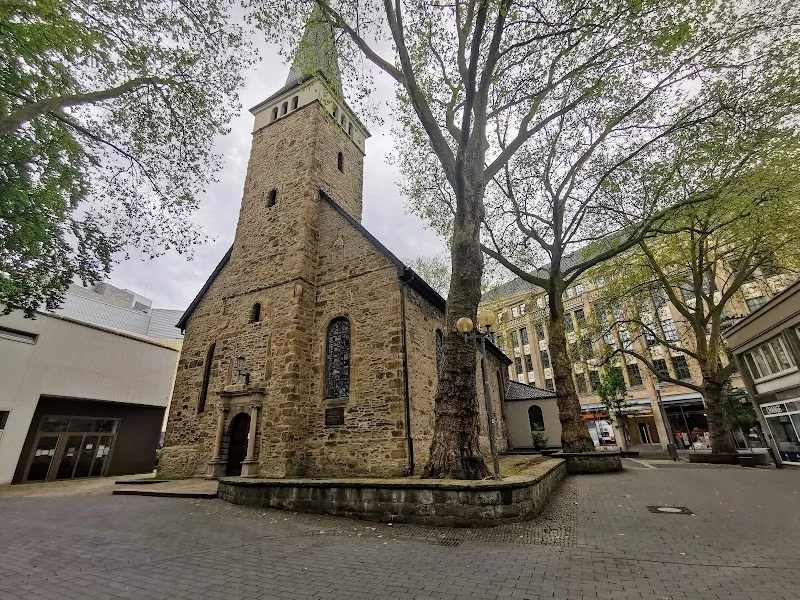
Grabenstraße 9, Bochum
Grabenstraße 9, 44787 Bochum, Germany
Protestant parish Bochum | English Service & Directions
In the middle of the pedestrian zone of Bochum's city center, framed by department stores and the lively Dr.-Ruer-Platz, stands the Pauluskirche as the city church of the Protestant parish of Bochum. Located at Grabenstraße 9, 44787 Bochum, it is an easily accessible place of tranquility, hospitality, and culture. Those who enter through the portal read the inscription Pax intrantibus, salus exeuntibus – a welcome that is still the program today: enter peacefully, go out strengthened. Particularly internationally oriented visitors find a spiritual home here, as an English-speaking service is held in the Pauluskirche on Sundays at 12:30 PM. The location is ideal: a short walk from the main train station leads through the city, alternatively, there are nearby subway stations such as Bochum Rathaus or Bermuda3Eck/Musikforum. Drivers will find several parking garages in the immediate vicinity. In addition to services, the church is open daily as a space for prayer, candlelight, and personal devotion, and offers exhibitions, readings, concerts, and other formats of city church work throughout the year. Right next door, the fair trade shop of the Pauluskirche invites conscious shopping. This mix of spirituality, city center location, and cultural openness makes the Pauluskirche a special destination for believers, seekers, students, city guests, and all those looking for a quiet, soothing place amidst the hustle and bustle.
English Service in Bochum: Time, Place, and Atmosphere
The English-speaking service in Bochum has a permanent home in the Pauluskirche. On Sundays and public holidays, the English Speaking Christian Congregation (ECC) begins at 12:30 PM with the worship service. The worship space is bright, the acoustics clear – ideal conditions for singing, prayer, and preaching in English together. Especially for international students, newcomers, researchers, or guests who still feel uncertain in German, a low-threshold access to the Protestant tradition in Germany is created. Those who come for the first time experience an open, warm community atmosphere: people of different backgrounds, age groups, and life situations celebrate together. The Pauluskirche is intentionally present in the city center as a city church. This allows church attendance and city strolling, a meeting afterward, or quiet moments of devotion to be easily combined. The church opens during the day as a space of silence; those who wish can find a moment of pause before the English service, light a candle, and let the colored stained glass windows affect them. Thematically, the English service is oriented towards the Protestant faith tradition, shaped by an ecumenically open community. The Pauluskirche provides a dignified framework for this – from the simple, light-filled interior to the distinctive tower that rises far above the Dr.-Ruer-Platz. Practically, the good accessibility is a plus: it is only a few minutes' walk from Bochum's main train station, so guests from the Ruhr area can easily arrive by train. Those who find a seat quickly should arrive a little earlier; this allows time for personal preparation and a friendly hello in the church space. The entry is uncomplicated: everyone is welcome, even without prior experience or church membership. The service itself usually offers – in addition to prayer and music – a Bible-related sermon in English and moments of silence. After the conclusion, many visitors end their Sunday with a joint stroll through the city or use the central location for errands. For families, students, or professionals who are flexible on Sundays, the start time of 12:30 PM is also pleasant: the morning remains relaxed, and the journey is stress-free. Thus, the English service at the Pauluskirche combines spirituality with urban ease.
Directions to Pauluskirche and Parking in the City Center
Thanks to its central location, the Pauluskirche is quickly and comfortably accessible. Those arriving by train leave Bochum's main train station towards the city center: the way leads past city galleries and squares; in 5–10 minutes, one can reach Grabenstraße 9 on foot. A helpful orientation point is the Dr.-Ruer-Platz, which borders the Pauluskirche; also in the immediate vicinity are well-known addresses such as the Baltz department store. Public transport connections are also convenient: the subway and tram stop at Rathaus (including lines 302, 306, 310, U35), alternatively at the Bermuda3Eck/Musikforum station. Both stops are close to the church, so even visitors who are not familiar with the area can intuitively find their way. For drivers, the city center offers several parking garages in the immediate vicinity. The parking garage P2 Dr.-Ruer-Platz, which can be accessed via Luisenstraße, is particularly close. The parking garage P8 Konrad-Adenauer-Platz in Bermuda3Eck is also recommended; it is centrally located and, according to the operator, open continuously. Those coming on weekends or in the evening usually find good parking options here; however, for large events in the city, it is advisable to use public transport or arrive earlier. An additional option is the parking garage P5 Brückstraße (City Point/Drehscheibe), which also provides very good access to the city area. It should be noted that opening hours, occupancy, or special regulations may vary depending on the date and event situation. Information about construction sites, temporary closures, or city events (e.g., in Bermuda3Eck) can usually be found at short notice in local media and on the operator's websites. Those wishing to arrive barrier-free should best use the level paths from the main train station or from the subway stops. The city is characterized as a pedestrian zone; thus, the last meters to the church are pleasant to walk. For navigation devices, the destination address Grabenstraße 9, 44787 Bochum is recommended; the nearby environment is characterized by shopping passages, squares, and gastronomy, which further facilitates orientation. A rule of thumb for Sunday afternoons: those coming to the English service should plan a few minutes buffer for parking search or walking. Those traveling with several people can form carpooling or arrange to meet from the train station. This way, the church visit starts relaxed, and after the service, one can quickly return to the train or car. Regardless of the mode of transport, the Pauluskirche impresses with its location: central, urban, and yet with a quiet, protected church space – ideal for devotion and encounter.
Opening Hours, City Church Work, and Local Offers
The Pauluskirche is reliably open during the day as a city church in Bochum's city center: typically, the doors are open daily from 10:00 AM to 6:00 PM. Thus, the church is not only a place of worship but also an urban retreat: people come to pray, light candles, write requests in a guest book, or read a moment in the Bible and daily verses. This open use is part of a broad profile of city church work: exhibitions, readings, concerts, and discussion formats address social, spiritual, and cultural topics and invite the city community to dialogue. The self-understanding is summed up in a motto that stands above the church portal: Pax intrantibus, salus exeuntibus – peace at the entrance, healing at the exit. Directly next to the church building, in the basement of the community center, is the fair trade shop with its own entrance and large display window. Here, fairly traded products are offered; many visitors combine their church visit with a short detour there. In the church space itself, light-filled windows shape the atmosphere. During the reconstruction after World War II, the windows initially received simple glazing; later, the Bochum artist Karl Willi Heyer redesigned the altar area (1962) and the abstract windows in the nave (1965), giving the interior its characteristic, calm colorfulness. As part of the Protestant parish of Bochum, the Pauluskirche is organizationally and content-wise embedded: in addition to German-language services, there is the Sunday English offering at 12:30 PM. Information about dates, special opening hours, concerts, or community series is continuously published by the parish on its channels; notices are available on-site. Those seeking a quiet devotion usually find the calmest times in the morning and afternoon. For groups, a brief coordination with the parish office is advisable, especially if a special occasion (e.g., a quiet memorial) is planned. Even outside of service times, the church space is a place where people from very different life situations meet: shoppers, city center employees, students on their way to lectures, seniors seeking a moment of peace. This mix makes the Pauluskirche an open church for the whole city – visible in the pedestrian zone and yet quietly audible inside.
History of the Pauluskirche: From the 17th Century to Today
The history of the Pauluskirche tells of religious self-assertion, destruction, and reconstruction – and of a church that continually rethinks itself in relation to its city. After Protestant services in Bochum took place for a long time in the Catholic Propsteikirche, the decision was made in the mid-17th century to build a Protestant church of its own. On April 26, 1655, the foundation stone was laid; donations came from prominent Protestant princes such as King Frederick III of Denmark, Elector Frederick William of Brandenburg, and Duke Augustus II of Brunswick-Lüneburg. The city of Bochum and surrounding cities such as Essen, Dortmund, and Hattingen also supported the project. The portal of the church is still adorned with coats of arms of noble families from the surrounding area who significantly enabled the construction. The church was consecrated in 1659; at that time, it towered over the citizens' houses and was widely visible. With the rapid growth of the Ruhr area cities in the 19th century, the church landscape also changed: in 1874, the formerly Lutheran and Reformed congregations merged to form the Protestant parish of Bochum; in 1879, the Christuskirche was added, and the existing churches were named Pauluskirche and Johanniskirche. World War II brought dramatic cuts: during the air raid on June 12/13, 1943, only the masonry made of Ruhr sandstone and about two-thirds of the tower remained of the Pauluskirche. Nevertheless, the congregation held on to its church. Between 1949 and 1950, reconstruction took place, financed mainly by church members and the city of Bochum. The tower received a bell chamber; two cast steel bells had already been installed in 1898, which survived both wars. A third bell was added in 1950. On October 31, 1950, the rebuilt Pauluskirche was reconsecrated on Reformation Day – a date with high symbolic power for Protestantism. The windows initially received provisional glazing; in 1962, new windows were installed in the altar area, designed by Bochum artist Karl Willi Heyer, and in 1965, abstract windows followed in the nave. This artistic redesign continues to shape the calm, modern atmosphere of the interior today. The inscription at the portal – Pax intrantibus, salus exeuntibus – has accompanied generations of visitors and essentially formulates the program of a city church that openly impacts everyday life: those who enter should find peace; those who exit should take blessings with them. Today, the Pauluskirche is once again a vibrant hub of church life in the city: a place for classic Sunday services, a stage for exhibitions, readings, concerts, and discussion series, home to the English-speaking ECC congregation, and a point of contact for quiet devotion amidst the shopping bustle. In the connection of history and present lies its special strength: the church is not a museum but a lived memory – rooted in centuries, open to the questions of today.
Do Not Confuse: Propsteikirche in Wattenscheid and Pauluskirche in Bochum
Because the terms sound similar and are located within the city of Bochum, there are occasional confusions online between the Pauluskirche in Bochum's city center and the Propsteikirche St. Gertrud in Bochum-Wattenscheid. Both churches are significant – but they differ in location, tradition, and church affiliation. The Pauluskirche is located in the pedestrian zone of Bochum's city center at Grabenstraße 9 and belongs to the Protestant parish of Bochum. It is a city church with open doors during the day, the site of the English-speaking service on Sundays at 12:30 PM, and a stage for cultural events. The Propsteikirche St. Gertrud, on the other hand, is located in the center of the district of Wattenscheid and is a Catholic church. It serves as a spiritual and cultural center for the district and the parish; historically, it shapes the old town of Wattenscheid. Those planning a visit should therefore first check the destination: for the Pauluskirche, navigation devices direct to Grabenstraße 9, 44787 Bochum; those wishing to visit the Propsteikirche St. Gertrud should orient themselves towards Bochum-Wattenscheid. Especially when searching online, it is worthwhile to take a close look at the search results and address details to ensure that directions, parking, and timing fit. For visitors looking for an English-speaking service in Bochum, the Pauluskirche in the city center is the right place. However, those wishing to experience Catholic liturgy in the district of Wattenscheid will find themselves well accommodated in the Propsteikirche St. Gertrud. This clarity helps to avoid errors and plan one's visit accurately.
Tips for the Visit: Best Times, Surroundings, and Quiet Moments
The Pauluskirche unfolds different moods at various times of the day. Those seeking peace often find it in the morning or late afternoon when shopping activity subsides. The muted city noise remains outside; inside, candle flames and the soft light of the windows dominate. Those coming to the English service at 12:30 PM should plan a few extra minutes for arrival and settling in. In good weather, a short walk from the main train station to the church is a nice start. The public transport stops Bochum Rathaus and Bermuda3Eck/Musikforum are particularly practical. Drivers should aim for P2 Dr.-Ruer-Platz or P8 Konrad-Adenauer-Platz; both are positioned so that the walk to the church is short. After the service, a stroll through the city or a visit to the fair trade shop of the Pauluskirche is worthwhile. Those wishing to deepen their understanding of the place should pay attention to the coats of arms and the Latin motto at the portal or look at the windows in the altar area and nave – they tell a lot about the attitude of this church: focused, inviting, and oriented towards the present. For groups or people with longer journeys, the central location is an advantage: early trains and later connections from Bochum Hbf make Sunday participation well-planned. It is advisable to check the current notices from the parish before special events (concert evenings, event series). Those wishing to take photographs should be mindful of the atmosphere of worship and the privacy of others; in quiet phases, the space can be particularly well captured. And one more practical note: in the city, seasonal festivals, construction work, or large events can affect routes; current information is provided by the parking garage operators' websites as well as local media. Overall, it holds true: the Pauluskirche is an urban place of interruption – a spiritual stopover with short paths, clear orientation, and the reassuring certainty that its doors are reliably open during the day.
Sources:
- Protestant Parish of Bochum – Pauluskirche in the City Center
- Protestant Parish of Bochum – Services (including English service 12:30)
- Open Churches Initiative – Bochum, Pauluskirche (History, Opening Hours, Offers)
- Events of the EKvW – Pauluskirche Bochum: Location, Public Transport, 5–10 Minutes from Hbf
- Parking in Bochum – Parking Garage P2 Dr.-Ruer-Platz
- Parking in Bochum – Parking Garage P8 Konrad-Adenauer-Platz / Bermuda3Eck
- Drehscheibe Bochum – Parking Garage P5 Brückstraße (City Point/Drehscheibe)
- Catholic Church Wattenscheid – Propsteikirche St. Gertrud (Information and Context)
Show moreShow less
Protestant parish Bochum | English Service & Directions
In the middle of the pedestrian zone of Bochum's city center, framed by department stores and the lively Dr.-Ruer-Platz, stands the Pauluskirche as the city church of the Protestant parish of Bochum. Located at Grabenstraße 9, 44787 Bochum, it is an easily accessible place of tranquility, hospitality, and culture. Those who enter through the portal read the inscription Pax intrantibus, salus exeuntibus – a welcome that is still the program today: enter peacefully, go out strengthened. Particularly internationally oriented visitors find a spiritual home here, as an English-speaking service is held in the Pauluskirche on Sundays at 12:30 PM. The location is ideal: a short walk from the main train station leads through the city, alternatively, there are nearby subway stations such as Bochum Rathaus or Bermuda3Eck/Musikforum. Drivers will find several parking garages in the immediate vicinity. In addition to services, the church is open daily as a space for prayer, candlelight, and personal devotion, and offers exhibitions, readings, concerts, and other formats of city church work throughout the year. Right next door, the fair trade shop of the Pauluskirche invites conscious shopping. This mix of spirituality, city center location, and cultural openness makes the Pauluskirche a special destination for believers, seekers, students, city guests, and all those looking for a quiet, soothing place amidst the hustle and bustle.
English Service in Bochum: Time, Place, and Atmosphere
The English-speaking service in Bochum has a permanent home in the Pauluskirche. On Sundays and public holidays, the English Speaking Christian Congregation (ECC) begins at 12:30 PM with the worship service. The worship space is bright, the acoustics clear – ideal conditions for singing, prayer, and preaching in English together. Especially for international students, newcomers, researchers, or guests who still feel uncertain in German, a low-threshold access to the Protestant tradition in Germany is created. Those who come for the first time experience an open, warm community atmosphere: people of different backgrounds, age groups, and life situations celebrate together. The Pauluskirche is intentionally present in the city center as a city church. This allows church attendance and city strolling, a meeting afterward, or quiet moments of devotion to be easily combined. The church opens during the day as a space of silence; those who wish can find a moment of pause before the English service, light a candle, and let the colored stained glass windows affect them. Thematically, the English service is oriented towards the Protestant faith tradition, shaped by an ecumenically open community. The Pauluskirche provides a dignified framework for this – from the simple, light-filled interior to the distinctive tower that rises far above the Dr.-Ruer-Platz. Practically, the good accessibility is a plus: it is only a few minutes' walk from Bochum's main train station, so guests from the Ruhr area can easily arrive by train. Those who find a seat quickly should arrive a little earlier; this allows time for personal preparation and a friendly hello in the church space. The entry is uncomplicated: everyone is welcome, even without prior experience or church membership. The service itself usually offers – in addition to prayer and music – a Bible-related sermon in English and moments of silence. After the conclusion, many visitors end their Sunday with a joint stroll through the city or use the central location for errands. For families, students, or professionals who are flexible on Sundays, the start time of 12:30 PM is also pleasant: the morning remains relaxed, and the journey is stress-free. Thus, the English service at the Pauluskirche combines spirituality with urban ease.
Directions to Pauluskirche and Parking in the City Center
Thanks to its central location, the Pauluskirche is quickly and comfortably accessible. Those arriving by train leave Bochum's main train station towards the city center: the way leads past city galleries and squares; in 5–10 minutes, one can reach Grabenstraße 9 on foot. A helpful orientation point is the Dr.-Ruer-Platz, which borders the Pauluskirche; also in the immediate vicinity are well-known addresses such as the Baltz department store. Public transport connections are also convenient: the subway and tram stop at Rathaus (including lines 302, 306, 310, U35), alternatively at the Bermuda3Eck/Musikforum station. Both stops are close to the church, so even visitors who are not familiar with the area can intuitively find their way. For drivers, the city center offers several parking garages in the immediate vicinity. The parking garage P2 Dr.-Ruer-Platz, which can be accessed via Luisenstraße, is particularly close. The parking garage P8 Konrad-Adenauer-Platz in Bermuda3Eck is also recommended; it is centrally located and, according to the operator, open continuously. Those coming on weekends or in the evening usually find good parking options here; however, for large events in the city, it is advisable to use public transport or arrive earlier. An additional option is the parking garage P5 Brückstraße (City Point/Drehscheibe), which also provides very good access to the city area. It should be noted that opening hours, occupancy, or special regulations may vary depending on the date and event situation. Information about construction sites, temporary closures, or city events (e.g., in Bermuda3Eck) can usually be found at short notice in local media and on the operator's websites. Those wishing to arrive barrier-free should best use the level paths from the main train station or from the subway stops. The city is characterized as a pedestrian zone; thus, the last meters to the church are pleasant to walk. For navigation devices, the destination address Grabenstraße 9, 44787 Bochum is recommended; the nearby environment is characterized by shopping passages, squares, and gastronomy, which further facilitates orientation. A rule of thumb for Sunday afternoons: those coming to the English service should plan a few minutes buffer for parking search or walking. Those traveling with several people can form carpooling or arrange to meet from the train station. This way, the church visit starts relaxed, and after the service, one can quickly return to the train or car. Regardless of the mode of transport, the Pauluskirche impresses with its location: central, urban, and yet with a quiet, protected church space – ideal for devotion and encounter.
Opening Hours, City Church Work, and Local Offers
The Pauluskirche is reliably open during the day as a city church in Bochum's city center: typically, the doors are open daily from 10:00 AM to 6:00 PM. Thus, the church is not only a place of worship but also an urban retreat: people come to pray, light candles, write requests in a guest book, or read a moment in the Bible and daily verses. This open use is part of a broad profile of city church work: exhibitions, readings, concerts, and discussion formats address social, spiritual, and cultural topics and invite the city community to dialogue. The self-understanding is summed up in a motto that stands above the church portal: Pax intrantibus, salus exeuntibus – peace at the entrance, healing at the exit. Directly next to the church building, in the basement of the community center, is the fair trade shop with its own entrance and large display window. Here, fairly traded products are offered; many visitors combine their church visit with a short detour there. In the church space itself, light-filled windows shape the atmosphere. During the reconstruction after World War II, the windows initially received simple glazing; later, the Bochum artist Karl Willi Heyer redesigned the altar area (1962) and the abstract windows in the nave (1965), giving the interior its characteristic, calm colorfulness. As part of the Protestant parish of Bochum, the Pauluskirche is organizationally and content-wise embedded: in addition to German-language services, there is the Sunday English offering at 12:30 PM. Information about dates, special opening hours, concerts, or community series is continuously published by the parish on its channels; notices are available on-site. Those seeking a quiet devotion usually find the calmest times in the morning and afternoon. For groups, a brief coordination with the parish office is advisable, especially if a special occasion (e.g., a quiet memorial) is planned. Even outside of service times, the church space is a place where people from very different life situations meet: shoppers, city center employees, students on their way to lectures, seniors seeking a moment of peace. This mix makes the Pauluskirche an open church for the whole city – visible in the pedestrian zone and yet quietly audible inside.
History of the Pauluskirche: From the 17th Century to Today
The history of the Pauluskirche tells of religious self-assertion, destruction, and reconstruction – and of a church that continually rethinks itself in relation to its city. After Protestant services in Bochum took place for a long time in the Catholic Propsteikirche, the decision was made in the mid-17th century to build a Protestant church of its own. On April 26, 1655, the foundation stone was laid; donations came from prominent Protestant princes such as King Frederick III of Denmark, Elector Frederick William of Brandenburg, and Duke Augustus II of Brunswick-Lüneburg. The city of Bochum and surrounding cities such as Essen, Dortmund, and Hattingen also supported the project. The portal of the church is still adorned with coats of arms of noble families from the surrounding area who significantly enabled the construction. The church was consecrated in 1659; at that time, it towered over the citizens' houses and was widely visible. With the rapid growth of the Ruhr area cities in the 19th century, the church landscape also changed: in 1874, the formerly Lutheran and Reformed congregations merged to form the Protestant parish of Bochum; in 1879, the Christuskirche was added, and the existing churches were named Pauluskirche and Johanniskirche. World War II brought dramatic cuts: during the air raid on June 12/13, 1943, only the masonry made of Ruhr sandstone and about two-thirds of the tower remained of the Pauluskirche. Nevertheless, the congregation held on to its church. Between 1949 and 1950, reconstruction took place, financed mainly by church members and the city of Bochum. The tower received a bell chamber; two cast steel bells had already been installed in 1898, which survived both wars. A third bell was added in 1950. On October 31, 1950, the rebuilt Pauluskirche was reconsecrated on Reformation Day – a date with high symbolic power for Protestantism. The windows initially received provisional glazing; in 1962, new windows were installed in the altar area, designed by Bochum artist Karl Willi Heyer, and in 1965, abstract windows followed in the nave. This artistic redesign continues to shape the calm, modern atmosphere of the interior today. The inscription at the portal – Pax intrantibus, salus exeuntibus – has accompanied generations of visitors and essentially formulates the program of a city church that openly impacts everyday life: those who enter should find peace; those who exit should take blessings with them. Today, the Pauluskirche is once again a vibrant hub of church life in the city: a place for classic Sunday services, a stage for exhibitions, readings, concerts, and discussion series, home to the English-speaking ECC congregation, and a point of contact for quiet devotion amidst the shopping bustle. In the connection of history and present lies its special strength: the church is not a museum but a lived memory – rooted in centuries, open to the questions of today.
Do Not Confuse: Propsteikirche in Wattenscheid and Pauluskirche in Bochum
Because the terms sound similar and are located within the city of Bochum, there are occasional confusions online between the Pauluskirche in Bochum's city center and the Propsteikirche St. Gertrud in Bochum-Wattenscheid. Both churches are significant – but they differ in location, tradition, and church affiliation. The Pauluskirche is located in the pedestrian zone of Bochum's city center at Grabenstraße 9 and belongs to the Protestant parish of Bochum. It is a city church with open doors during the day, the site of the English-speaking service on Sundays at 12:30 PM, and a stage for cultural events. The Propsteikirche St. Gertrud, on the other hand, is located in the center of the district of Wattenscheid and is a Catholic church. It serves as a spiritual and cultural center for the district and the parish; historically, it shapes the old town of Wattenscheid. Those planning a visit should therefore first check the destination: for the Pauluskirche, navigation devices direct to Grabenstraße 9, 44787 Bochum; those wishing to visit the Propsteikirche St. Gertrud should orient themselves towards Bochum-Wattenscheid. Especially when searching online, it is worthwhile to take a close look at the search results and address details to ensure that directions, parking, and timing fit. For visitors looking for an English-speaking service in Bochum, the Pauluskirche in the city center is the right place. However, those wishing to experience Catholic liturgy in the district of Wattenscheid will find themselves well accommodated in the Propsteikirche St. Gertrud. This clarity helps to avoid errors and plan one's visit accurately.
Tips for the Visit: Best Times, Surroundings, and Quiet Moments
The Pauluskirche unfolds different moods at various times of the day. Those seeking peace often find it in the morning or late afternoon when shopping activity subsides. The muted city noise remains outside; inside, candle flames and the soft light of the windows dominate. Those coming to the English service at 12:30 PM should plan a few extra minutes for arrival and settling in. In good weather, a short walk from the main train station to the church is a nice start. The public transport stops Bochum Rathaus and Bermuda3Eck/Musikforum are particularly practical. Drivers should aim for P2 Dr.-Ruer-Platz or P8 Konrad-Adenauer-Platz; both are positioned so that the walk to the church is short. After the service, a stroll through the city or a visit to the fair trade shop of the Pauluskirche is worthwhile. Those wishing to deepen their understanding of the place should pay attention to the coats of arms and the Latin motto at the portal or look at the windows in the altar area and nave – they tell a lot about the attitude of this church: focused, inviting, and oriented towards the present. For groups or people with longer journeys, the central location is an advantage: early trains and later connections from Bochum Hbf make Sunday participation well-planned. It is advisable to check the current notices from the parish before special events (concert evenings, event series). Those wishing to take photographs should be mindful of the atmosphere of worship and the privacy of others; in quiet phases, the space can be particularly well captured. And one more practical note: in the city, seasonal festivals, construction work, or large events can affect routes; current information is provided by the parking garage operators' websites as well as local media. Overall, it holds true: the Pauluskirche is an urban place of interruption – a spiritual stopover with short paths, clear orientation, and the reassuring certainty that its doors are reliably open during the day.
Sources:
- Protestant Parish of Bochum – Pauluskirche in the City Center
- Protestant Parish of Bochum – Services (including English service 12:30)
- Open Churches Initiative – Bochum, Pauluskirche (History, Opening Hours, Offers)
- Events of the EKvW – Pauluskirche Bochum: Location, Public Transport, 5–10 Minutes from Hbf
- Parking in Bochum – Parking Garage P2 Dr.-Ruer-Platz
- Parking in Bochum – Parking Garage P8 Konrad-Adenauer-Platz / Bermuda3Eck
- Drehscheibe Bochum – Parking Garage P5 Brückstraße (City Point/Drehscheibe)
- Catholic Church Wattenscheid – Propsteikirche St. Gertrud (Information and Context)
Protestant parish Bochum | English Service & Directions
In the middle of the pedestrian zone of Bochum's city center, framed by department stores and the lively Dr.-Ruer-Platz, stands the Pauluskirche as the city church of the Protestant parish of Bochum. Located at Grabenstraße 9, 44787 Bochum, it is an easily accessible place of tranquility, hospitality, and culture. Those who enter through the portal read the inscription Pax intrantibus, salus exeuntibus – a welcome that is still the program today: enter peacefully, go out strengthened. Particularly internationally oriented visitors find a spiritual home here, as an English-speaking service is held in the Pauluskirche on Sundays at 12:30 PM. The location is ideal: a short walk from the main train station leads through the city, alternatively, there are nearby subway stations such as Bochum Rathaus or Bermuda3Eck/Musikforum. Drivers will find several parking garages in the immediate vicinity. In addition to services, the church is open daily as a space for prayer, candlelight, and personal devotion, and offers exhibitions, readings, concerts, and other formats of city church work throughout the year. Right next door, the fair trade shop of the Pauluskirche invites conscious shopping. This mix of spirituality, city center location, and cultural openness makes the Pauluskirche a special destination for believers, seekers, students, city guests, and all those looking for a quiet, soothing place amidst the hustle and bustle.
English Service in Bochum: Time, Place, and Atmosphere
The English-speaking service in Bochum has a permanent home in the Pauluskirche. On Sundays and public holidays, the English Speaking Christian Congregation (ECC) begins at 12:30 PM with the worship service. The worship space is bright, the acoustics clear – ideal conditions for singing, prayer, and preaching in English together. Especially for international students, newcomers, researchers, or guests who still feel uncertain in German, a low-threshold access to the Protestant tradition in Germany is created. Those who come for the first time experience an open, warm community atmosphere: people of different backgrounds, age groups, and life situations celebrate together. The Pauluskirche is intentionally present in the city center as a city church. This allows church attendance and city strolling, a meeting afterward, or quiet moments of devotion to be easily combined. The church opens during the day as a space of silence; those who wish can find a moment of pause before the English service, light a candle, and let the colored stained glass windows affect them. Thematically, the English service is oriented towards the Protestant faith tradition, shaped by an ecumenically open community. The Pauluskirche provides a dignified framework for this – from the simple, light-filled interior to the distinctive tower that rises far above the Dr.-Ruer-Platz. Practically, the good accessibility is a plus: it is only a few minutes' walk from Bochum's main train station, so guests from the Ruhr area can easily arrive by train. Those who find a seat quickly should arrive a little earlier; this allows time for personal preparation and a friendly hello in the church space. The entry is uncomplicated: everyone is welcome, even without prior experience or church membership. The service itself usually offers – in addition to prayer and music – a Bible-related sermon in English and moments of silence. After the conclusion, many visitors end their Sunday with a joint stroll through the city or use the central location for errands. For families, students, or professionals who are flexible on Sundays, the start time of 12:30 PM is also pleasant: the morning remains relaxed, and the journey is stress-free. Thus, the English service at the Pauluskirche combines spirituality with urban ease.
Directions to Pauluskirche and Parking in the City Center
Thanks to its central location, the Pauluskirche is quickly and comfortably accessible. Those arriving by train leave Bochum's main train station towards the city center: the way leads past city galleries and squares; in 5–10 minutes, one can reach Grabenstraße 9 on foot. A helpful orientation point is the Dr.-Ruer-Platz, which borders the Pauluskirche; also in the immediate vicinity are well-known addresses such as the Baltz department store. Public transport connections are also convenient: the subway and tram stop at Rathaus (including lines 302, 306, 310, U35), alternatively at the Bermuda3Eck/Musikforum station. Both stops are close to the church, so even visitors who are not familiar with the area can intuitively find their way. For drivers, the city center offers several parking garages in the immediate vicinity. The parking garage P2 Dr.-Ruer-Platz, which can be accessed via Luisenstraße, is particularly close. The parking garage P8 Konrad-Adenauer-Platz in Bermuda3Eck is also recommended; it is centrally located and, according to the operator, open continuously. Those coming on weekends or in the evening usually find good parking options here; however, for large events in the city, it is advisable to use public transport or arrive earlier. An additional option is the parking garage P5 Brückstraße (City Point/Drehscheibe), which also provides very good access to the city area. It should be noted that opening hours, occupancy, or special regulations may vary depending on the date and event situation. Information about construction sites, temporary closures, or city events (e.g., in Bermuda3Eck) can usually be found at short notice in local media and on the operator's websites. Those wishing to arrive barrier-free should best use the level paths from the main train station or from the subway stops. The city is characterized as a pedestrian zone; thus, the last meters to the church are pleasant to walk. For navigation devices, the destination address Grabenstraße 9, 44787 Bochum is recommended; the nearby environment is characterized by shopping passages, squares, and gastronomy, which further facilitates orientation. A rule of thumb for Sunday afternoons: those coming to the English service should plan a few minutes buffer for parking search or walking. Those traveling with several people can form carpooling or arrange to meet from the train station. This way, the church visit starts relaxed, and after the service, one can quickly return to the train or car. Regardless of the mode of transport, the Pauluskirche impresses with its location: central, urban, and yet with a quiet, protected church space – ideal for devotion and encounter.
Opening Hours, City Church Work, and Local Offers
The Pauluskirche is reliably open during the day as a city church in Bochum's city center: typically, the doors are open daily from 10:00 AM to 6:00 PM. Thus, the church is not only a place of worship but also an urban retreat: people come to pray, light candles, write requests in a guest book, or read a moment in the Bible and daily verses. This open use is part of a broad profile of city church work: exhibitions, readings, concerts, and discussion formats address social, spiritual, and cultural topics and invite the city community to dialogue. The self-understanding is summed up in a motto that stands above the church portal: Pax intrantibus, salus exeuntibus – peace at the entrance, healing at the exit. Directly next to the church building, in the basement of the community center, is the fair trade shop with its own entrance and large display window. Here, fairly traded products are offered; many visitors combine their church visit with a short detour there. In the church space itself, light-filled windows shape the atmosphere. During the reconstruction after World War II, the windows initially received simple glazing; later, the Bochum artist Karl Willi Heyer redesigned the altar area (1962) and the abstract windows in the nave (1965), giving the interior its characteristic, calm colorfulness. As part of the Protestant parish of Bochum, the Pauluskirche is organizationally and content-wise embedded: in addition to German-language services, there is the Sunday English offering at 12:30 PM. Information about dates, special opening hours, concerts, or community series is continuously published by the parish on its channels; notices are available on-site. Those seeking a quiet devotion usually find the calmest times in the morning and afternoon. For groups, a brief coordination with the parish office is advisable, especially if a special occasion (e.g., a quiet memorial) is planned. Even outside of service times, the church space is a place where people from very different life situations meet: shoppers, city center employees, students on their way to lectures, seniors seeking a moment of peace. This mix makes the Pauluskirche an open church for the whole city – visible in the pedestrian zone and yet quietly audible inside.
History of the Pauluskirche: From the 17th Century to Today
The history of the Pauluskirche tells of religious self-assertion, destruction, and reconstruction – and of a church that continually rethinks itself in relation to its city. After Protestant services in Bochum took place for a long time in the Catholic Propsteikirche, the decision was made in the mid-17th century to build a Protestant church of its own. On April 26, 1655, the foundation stone was laid; donations came from prominent Protestant princes such as King Frederick III of Denmark, Elector Frederick William of Brandenburg, and Duke Augustus II of Brunswick-Lüneburg. The city of Bochum and surrounding cities such as Essen, Dortmund, and Hattingen also supported the project. The portal of the church is still adorned with coats of arms of noble families from the surrounding area who significantly enabled the construction. The church was consecrated in 1659; at that time, it towered over the citizens' houses and was widely visible. With the rapid growth of the Ruhr area cities in the 19th century, the church landscape also changed: in 1874, the formerly Lutheran and Reformed congregations merged to form the Protestant parish of Bochum; in 1879, the Christuskirche was added, and the existing churches were named Pauluskirche and Johanniskirche. World War II brought dramatic cuts: during the air raid on June 12/13, 1943, only the masonry made of Ruhr sandstone and about two-thirds of the tower remained of the Pauluskirche. Nevertheless, the congregation held on to its church. Between 1949 and 1950, reconstruction took place, financed mainly by church members and the city of Bochum. The tower received a bell chamber; two cast steel bells had already been installed in 1898, which survived both wars. A third bell was added in 1950. On October 31, 1950, the rebuilt Pauluskirche was reconsecrated on Reformation Day – a date with high symbolic power for Protestantism. The windows initially received provisional glazing; in 1962, new windows were installed in the altar area, designed by Bochum artist Karl Willi Heyer, and in 1965, abstract windows followed in the nave. This artistic redesign continues to shape the calm, modern atmosphere of the interior today. The inscription at the portal – Pax intrantibus, salus exeuntibus – has accompanied generations of visitors and essentially formulates the program of a city church that openly impacts everyday life: those who enter should find peace; those who exit should take blessings with them. Today, the Pauluskirche is once again a vibrant hub of church life in the city: a place for classic Sunday services, a stage for exhibitions, readings, concerts, and discussion series, home to the English-speaking ECC congregation, and a point of contact for quiet devotion amidst the shopping bustle. In the connection of history and present lies its special strength: the church is not a museum but a lived memory – rooted in centuries, open to the questions of today.
Do Not Confuse: Propsteikirche in Wattenscheid and Pauluskirche in Bochum
Because the terms sound similar and are located within the city of Bochum, there are occasional confusions online between the Pauluskirche in Bochum's city center and the Propsteikirche St. Gertrud in Bochum-Wattenscheid. Both churches are significant – but they differ in location, tradition, and church affiliation. The Pauluskirche is located in the pedestrian zone of Bochum's city center at Grabenstraße 9 and belongs to the Protestant parish of Bochum. It is a city church with open doors during the day, the site of the English-speaking service on Sundays at 12:30 PM, and a stage for cultural events. The Propsteikirche St. Gertrud, on the other hand, is located in the center of the district of Wattenscheid and is a Catholic church. It serves as a spiritual and cultural center for the district and the parish; historically, it shapes the old town of Wattenscheid. Those planning a visit should therefore first check the destination: for the Pauluskirche, navigation devices direct to Grabenstraße 9, 44787 Bochum; those wishing to visit the Propsteikirche St. Gertrud should orient themselves towards Bochum-Wattenscheid. Especially when searching online, it is worthwhile to take a close look at the search results and address details to ensure that directions, parking, and timing fit. For visitors looking for an English-speaking service in Bochum, the Pauluskirche in the city center is the right place. However, those wishing to experience Catholic liturgy in the district of Wattenscheid will find themselves well accommodated in the Propsteikirche St. Gertrud. This clarity helps to avoid errors and plan one's visit accurately.
Tips for the Visit: Best Times, Surroundings, and Quiet Moments
The Pauluskirche unfolds different moods at various times of the day. Those seeking peace often find it in the morning or late afternoon when shopping activity subsides. The muted city noise remains outside; inside, candle flames and the soft light of the windows dominate. Those coming to the English service at 12:30 PM should plan a few extra minutes for arrival and settling in. In good weather, a short walk from the main train station to the church is a nice start. The public transport stops Bochum Rathaus and Bermuda3Eck/Musikforum are particularly practical. Drivers should aim for P2 Dr.-Ruer-Platz or P8 Konrad-Adenauer-Platz; both are positioned so that the walk to the church is short. After the service, a stroll through the city or a visit to the fair trade shop of the Pauluskirche is worthwhile. Those wishing to deepen their understanding of the place should pay attention to the coats of arms and the Latin motto at the portal or look at the windows in the altar area and nave – they tell a lot about the attitude of this church: focused, inviting, and oriented towards the present. For groups or people with longer journeys, the central location is an advantage: early trains and later connections from Bochum Hbf make Sunday participation well-planned. It is advisable to check the current notices from the parish before special events (concert evenings, event series). Those wishing to take photographs should be mindful of the atmosphere of worship and the privacy of others; in quiet phases, the space can be particularly well captured. And one more practical note: in the city, seasonal festivals, construction work, or large events can affect routes; current information is provided by the parking garage operators' websites as well as local media. Overall, it holds true: the Pauluskirche is an urban place of interruption – a spiritual stopover with short paths, clear orientation, and the reassuring certainty that its doors are reliably open during the day.
Sources:
- Protestant Parish of Bochum – Pauluskirche in the City Center
- Protestant Parish of Bochum – Services (including English service 12:30)
- Open Churches Initiative – Bochum, Pauluskirche (History, Opening Hours, Offers)
- Events of the EKvW – Pauluskirche Bochum: Location, Public Transport, 5–10 Minutes from Hbf
- Parking in Bochum – Parking Garage P2 Dr.-Ruer-Platz
- Parking in Bochum – Parking Garage P8 Konrad-Adenauer-Platz / Bermuda3Eck
- Drehscheibe Bochum – Parking Garage P5 Brückstraße (City Point/Drehscheibe)
- Catholic Church Wattenscheid – Propsteikirche St. Gertrud (Information and Context)

Frequently Asked Questions
Reviews
Navadeep Dorai
1. December 2024
There is an English service every Sunday at 12:30 p.m. I am so happy to find this place of worship. The congregation is very warm and welcoming. International students or non-German speaking foreigners can definitely visit this church.
Andrew Gordon
9. January 2020
warmest heartfelt place .. lovely get together cafe after every church service ❤
Markus Poltermann
21. December 2025
It appears to have been a Romanesque church. Now, as a Lutheran church, it has been stripped of its interior ornamentation. During the day, the windows must create a unique atmosphere. It was lovely that candles could apparently be lit free of charge when we visited the church. Definitely a peaceful haven amidst the hustle and bustle of the city.
Peter Wagner, Bochum
29. November 2019
A beautiful Protestant church situated in a courtyard. Due to a small medieval market taking place in the courtyard, St. Paul's Church is also open and can be visited. p.w.
Pavol Cvíčela
16. September 2025
Pauluskirche Bochum – is a relatively small Protestant church in the center of Bochum. Admission is free. The church is simply decorated.