
Bochum
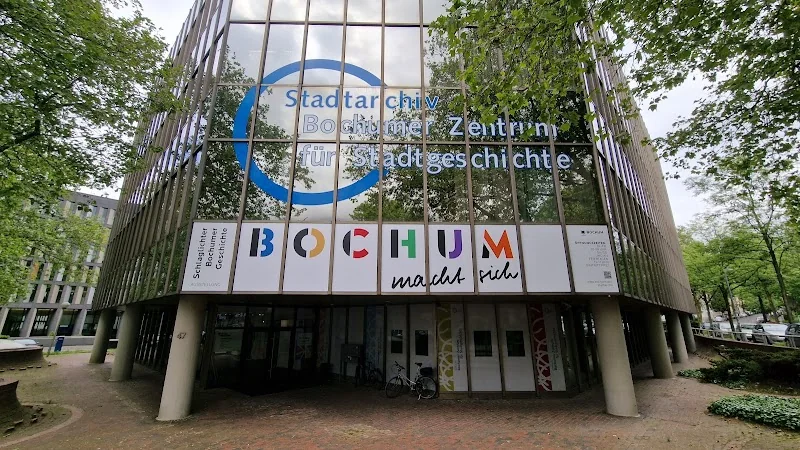
Wittener Str. 47, 44789 Bochum, Deutschland
City Archive Bochum | Collections & Photos
The City Archive - Bochum Center for Urban History is the memory of the city and at the same time a place where history is not only preserved but actively researched, discovered, and communicated. Those looking for photos, collections, or historical sources will find an unusually versatile approach to Bochum's past here: medieval documents, files, plans, newspapers, literature, objects of material culture, exhibitions, and an archive cinema are all part of it, as well as support in the reading room. The current search intention around photos, reviews, and collections fits very well with this institution, as it combines scientific research, local memory culture, and a direct visit on-site into a coherent overall picture. ([bochum.de](https://www.bochum.de/Stadtarchiv))
Photos, Collections, and Historical Sources in the City Archive Bochum
The collections of the City Archive Bochum are broad and cover the history of the city from very different perspectives. Particularly important are the historical archives of Bochum and Wattenscheid, the modern urban records from 1880, private estates and collections, as well as archival special collections. These include maps and plans, daily newspapers from the Bochum area, newspaper clipping collections, a contemporary historical collection, posters, theater materials, autographs, funeral cards, coins, medals, museum objects, and audiovisual archival material. This enumeration already shows that it is not a narrow special archive, but a very wide source area for urban, cultural, social, and everyday history. ([bochum.de](https://www.bochum.de/Stadtarchiv/Dienstleistungen-und-Infos/Archivbestaende-des-Stadtarchivs---Bochumer-Zentrum-fuer-Stadtgeschichte))
For the keyword photos, the photo collection with postcard collection and slide collection is particularly interesting. The city of Bochum also regularly refers to image collections and photographic collections in press releases, for example, when historical images from certain districts are shown or new photo collections are presented. The archive is therefore not only a place for written sources but also for visual memory. Those who want to understand Bochum through images will find material that makes urban development, work, housing, clubs, and leisure visible over decades. In addition, there is the archive library with over 76,000 volumes, which, according to the city of Bochum, offers an almost complete range of Bochum's urban history, thus significantly expanding the source base. ([bochum.de](https://www.bochum.de/Stadtarchiv/Dienstleistungen-und-Infos/Archivbestaende-des-Stadtarchivs---Bochumer-Zentrum-fuer-Stadtgeschichte))
Reviews, Ratings, and Visitor Expectations
Those looking for reviews or ratings usually want to assess in advance whether a visit is worthwhile and what experience awaits them. At the City Archive Bochum, the hard facts speak a clear language: the exhibitions are usually free, access is barrier-free, the reading room supports research, and historical sources are often available to interested parties even at the originals. For many visitors, this mix of public access, professional assistance, and authentic source material is crucial. The institution thus caters to very different groups: local history enthusiasts, family researchers, school classes, students, and people who want to visit an exhibition or a lecture. ([bochum.de](https://www.bochum.de/Stadtarchiv))
The search queries for reviews are also understandable because the City Archive is more than just a classic authority. It is also a city historical museum, a research site, and an event venue. This versatility often leads visitors to want to know in advance how to orient themselves, whether a reservation is necessary, and how extensive the offerings are. The official information from the city of Bochum helps here very concretely: guided tours, cinema events, and paid group tours can be booked, admission to the exhibitions is usually free, and even in the reading room, support is provided. So, those asking for a positive review in a practical sense will mainly find an institution that makes its history openly accessible and works with a clear service orientation. ([bochum.de](https://www.bochum.de/Kontakt-und-Anfahrt-Stadtarchiv))
Opening Hours, Reading Room, and Admission at the City Archive Bochum
The opening hours are particularly important for a visit to the archive and exhibition, and the City Archive Bochum communicates them clearly and user-friendly. The exhibitions are open from Tuesday to Friday from 10:00 AM to 6:00 PM. On Saturdays, Sundays, and public holidays, the exhibitions can be visited from 11:00 AM to 5:00 PM. This makes the institution easily accessible on weekends, which is by no means a given for an archive with an urban historical profile. Especially for people who work during the week or travel from outside, this arrangement is a significant advantage. ([bochum.de](https://www.bochum.de/Kontakt-und-Anfahrt-Stadtarchiv))
The reading room follows its own rhythm: Tuesday and Wednesday from 10:00 AM to 3:30 PM, Thursday from 10:00 AM to 6:00 PM, and Fridays for groups by prior arrangement. This shows that the archive is organized for both spontaneous exhibition visits and targeted research. Therefore, anyone wishing to view maps, photos, newspapers, documents, or other collections should plan their visit with some advance notice. Additionally, the city of Bochum charges fees for written research and various reproduction services, while the exhibitions themselves are usually freely accessible. This creates a balanced model of public cultural mediation and archival expertise. ([bochum.de](https://www.bochum.de/Kontakt-und-Anfahrt-Stadtarchiv))
Directions, Parking, and Barrier-Free Access
The City Archive is located at Wittener Straße 47 in Bochum and offers direct routes by bus and train, bicycle, and car on its contact page. The official site also refers to the geoportal and external route planners, which makes orientation easier. For visitors, it is especially important that the location is easily accessible not only for research appointments but also for exhibitions and events. Especially in a city like Bochum, where many cultural venues are located between the city center, university proximity, and residential areas, clear travel information is a real advantage. ([bochum.de](https://www.bochum.de/Kontakt-und-Anfahrt-Stadtarchiv))
Regarding parking, the archive cinema of the City Archive specifically mentions parking lot P4 on Akademiestraße, accessible via Wittener Straße. This is particularly helpful for evening appointments, film screenings, and events with fixed start times. Even more important is the barrier-free accessibility: the city of Bochum explicitly describes the City Archive as barrier-free, with an elevator and fully accessible event and exhibition areas for people with mobility impairments. Thus, the institution is not only historically but also organizationally prepared for a wide audience. Those coming with a wheelchair, walking aid, or stroller can plan their visit much more relaxed. ([bochum.de](https://www.bochum.de/Stadtarchiv/Dienstleistungen-und-Infos/Archivkino-des-Stadtarchivs))
Exhibitions, Archive Cinema, and Events at the Bochum Center for Urban History
The City Archive Bochum sees itself not only as a storage place but also as a lively cultural house. The city of Bochum describes the exhibitions as a city historical museum that vividly conveys Bochum's history. The current and past exhibitions have included topics such as monument protection, the history of the registry office, the women's archive ausZeiten, photography, and sports history. This thematic breadth shows that the institution is always seeking current approaches to urban history and brings together different media and perspectives. For visitors, this means: each visit can establish new connections and make another aspect of the city visible. ([bochum.de](https://www.bochum.de/Stadtarchiv))
Particularly notable is the archive cinema. It is a monthly film series in which partly historical films about the city's history are shown. Admission is free, but the number of seats is limited, so a reservation is required. The screenings begin at 7 PM. Here, too, one can see the typical mix of openness and structure: the archive invites discovery while organizing the process so that it remains well-planned for visitors. Those who want to experience Bochum's history not only through reading but also in moving images will find an ideal access point in the archive cinema. In addition, there are lecture series and other events that repeatedly address new topics from politics, industry, memory culture, and everyday history. ([bochum.de](https://www.bochum.de/Stadtarchiv/Dienstleistungen-und-Infos/Archivkino-des-Stadtarchivs))
Documents, Finding Aids, and Family Research
For many users, the City Archive Bochum is also an important address for family research and document inquiries. The city points out that documents from older registers should be directed to the City Archive, while younger civil status documents are initially kept at the registry office. In the archival area, finding aids for birth registers, marriage registers, and death registers are available. This is particularly valuable for genealogical research because it allows systematic searching by names, time periods, and collections. Therefore, anyone reconstructing a family history or wishing to view older Bochum registers will find a clearly structured access point here. ([bochum.de](https://www.bochum.de/standesamt/Dienstleistungen-und-Infos/Ausstellung-von-Urkunden))
Additionally, the archive not only preserves registers but also numerous supplementary sources. These include maps, plans, newspapers, private estates, club documents, and image sources. This variety is particularly important for family research because biographies often cannot be derived solely from documents but only come to life through photos, newspaper clippings, club documents, or local maps. The city of Bochum also emphasizes that the historical sources in the reading room can be used with support and competent assistance. This makes the archive a place where not only data is collected but stories are reconstructed step by step. ([bochum.de](https://www.bochum.de/Stadtarchiv))
Sources:
- City of Bochum - City Archive: Overview, Offer, and Historical Sources ([bochum.de](https://www.bochum.de/Stadtarchiv))
- City of Bochum - Contact, Opening Hours, and Directions ([bochum.de](https://www.bochum.de/Kontakt-und-Anfahrt-Stadtarchiv))
- City of Bochum - Research in the Archive, Reading Room, and Finding Aids ([bochum.de](https://www.bochum.de/Stadtarchiv/Dienstleistungen-und-Infos/Recherche-im-Archiv))
- City of Bochum - Archive Cinema and Parking Options ([bochum.de](https://www.bochum.de/Stadtarchiv/Dienstleistungen-und-Infos/Archivkino-des-Stadtarchivs))
- City of Bochum - Current Exhibitions and Event Examples ([bochum.de](https://www.bochum.de/Pressemeldungen/17-November-2025/Stadtarchiv-praesentiert-Ausstellung-zum-Frauenarchiv--ausZeiten-?utm_source=openai))
Show moreShow less
City Archive Bochum | Collections & Photos
The City Archive - Bochum Center for Urban History is the memory of the city and at the same time a place where history is not only preserved but actively researched, discovered, and communicated. Those looking for photos, collections, or historical sources will find an unusually versatile approach to Bochum's past here: medieval documents, files, plans, newspapers, literature, objects of material culture, exhibitions, and an archive cinema are all part of it, as well as support in the reading room. The current search intention around photos, reviews, and collections fits very well with this institution, as it combines scientific research, local memory culture, and a direct visit on-site into a coherent overall picture. ([bochum.de](https://www.bochum.de/Stadtarchiv))
Photos, Collections, and Historical Sources in the City Archive Bochum
The collections of the City Archive Bochum are broad and cover the history of the city from very different perspectives. Particularly important are the historical archives of Bochum and Wattenscheid, the modern urban records from 1880, private estates and collections, as well as archival special collections. These include maps and plans, daily newspapers from the Bochum area, newspaper clipping collections, a contemporary historical collection, posters, theater materials, autographs, funeral cards, coins, medals, museum objects, and audiovisual archival material. This enumeration already shows that it is not a narrow special archive, but a very wide source area for urban, cultural, social, and everyday history. ([bochum.de](https://www.bochum.de/Stadtarchiv/Dienstleistungen-und-Infos/Archivbestaende-des-Stadtarchivs---Bochumer-Zentrum-fuer-Stadtgeschichte))
For the keyword photos, the photo collection with postcard collection and slide collection is particularly interesting. The city of Bochum also regularly refers to image collections and photographic collections in press releases, for example, when historical images from certain districts are shown or new photo collections are presented. The archive is therefore not only a place for written sources but also for visual memory. Those who want to understand Bochum through images will find material that makes urban development, work, housing, clubs, and leisure visible over decades. In addition, there is the archive library with over 76,000 volumes, which, according to the city of Bochum, offers an almost complete range of Bochum's urban history, thus significantly expanding the source base. ([bochum.de](https://www.bochum.de/Stadtarchiv/Dienstleistungen-und-Infos/Archivbestaende-des-Stadtarchivs---Bochumer-Zentrum-fuer-Stadtgeschichte))
Reviews, Ratings, and Visitor Expectations
Those looking for reviews or ratings usually want to assess in advance whether a visit is worthwhile and what experience awaits them. At the City Archive Bochum, the hard facts speak a clear language: the exhibitions are usually free, access is barrier-free, the reading room supports research, and historical sources are often available to interested parties even at the originals. For many visitors, this mix of public access, professional assistance, and authentic source material is crucial. The institution thus caters to very different groups: local history enthusiasts, family researchers, school classes, students, and people who want to visit an exhibition or a lecture. ([bochum.de](https://www.bochum.de/Stadtarchiv))
The search queries for reviews are also understandable because the City Archive is more than just a classic authority. It is also a city historical museum, a research site, and an event venue. This versatility often leads visitors to want to know in advance how to orient themselves, whether a reservation is necessary, and how extensive the offerings are. The official information from the city of Bochum helps here very concretely: guided tours, cinema events, and paid group tours can be booked, admission to the exhibitions is usually free, and even in the reading room, support is provided. So, those asking for a positive review in a practical sense will mainly find an institution that makes its history openly accessible and works with a clear service orientation. ([bochum.de](https://www.bochum.de/Kontakt-und-Anfahrt-Stadtarchiv))
Opening Hours, Reading Room, and Admission at the City Archive Bochum
The opening hours are particularly important for a visit to the archive and exhibition, and the City Archive Bochum communicates them clearly and user-friendly. The exhibitions are open from Tuesday to Friday from 10:00 AM to 6:00 PM. On Saturdays, Sundays, and public holidays, the exhibitions can be visited from 11:00 AM to 5:00 PM. This makes the institution easily accessible on weekends, which is by no means a given for an archive with an urban historical profile. Especially for people who work during the week or travel from outside, this arrangement is a significant advantage. ([bochum.de](https://www.bochum.de/Kontakt-und-Anfahrt-Stadtarchiv))
The reading room follows its own rhythm: Tuesday and Wednesday from 10:00 AM to 3:30 PM, Thursday from 10:00 AM to 6:00 PM, and Fridays for groups by prior arrangement. This shows that the archive is organized for both spontaneous exhibition visits and targeted research. Therefore, anyone wishing to view maps, photos, newspapers, documents, or other collections should plan their visit with some advance notice. Additionally, the city of Bochum charges fees for written research and various reproduction services, while the exhibitions themselves are usually freely accessible. This creates a balanced model of public cultural mediation and archival expertise. ([bochum.de](https://www.bochum.de/Kontakt-und-Anfahrt-Stadtarchiv))
Directions, Parking, and Barrier-Free Access
The City Archive is located at Wittener Straße 47 in Bochum and offers direct routes by bus and train, bicycle, and car on its contact page. The official site also refers to the geoportal and external route planners, which makes orientation easier. For visitors, it is especially important that the location is easily accessible not only for research appointments but also for exhibitions and events. Especially in a city like Bochum, where many cultural venues are located between the city center, university proximity, and residential areas, clear travel information is a real advantage. ([bochum.de](https://www.bochum.de/Kontakt-und-Anfahrt-Stadtarchiv))
Regarding parking, the archive cinema of the City Archive specifically mentions parking lot P4 on Akademiestraße, accessible via Wittener Straße. This is particularly helpful for evening appointments, film screenings, and events with fixed start times. Even more important is the barrier-free accessibility: the city of Bochum explicitly describes the City Archive as barrier-free, with an elevator and fully accessible event and exhibition areas for people with mobility impairments. Thus, the institution is not only historically but also organizationally prepared for a wide audience. Those coming with a wheelchair, walking aid, or stroller can plan their visit much more relaxed. ([bochum.de](https://www.bochum.de/Stadtarchiv/Dienstleistungen-und-Infos/Archivkino-des-Stadtarchivs))
Exhibitions, Archive Cinema, and Events at the Bochum Center for Urban History
The City Archive Bochum sees itself not only as a storage place but also as a lively cultural house. The city of Bochum describes the exhibitions as a city historical museum that vividly conveys Bochum's history. The current and past exhibitions have included topics such as monument protection, the history of the registry office, the women's archive ausZeiten, photography, and sports history. This thematic breadth shows that the institution is always seeking current approaches to urban history and brings together different media and perspectives. For visitors, this means: each visit can establish new connections and make another aspect of the city visible. ([bochum.de](https://www.bochum.de/Stadtarchiv))
Particularly notable is the archive cinema. It is a monthly film series in which partly historical films about the city's history are shown. Admission is free, but the number of seats is limited, so a reservation is required. The screenings begin at 7 PM. Here, too, one can see the typical mix of openness and structure: the archive invites discovery while organizing the process so that it remains well-planned for visitors. Those who want to experience Bochum's history not only through reading but also in moving images will find an ideal access point in the archive cinema. In addition, there are lecture series and other events that repeatedly address new topics from politics, industry, memory culture, and everyday history. ([bochum.de](https://www.bochum.de/Stadtarchiv/Dienstleistungen-und-Infos/Archivkino-des-Stadtarchivs))
Documents, Finding Aids, and Family Research
For many users, the City Archive Bochum is also an important address for family research and document inquiries. The city points out that documents from older registers should be directed to the City Archive, while younger civil status documents are initially kept at the registry office. In the archival area, finding aids for birth registers, marriage registers, and death registers are available. This is particularly valuable for genealogical research because it allows systematic searching by names, time periods, and collections. Therefore, anyone reconstructing a family history or wishing to view older Bochum registers will find a clearly structured access point here. ([bochum.de](https://www.bochum.de/standesamt/Dienstleistungen-und-Infos/Ausstellung-von-Urkunden))
Additionally, the archive not only preserves registers but also numerous supplementary sources. These include maps, plans, newspapers, private estates, club documents, and image sources. This variety is particularly important for family research because biographies often cannot be derived solely from documents but only come to life through photos, newspaper clippings, club documents, or local maps. The city of Bochum also emphasizes that the historical sources in the reading room can be used with support and competent assistance. This makes the archive a place where not only data is collected but stories are reconstructed step by step. ([bochum.de](https://www.bochum.de/Stadtarchiv))
Sources:
- City of Bochum - City Archive: Overview, Offer, and Historical Sources ([bochum.de](https://www.bochum.de/Stadtarchiv))
- City of Bochum - Contact, Opening Hours, and Directions ([bochum.de](https://www.bochum.de/Kontakt-und-Anfahrt-Stadtarchiv))
- City of Bochum - Research in the Archive, Reading Room, and Finding Aids ([bochum.de](https://www.bochum.de/Stadtarchiv/Dienstleistungen-und-Infos/Recherche-im-Archiv))
- City of Bochum - Archive Cinema and Parking Options ([bochum.de](https://www.bochum.de/Stadtarchiv/Dienstleistungen-und-Infos/Archivkino-des-Stadtarchivs))
- City of Bochum - Current Exhibitions and Event Examples ([bochum.de](https://www.bochum.de/Pressemeldungen/17-November-2025/Stadtarchiv-praesentiert-Ausstellung-zum-Frauenarchiv--ausZeiten-?utm_source=openai))
City Archive Bochum | Collections & Photos
The City Archive - Bochum Center for Urban History is the memory of the city and at the same time a place where history is not only preserved but actively researched, discovered, and communicated. Those looking for photos, collections, or historical sources will find an unusually versatile approach to Bochum's past here: medieval documents, files, plans, newspapers, literature, objects of material culture, exhibitions, and an archive cinema are all part of it, as well as support in the reading room. The current search intention around photos, reviews, and collections fits very well with this institution, as it combines scientific research, local memory culture, and a direct visit on-site into a coherent overall picture. ([bochum.de](https://www.bochum.de/Stadtarchiv))
Photos, Collections, and Historical Sources in the City Archive Bochum
The collections of the City Archive Bochum are broad and cover the history of the city from very different perspectives. Particularly important are the historical archives of Bochum and Wattenscheid, the modern urban records from 1880, private estates and collections, as well as archival special collections. These include maps and plans, daily newspapers from the Bochum area, newspaper clipping collections, a contemporary historical collection, posters, theater materials, autographs, funeral cards, coins, medals, museum objects, and audiovisual archival material. This enumeration already shows that it is not a narrow special archive, but a very wide source area for urban, cultural, social, and everyday history. ([bochum.de](https://www.bochum.de/Stadtarchiv/Dienstleistungen-und-Infos/Archivbestaende-des-Stadtarchivs---Bochumer-Zentrum-fuer-Stadtgeschichte))
For the keyword photos, the photo collection with postcard collection and slide collection is particularly interesting. The city of Bochum also regularly refers to image collections and photographic collections in press releases, for example, when historical images from certain districts are shown or new photo collections are presented. The archive is therefore not only a place for written sources but also for visual memory. Those who want to understand Bochum through images will find material that makes urban development, work, housing, clubs, and leisure visible over decades. In addition, there is the archive library with over 76,000 volumes, which, according to the city of Bochum, offers an almost complete range of Bochum's urban history, thus significantly expanding the source base. ([bochum.de](https://www.bochum.de/Stadtarchiv/Dienstleistungen-und-Infos/Archivbestaende-des-Stadtarchivs---Bochumer-Zentrum-fuer-Stadtgeschichte))
Reviews, Ratings, and Visitor Expectations
Those looking for reviews or ratings usually want to assess in advance whether a visit is worthwhile and what experience awaits them. At the City Archive Bochum, the hard facts speak a clear language: the exhibitions are usually free, access is barrier-free, the reading room supports research, and historical sources are often available to interested parties even at the originals. For many visitors, this mix of public access, professional assistance, and authentic source material is crucial. The institution thus caters to very different groups: local history enthusiasts, family researchers, school classes, students, and people who want to visit an exhibition or a lecture. ([bochum.de](https://www.bochum.de/Stadtarchiv))
The search queries for reviews are also understandable because the City Archive is more than just a classic authority. It is also a city historical museum, a research site, and an event venue. This versatility often leads visitors to want to know in advance how to orient themselves, whether a reservation is necessary, and how extensive the offerings are. The official information from the city of Bochum helps here very concretely: guided tours, cinema events, and paid group tours can be booked, admission to the exhibitions is usually free, and even in the reading room, support is provided. So, those asking for a positive review in a practical sense will mainly find an institution that makes its history openly accessible and works with a clear service orientation. ([bochum.de](https://www.bochum.de/Kontakt-und-Anfahrt-Stadtarchiv))
Opening Hours, Reading Room, and Admission at the City Archive Bochum
The opening hours are particularly important for a visit to the archive and exhibition, and the City Archive Bochum communicates them clearly and user-friendly. The exhibitions are open from Tuesday to Friday from 10:00 AM to 6:00 PM. On Saturdays, Sundays, and public holidays, the exhibitions can be visited from 11:00 AM to 5:00 PM. This makes the institution easily accessible on weekends, which is by no means a given for an archive with an urban historical profile. Especially for people who work during the week or travel from outside, this arrangement is a significant advantage. ([bochum.de](https://www.bochum.de/Kontakt-und-Anfahrt-Stadtarchiv))
The reading room follows its own rhythm: Tuesday and Wednesday from 10:00 AM to 3:30 PM, Thursday from 10:00 AM to 6:00 PM, and Fridays for groups by prior arrangement. This shows that the archive is organized for both spontaneous exhibition visits and targeted research. Therefore, anyone wishing to view maps, photos, newspapers, documents, or other collections should plan their visit with some advance notice. Additionally, the city of Bochum charges fees for written research and various reproduction services, while the exhibitions themselves are usually freely accessible. This creates a balanced model of public cultural mediation and archival expertise. ([bochum.de](https://www.bochum.de/Kontakt-und-Anfahrt-Stadtarchiv))
Directions, Parking, and Barrier-Free Access
The City Archive is located at Wittener Straße 47 in Bochum and offers direct routes by bus and train, bicycle, and car on its contact page. The official site also refers to the geoportal and external route planners, which makes orientation easier. For visitors, it is especially important that the location is easily accessible not only for research appointments but also for exhibitions and events. Especially in a city like Bochum, where many cultural venues are located between the city center, university proximity, and residential areas, clear travel information is a real advantage. ([bochum.de](https://www.bochum.de/Kontakt-und-Anfahrt-Stadtarchiv))
Regarding parking, the archive cinema of the City Archive specifically mentions parking lot P4 on Akademiestraße, accessible via Wittener Straße. This is particularly helpful for evening appointments, film screenings, and events with fixed start times. Even more important is the barrier-free accessibility: the city of Bochum explicitly describes the City Archive as barrier-free, with an elevator and fully accessible event and exhibition areas for people with mobility impairments. Thus, the institution is not only historically but also organizationally prepared for a wide audience. Those coming with a wheelchair, walking aid, or stroller can plan their visit much more relaxed. ([bochum.de](https://www.bochum.de/Stadtarchiv/Dienstleistungen-und-Infos/Archivkino-des-Stadtarchivs))
Exhibitions, Archive Cinema, and Events at the Bochum Center for Urban History
The City Archive Bochum sees itself not only as a storage place but also as a lively cultural house. The city of Bochum describes the exhibitions as a city historical museum that vividly conveys Bochum's history. The current and past exhibitions have included topics such as monument protection, the history of the registry office, the women's archive ausZeiten, photography, and sports history. This thematic breadth shows that the institution is always seeking current approaches to urban history and brings together different media and perspectives. For visitors, this means: each visit can establish new connections and make another aspect of the city visible. ([bochum.de](https://www.bochum.de/Stadtarchiv))
Particularly notable is the archive cinema. It is a monthly film series in which partly historical films about the city's history are shown. Admission is free, but the number of seats is limited, so a reservation is required. The screenings begin at 7 PM. Here, too, one can see the typical mix of openness and structure: the archive invites discovery while organizing the process so that it remains well-planned for visitors. Those who want to experience Bochum's history not only through reading but also in moving images will find an ideal access point in the archive cinema. In addition, there are lecture series and other events that repeatedly address new topics from politics, industry, memory culture, and everyday history. ([bochum.de](https://www.bochum.de/Stadtarchiv/Dienstleistungen-und-Infos/Archivkino-des-Stadtarchivs))
Documents, Finding Aids, and Family Research
For many users, the City Archive Bochum is also an important address for family research and document inquiries. The city points out that documents from older registers should be directed to the City Archive, while younger civil status documents are initially kept at the registry office. In the archival area, finding aids for birth registers, marriage registers, and death registers are available. This is particularly valuable for genealogical research because it allows systematic searching by names, time periods, and collections. Therefore, anyone reconstructing a family history or wishing to view older Bochum registers will find a clearly structured access point here. ([bochum.de](https://www.bochum.de/standesamt/Dienstleistungen-und-Infos/Ausstellung-von-Urkunden))
Additionally, the archive not only preserves registers but also numerous supplementary sources. These include maps, plans, newspapers, private estates, club documents, and image sources. This variety is particularly important for family research because biographies often cannot be derived solely from documents but only come to life through photos, newspaper clippings, club documents, or local maps. The city of Bochum also emphasizes that the historical sources in the reading room can be used with support and competent assistance. This makes the archive a place where not only data is collected but stories are reconstructed step by step. ([bochum.de](https://www.bochum.de/Stadtarchiv))
Sources:
- City of Bochum - City Archive: Overview, Offer, and Historical Sources ([bochum.de](https://www.bochum.de/Stadtarchiv))
- City of Bochum - Contact, Opening Hours, and Directions ([bochum.de](https://www.bochum.de/Kontakt-und-Anfahrt-Stadtarchiv))
- City of Bochum - Research in the Archive, Reading Room, and Finding Aids ([bochum.de](https://www.bochum.de/Stadtarchiv/Dienstleistungen-und-Infos/Recherche-im-Archiv))
- City of Bochum - Archive Cinema and Parking Options ([bochum.de](https://www.bochum.de/Stadtarchiv/Dienstleistungen-und-Infos/Archivkino-des-Stadtarchivs))
- City of Bochum - Current Exhibitions and Event Examples ([bochum.de](https://www.bochum.de/Pressemeldungen/17-November-2025/Stadtarchiv-praesentiert-Ausstellung-zum-Frauenarchiv--ausZeiten-?utm_source=openai))
Upcoming Events
Light and Shadow: Photographs of the Bochum Association
Industrial history as an artistic experience: In Bochum, photographs of the Bochum Association open up views on work, technology, and memory. Starting from 28.05.2026, free admission. #Bochum #IndustrialCulture
Lecture: Move of Superlatives - the University Archive Bochum in Motion
A Bochum evening for all who love city history and knowledge: The lecture shows the spectacular move of the University Archive. #Bochum #Archive
Archive Cinema: 1. City and City Park 2. Recreational Green in Bochum

Lecture: Sterilization and Euthanasia of Mentally Ill Citizens of Bochum
A moving lecture at the Bochum City Archive: Prof. Dr. Georg Juckel sheds light on NS medical history and local victim research. 21.10.2026, 19:00, free admission. #Bochum #MemoryCulture
Frequently Asked Questions
Reviews
Thisanut Kaewnukul
29. March 2022
Very interesting exhibition. No entrance fee.
Oli Klapschus
15. July 2025
The exhibition is nice, nothing more and nothing less. However, one must consider that it’s just a hobby and a lot of love is put into it. For free, it’s good.
Martina Weichhaus
25. January 2026
The city archive is always worth a visit. Mr. Rawe explained to us visitors today the elaborate and diverse work of archiving. Very impressive and varied. As a former resident of Wattenscheid, now a newcomer in Bochum-Mitte, I had to take this tour of the archive today. I definitely won't be here for the last time. THANK YOU.
Udo Vette
3. March 2026
Here you can buy films on Bochum topics (Bochum Annual Review). The staff is very friendly and provides good advice. Elsewhere, you have no success, but here.
Stefan Sieverdingbeck
28. May 2024
We recently visited the city archive in Bochum and enjoyed both exhibitions. One is dedicated to the history of Bochum, the other to VfL Bochum. Both were very interesting, especially for Bochumers and those interested in the city. Admission is free, which makes the visit even more attractive. Overall, it was a worthwhile experience that we would gladly recommend.