
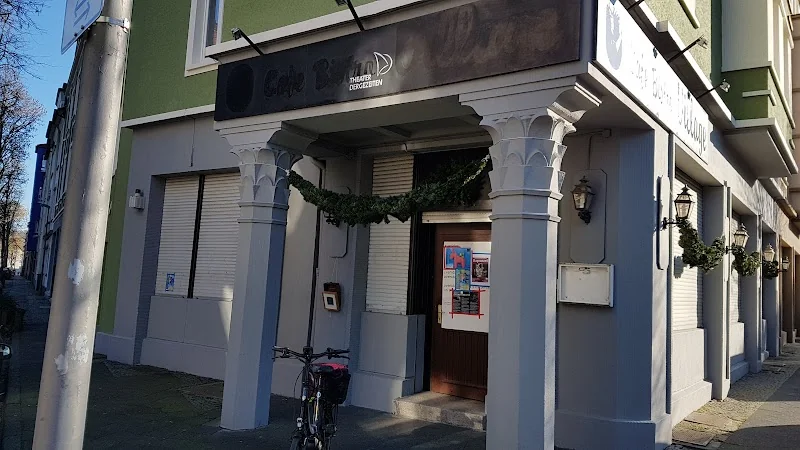
Schmechtingstraße 40, Bochum
Schmechtingstraße 40, 44809 Bochum, Germany
Theater der Gezeiten | Program & Tickets in Bochum
The Theater der Gezeiten is a rare stroke of luck for culture lovers who cherish direct encounters with art. In a former retail space at Schmechtingstraße 38–40 in Bochum-Hamme, Bochum's smallest stage unfolds its impact on narrowly defined, yet vibrantly used square meters. About 30 seats bring the audience and artists together, allowing voices, glances, pauses, and subtle nuances to become palpable without technical barriers. This special setting also shapes the program: alongside puppet theater and readings, intimate music evenings, neighborhood formats, and interdisciplinary projects take place, weaving together language, body, music, and image. The house sees itself as a place of encounter, where after the performance, thoughts can continue at the bar, laughter can be shared, and conversations can be had. At the same time, it is an active hub in the Hamme district and in the so-called Speckschweiz, where volunteer engagement, artistic initiative, and lived neighborhood culture intertwine.
Program and Events at Theater der Gezeiten
If you want to experience the atmosphere of the Theater der Gezeiten, it's best to start by looking at the current program. There you will regularly find formats that have given the place its distinctive profile for years: puppet theater for young and adult audiences, literary readings, music evenings ranging from singer-songwriter, chanson, and poetic song art, as well as special series like Flimmern und Lauschen, where Bochum films and readings come together. The curated mix of professional guests and dedicated newcomers invites you to discover new voices and closely accompany artistic processes. Open rehearsals or workshop formats also repeatedly offer a glimpse behind the scenes. In this dense, intimate environment, guests do not experience an anonymous show, but evenings that are personally colored and immediate. Recurring neighborhood actions – such as the Brotzeit, where bread from the organic bakery Hutzel is given away on the last Sunday of the month – connect culture with lived solidarity. The program is not seen as a rigid seasonal plan, but as a lively flow that responds to the energy of those involved: an author bids farewell to the city in a literary manner, a local band tries out new things in a small setting, a collective tests text, sound, and movement in experimental settings. Children's and family offerings are, of course, also included – from workshops during the holidays to Sunday performances that showcase puppet theater in all its artisanal beauty. The theater uses the close exchange with the audience as a creative motor: feedback flows into the planning, and collaborations with studios and initiatives from the neighborhood bring additional perspectives to the stage. Those seeking inspiration will not be confronted with overwhelm, but with carefully set, approachable moments.
Tickets and Admission: How the Hat Donation Works
The Theater der Gezeiten consciously lowers the barriers for a spontaneous theater visit. Instead of fixed ticket prices, the house often relies on the classic hat donation. At the end of the evening, the hat is passed around, and the audience gives what is possible and what the evening was worth. This model has several advantages: it facilitates cultural participation regardless of financial means, strengthens the solidarity attitude in the neighborhood, and typically leads to very conscious, appreciative contributions. For selected events, advance registrations or reservations are advisable, especially for readings and concerts with limited capacity. Information about this is indicated in the respective program point. The intimate size of the theater generally makes early arrival advisable. Those who come first often sit closer to the stage and can follow the artisanal precision of puppet play, live music, or readings particularly well. After the performance, the bar offers space for conversations with the participants. This closeness replaces anonymous applause with genuine feedback and questions. For culture enthusiasts who enjoy gifting events, the hat donation is also attractive: instead of a fixed price, a shared evening can be planned, where the support directly and visibly reaches the participants. For groups from education, culture, or the neighborhood, low-threshold formats are the focus, which can be variably set in content. If free seating is provided on an evening, it is worth checking the program description. There, it is transparently communicated whether there is a registration requirement or if a donation note is given. The payment principle of the hat is a lived attitude of the house and an expression of trust in its audience – a trust advance that has been sustainable for years and promotes artistic diversity.
Directions and Parking at Schmechtingstraße 38–40 in Bochum-Hamme
The location in Bochum-Hamme makes the visit easy and urban at the same time. The Theater der Gezeiten is located at Schmechtingstraße 38–40, in the midst of the Speckschweiz, a developed old building district between the Schmechting meadows and the train station area. Those arriving by public transport can choose the surrounding stops in the neighborhood, for example, Hamme Kirche, and walk the last minutes through the neighborhood. From other districts, the city train and bus lines provide connections towards Grumme, the city center, and Riemke; the short walking distance from the Schmechting meadows is attractive for many guests. For those arriving by bicycle, the topographically relatively flat location in Hamme is suitable. Bicycle parking spaces are available in the vicinity, and cycling is comfortable on many paths through the neighborhood. For visitors arriving by car, it is important to note that there is no in-house underground garage or exclusive parking space. Parking is done on public spaces along the street in Schmechtingstraße and the adjacent streets, mostly at the roadside. Parking in the neighborhood depends on the time of day and event day, and capacity is naturally limited. Therefore, it is advisable to plan some time for finding a parking spot or to rely on a combination of public transport and a short walk. Those who depend on accessibility can let companions drop them off directly at the entrance and then look for a parking spot in the vicinity. Due to the residential location, it is advisable to park considerately and avoid noise disturbances when picking up. For navigation devices, entering the address Schmechtingstraße 40, 44809 Bochum is sufficient. Hamme can be reached in a few minutes from the A40 or A43 highways. Once in the neighborhood, Schmechtingstraße leads through a quiet neighborhood. The slender retail space with the characteristic foyer is centrally located in the street. Guests appreciate the short path from the street directly into the theater room. Especially in winter, the short distances and the proximity to gastronomy and studios in the vicinity are a pleasant plus.
Seating Plan, Seats, and Acoustics: How to Sit Best
The Theater der Gezeiten thrives on its compactness. The hall accommodates about 30 chairs, which are oriented towards the stage in a single room. A complex, numbered seating plan is therefore not necessary. Instead, a clear arrangement with few rows is created. This has practical advantages: even seats further back guarantee good visibility and direct engagement, while the front rows allow for a particularly intense experience. Those who want to see the fine details of the puppet play benefit from short distances and a seat oriented as frontally as possible. For music and reading evenings, the acoustics are usually natural and unamplified, which is due to the proximity. This makes voices sound warm and direct, and instruments unfold without significant amplification. Those sensitive to volume often find the middle rows to be the most pleasant compromise between presence and distance. In participatory formats, open rehearsals, or discussion rounds, a seat that offers a good view of the podium or performance area is often worthwhile, often diagonally to the central axis. Due to the limited capacity, it is advisable to arrive early to secure preferred seats, especially for popular readings, guest performances, or concerts. For families with children, the second row is often ideal, as it offers proximity without immediate stage closeness, providing comfort for young visitors. Depending on the project, the room layout may vary, such as in workshop formats that provide different seating circles or a free performance area. Such information is transparently communicated in the program announcement. Overall, it holds true: the quality of the experience here depends less on the seating plan than on the openness to encounter. The intimate acoustics and the short distance to the performance area make almost every seat a good seat, which is why many regular guests consciously vary – sometimes sitting in front for maximum intensity, sometimes in the middle for an overall view.
History, Management, and Special Features: Bochum's Smallest Stage
The Theater der Gezeiten was founded in the mid-1990s and has since taken an independent path. The stage is housed in a former Bochum pub or an old retail space, which continues to shape the charm of the house today. Historically, the profile developed from a combination of language, body, music, video art, and dance. The artistic direction is currently held by Giampiero Piria, whose signature makes the program low-threshold and yet ambitious in the best sense. The theater early on focused on guest performances that radiate beyond the city limits. Appearances at festivals at home and abroad – including in Avignon, Edinburgh, and Viterbo – show that the small space can achieve great artistic feats. Known as Bochum's smallest stage, the house is recognized in the city, a designation that not only refers to the number of seats but also to the culture of togetherness that is lived here. In the foyer, TINYrooms features a curated gem with 48 miniature artworks in the drawers of an antique haberdashery cabinet. Each compartment has been designed by an artist from Bochum, creating a concentrated cross-section of the local art scene. This exhibition anchors the theater even deeper in the cultural fabric of the city. In addition to artistic activities, engagement in the Hamme neighborhood plays a significant role. An active neighborhood circle meets regularly in the house, plans street festival events in cooperation with traffic and urban societal initiatives, discusses urban development topics, and brings people from different generations together. This rooting is evident in formats like the Brotzeit, which monthly sets a sign for community and participation. Together, this creates a theater image that understands closeness as an artistic method. Without a large house, but with a strong idea, it has been shown here for years how culture, everyday life, and neighborhood can enrich each other.
Facilities, Foyer, and KPR 38: Spaces for Closeness and Exchange
The spatial structure of the Theater der Gezeiten is concentrated and functional. The stage area measures about 70 square meters, and the seating is flexible and oriented towards the format of the evening. The foyer retains the character of the former shop and serves as a meeting point before and after events. Here stands the large bar, where conversations continue, new ideas emerge, and guests and artists naturally mingle. As an extension of the house, KPR 38 is an additional room available, serving as a rehearsal, workshop, and development space. Productions can grow there before they meet the audience in the theater hall. The technical equipment is deliberately reduced and tailored to the requirements of small formats. Lighting moods and sound are set to support closeness rather than create distance. For this reason, many artists appreciate working on this stage: between performance and resonance, there are only a few steps. Those visiting for the first time usually find a simple, clearly understandable wayfinding system. Cloakrooms, box office or donation hat, and access to the hall are located close together. The short transition makes the theater evening streamlined without sacrificing atmosphere. In the vicinity of the house, studios and other cultural venues are present, which favors cooperative projects. The audience thus experiences not only individual evenings but can also go on cultural walks in the neighborhood, for example, to exhibitions or small concerts nearby. This networking is also programmatically important: the theater sees itself as a place of communal shaping, where sustainable ideas from the neighborhood are translated into artistic formats. Practically, this means short paths in organization, direct communication channels, and flexible rehearsal opportunities. In sum, an infrastructure of closeness emerges that makes the character of the house visible and shapes its artistic signature.
Sources:
- Theater der Gezeiten – Official Website
- About Us – Theater der Gezeiten
- TINYrooms – Theater der Gezeiten
- Bochum Tourism – Theater der Gezeiten
- Bochum Marketing – Theater der Gezeiten
- Cultural Report City of Bochum – Theater der Gezeiten, Capacity and Profile
- Local Mobility Concept Bochum-Hamme – Parking and Street Space Schmechtingstraße
- Lokalkompass – Cultural Evenings at Theater der Gezeiten
- ruhrpottKIDS – Theater der Gezeiten
- VRR Timetable – Stop Hamme Kirche (Surrounding Schmechtingstraße)
Show moreShow less
Theater der Gezeiten | Program & Tickets in Bochum
The Theater der Gezeiten is a rare stroke of luck for culture lovers who cherish direct encounters with art. In a former retail space at Schmechtingstraße 38–40 in Bochum-Hamme, Bochum's smallest stage unfolds its impact on narrowly defined, yet vibrantly used square meters. About 30 seats bring the audience and artists together, allowing voices, glances, pauses, and subtle nuances to become palpable without technical barriers. This special setting also shapes the program: alongside puppet theater and readings, intimate music evenings, neighborhood formats, and interdisciplinary projects take place, weaving together language, body, music, and image. The house sees itself as a place of encounter, where after the performance, thoughts can continue at the bar, laughter can be shared, and conversations can be had. At the same time, it is an active hub in the Hamme district and in the so-called Speckschweiz, where volunteer engagement, artistic initiative, and lived neighborhood culture intertwine.
Program and Events at Theater der Gezeiten
If you want to experience the atmosphere of the Theater der Gezeiten, it's best to start by looking at the current program. There you will regularly find formats that have given the place its distinctive profile for years: puppet theater for young and adult audiences, literary readings, music evenings ranging from singer-songwriter, chanson, and poetic song art, as well as special series like Flimmern und Lauschen, where Bochum films and readings come together. The curated mix of professional guests and dedicated newcomers invites you to discover new voices and closely accompany artistic processes. Open rehearsals or workshop formats also repeatedly offer a glimpse behind the scenes. In this dense, intimate environment, guests do not experience an anonymous show, but evenings that are personally colored and immediate. Recurring neighborhood actions – such as the Brotzeit, where bread from the organic bakery Hutzel is given away on the last Sunday of the month – connect culture with lived solidarity. The program is not seen as a rigid seasonal plan, but as a lively flow that responds to the energy of those involved: an author bids farewell to the city in a literary manner, a local band tries out new things in a small setting, a collective tests text, sound, and movement in experimental settings. Children's and family offerings are, of course, also included – from workshops during the holidays to Sunday performances that showcase puppet theater in all its artisanal beauty. The theater uses the close exchange with the audience as a creative motor: feedback flows into the planning, and collaborations with studios and initiatives from the neighborhood bring additional perspectives to the stage. Those seeking inspiration will not be confronted with overwhelm, but with carefully set, approachable moments.
Tickets and Admission: How the Hat Donation Works
The Theater der Gezeiten consciously lowers the barriers for a spontaneous theater visit. Instead of fixed ticket prices, the house often relies on the classic hat donation. At the end of the evening, the hat is passed around, and the audience gives what is possible and what the evening was worth. This model has several advantages: it facilitates cultural participation regardless of financial means, strengthens the solidarity attitude in the neighborhood, and typically leads to very conscious, appreciative contributions. For selected events, advance registrations or reservations are advisable, especially for readings and concerts with limited capacity. Information about this is indicated in the respective program point. The intimate size of the theater generally makes early arrival advisable. Those who come first often sit closer to the stage and can follow the artisanal precision of puppet play, live music, or readings particularly well. After the performance, the bar offers space for conversations with the participants. This closeness replaces anonymous applause with genuine feedback and questions. For culture enthusiasts who enjoy gifting events, the hat donation is also attractive: instead of a fixed price, a shared evening can be planned, where the support directly and visibly reaches the participants. For groups from education, culture, or the neighborhood, low-threshold formats are the focus, which can be variably set in content. If free seating is provided on an evening, it is worth checking the program description. There, it is transparently communicated whether there is a registration requirement or if a donation note is given. The payment principle of the hat is a lived attitude of the house and an expression of trust in its audience – a trust advance that has been sustainable for years and promotes artistic diversity.
Directions and Parking at Schmechtingstraße 38–40 in Bochum-Hamme
The location in Bochum-Hamme makes the visit easy and urban at the same time. The Theater der Gezeiten is located at Schmechtingstraße 38–40, in the midst of the Speckschweiz, a developed old building district between the Schmechting meadows and the train station area. Those arriving by public transport can choose the surrounding stops in the neighborhood, for example, Hamme Kirche, and walk the last minutes through the neighborhood. From other districts, the city train and bus lines provide connections towards Grumme, the city center, and Riemke; the short walking distance from the Schmechting meadows is attractive for many guests. For those arriving by bicycle, the topographically relatively flat location in Hamme is suitable. Bicycle parking spaces are available in the vicinity, and cycling is comfortable on many paths through the neighborhood. For visitors arriving by car, it is important to note that there is no in-house underground garage or exclusive parking space. Parking is done on public spaces along the street in Schmechtingstraße and the adjacent streets, mostly at the roadside. Parking in the neighborhood depends on the time of day and event day, and capacity is naturally limited. Therefore, it is advisable to plan some time for finding a parking spot or to rely on a combination of public transport and a short walk. Those who depend on accessibility can let companions drop them off directly at the entrance and then look for a parking spot in the vicinity. Due to the residential location, it is advisable to park considerately and avoid noise disturbances when picking up. For navigation devices, entering the address Schmechtingstraße 40, 44809 Bochum is sufficient. Hamme can be reached in a few minutes from the A40 or A43 highways. Once in the neighborhood, Schmechtingstraße leads through a quiet neighborhood. The slender retail space with the characteristic foyer is centrally located in the street. Guests appreciate the short path from the street directly into the theater room. Especially in winter, the short distances and the proximity to gastronomy and studios in the vicinity are a pleasant plus.
Seating Plan, Seats, and Acoustics: How to Sit Best
The Theater der Gezeiten thrives on its compactness. The hall accommodates about 30 chairs, which are oriented towards the stage in a single room. A complex, numbered seating plan is therefore not necessary. Instead, a clear arrangement with few rows is created. This has practical advantages: even seats further back guarantee good visibility and direct engagement, while the front rows allow for a particularly intense experience. Those who want to see the fine details of the puppet play benefit from short distances and a seat oriented as frontally as possible. For music and reading evenings, the acoustics are usually natural and unamplified, which is due to the proximity. This makes voices sound warm and direct, and instruments unfold without significant amplification. Those sensitive to volume often find the middle rows to be the most pleasant compromise between presence and distance. In participatory formats, open rehearsals, or discussion rounds, a seat that offers a good view of the podium or performance area is often worthwhile, often diagonally to the central axis. Due to the limited capacity, it is advisable to arrive early to secure preferred seats, especially for popular readings, guest performances, or concerts. For families with children, the second row is often ideal, as it offers proximity without immediate stage closeness, providing comfort for young visitors. Depending on the project, the room layout may vary, such as in workshop formats that provide different seating circles or a free performance area. Such information is transparently communicated in the program announcement. Overall, it holds true: the quality of the experience here depends less on the seating plan than on the openness to encounter. The intimate acoustics and the short distance to the performance area make almost every seat a good seat, which is why many regular guests consciously vary – sometimes sitting in front for maximum intensity, sometimes in the middle for an overall view.
History, Management, and Special Features: Bochum's Smallest Stage
The Theater der Gezeiten was founded in the mid-1990s and has since taken an independent path. The stage is housed in a former Bochum pub or an old retail space, which continues to shape the charm of the house today. Historically, the profile developed from a combination of language, body, music, video art, and dance. The artistic direction is currently held by Giampiero Piria, whose signature makes the program low-threshold and yet ambitious in the best sense. The theater early on focused on guest performances that radiate beyond the city limits. Appearances at festivals at home and abroad – including in Avignon, Edinburgh, and Viterbo – show that the small space can achieve great artistic feats. Known as Bochum's smallest stage, the house is recognized in the city, a designation that not only refers to the number of seats but also to the culture of togetherness that is lived here. In the foyer, TINYrooms features a curated gem with 48 miniature artworks in the drawers of an antique haberdashery cabinet. Each compartment has been designed by an artist from Bochum, creating a concentrated cross-section of the local art scene. This exhibition anchors the theater even deeper in the cultural fabric of the city. In addition to artistic activities, engagement in the Hamme neighborhood plays a significant role. An active neighborhood circle meets regularly in the house, plans street festival events in cooperation with traffic and urban societal initiatives, discusses urban development topics, and brings people from different generations together. This rooting is evident in formats like the Brotzeit, which monthly sets a sign for community and participation. Together, this creates a theater image that understands closeness as an artistic method. Without a large house, but with a strong idea, it has been shown here for years how culture, everyday life, and neighborhood can enrich each other.
Facilities, Foyer, and KPR 38: Spaces for Closeness and Exchange
The spatial structure of the Theater der Gezeiten is concentrated and functional. The stage area measures about 70 square meters, and the seating is flexible and oriented towards the format of the evening. The foyer retains the character of the former shop and serves as a meeting point before and after events. Here stands the large bar, where conversations continue, new ideas emerge, and guests and artists naturally mingle. As an extension of the house, KPR 38 is an additional room available, serving as a rehearsal, workshop, and development space. Productions can grow there before they meet the audience in the theater hall. The technical equipment is deliberately reduced and tailored to the requirements of small formats. Lighting moods and sound are set to support closeness rather than create distance. For this reason, many artists appreciate working on this stage: between performance and resonance, there are only a few steps. Those visiting for the first time usually find a simple, clearly understandable wayfinding system. Cloakrooms, box office or donation hat, and access to the hall are located close together. The short transition makes the theater evening streamlined without sacrificing atmosphere. In the vicinity of the house, studios and other cultural venues are present, which favors cooperative projects. The audience thus experiences not only individual evenings but can also go on cultural walks in the neighborhood, for example, to exhibitions or small concerts nearby. This networking is also programmatically important: the theater sees itself as a place of communal shaping, where sustainable ideas from the neighborhood are translated into artistic formats. Practically, this means short paths in organization, direct communication channels, and flexible rehearsal opportunities. In sum, an infrastructure of closeness emerges that makes the character of the house visible and shapes its artistic signature.
Sources:
- Theater der Gezeiten – Official Website
- About Us – Theater der Gezeiten
- TINYrooms – Theater der Gezeiten
- Bochum Tourism – Theater der Gezeiten
- Bochum Marketing – Theater der Gezeiten
- Cultural Report City of Bochum – Theater der Gezeiten, Capacity and Profile
- Local Mobility Concept Bochum-Hamme – Parking and Street Space Schmechtingstraße
- Lokalkompass – Cultural Evenings at Theater der Gezeiten
- ruhrpottKIDS – Theater der Gezeiten
- VRR Timetable – Stop Hamme Kirche (Surrounding Schmechtingstraße)
Theater der Gezeiten | Program & Tickets in Bochum
The Theater der Gezeiten is a rare stroke of luck for culture lovers who cherish direct encounters with art. In a former retail space at Schmechtingstraße 38–40 in Bochum-Hamme, Bochum's smallest stage unfolds its impact on narrowly defined, yet vibrantly used square meters. About 30 seats bring the audience and artists together, allowing voices, glances, pauses, and subtle nuances to become palpable without technical barriers. This special setting also shapes the program: alongside puppet theater and readings, intimate music evenings, neighborhood formats, and interdisciplinary projects take place, weaving together language, body, music, and image. The house sees itself as a place of encounter, where after the performance, thoughts can continue at the bar, laughter can be shared, and conversations can be had. At the same time, it is an active hub in the Hamme district and in the so-called Speckschweiz, where volunteer engagement, artistic initiative, and lived neighborhood culture intertwine.
Program and Events at Theater der Gezeiten
If you want to experience the atmosphere of the Theater der Gezeiten, it's best to start by looking at the current program. There you will regularly find formats that have given the place its distinctive profile for years: puppet theater for young and adult audiences, literary readings, music evenings ranging from singer-songwriter, chanson, and poetic song art, as well as special series like Flimmern und Lauschen, where Bochum films and readings come together. The curated mix of professional guests and dedicated newcomers invites you to discover new voices and closely accompany artistic processes. Open rehearsals or workshop formats also repeatedly offer a glimpse behind the scenes. In this dense, intimate environment, guests do not experience an anonymous show, but evenings that are personally colored and immediate. Recurring neighborhood actions – such as the Brotzeit, where bread from the organic bakery Hutzel is given away on the last Sunday of the month – connect culture with lived solidarity. The program is not seen as a rigid seasonal plan, but as a lively flow that responds to the energy of those involved: an author bids farewell to the city in a literary manner, a local band tries out new things in a small setting, a collective tests text, sound, and movement in experimental settings. Children's and family offerings are, of course, also included – from workshops during the holidays to Sunday performances that showcase puppet theater in all its artisanal beauty. The theater uses the close exchange with the audience as a creative motor: feedback flows into the planning, and collaborations with studios and initiatives from the neighborhood bring additional perspectives to the stage. Those seeking inspiration will not be confronted with overwhelm, but with carefully set, approachable moments.
Tickets and Admission: How the Hat Donation Works
The Theater der Gezeiten consciously lowers the barriers for a spontaneous theater visit. Instead of fixed ticket prices, the house often relies on the classic hat donation. At the end of the evening, the hat is passed around, and the audience gives what is possible and what the evening was worth. This model has several advantages: it facilitates cultural participation regardless of financial means, strengthens the solidarity attitude in the neighborhood, and typically leads to very conscious, appreciative contributions. For selected events, advance registrations or reservations are advisable, especially for readings and concerts with limited capacity. Information about this is indicated in the respective program point. The intimate size of the theater generally makes early arrival advisable. Those who come first often sit closer to the stage and can follow the artisanal precision of puppet play, live music, or readings particularly well. After the performance, the bar offers space for conversations with the participants. This closeness replaces anonymous applause with genuine feedback and questions. For culture enthusiasts who enjoy gifting events, the hat donation is also attractive: instead of a fixed price, a shared evening can be planned, where the support directly and visibly reaches the participants. For groups from education, culture, or the neighborhood, low-threshold formats are the focus, which can be variably set in content. If free seating is provided on an evening, it is worth checking the program description. There, it is transparently communicated whether there is a registration requirement or if a donation note is given. The payment principle of the hat is a lived attitude of the house and an expression of trust in its audience – a trust advance that has been sustainable for years and promotes artistic diversity.
Directions and Parking at Schmechtingstraße 38–40 in Bochum-Hamme
The location in Bochum-Hamme makes the visit easy and urban at the same time. The Theater der Gezeiten is located at Schmechtingstraße 38–40, in the midst of the Speckschweiz, a developed old building district between the Schmechting meadows and the train station area. Those arriving by public transport can choose the surrounding stops in the neighborhood, for example, Hamme Kirche, and walk the last minutes through the neighborhood. From other districts, the city train and bus lines provide connections towards Grumme, the city center, and Riemke; the short walking distance from the Schmechting meadows is attractive for many guests. For those arriving by bicycle, the topographically relatively flat location in Hamme is suitable. Bicycle parking spaces are available in the vicinity, and cycling is comfortable on many paths through the neighborhood. For visitors arriving by car, it is important to note that there is no in-house underground garage or exclusive parking space. Parking is done on public spaces along the street in Schmechtingstraße and the adjacent streets, mostly at the roadside. Parking in the neighborhood depends on the time of day and event day, and capacity is naturally limited. Therefore, it is advisable to plan some time for finding a parking spot or to rely on a combination of public transport and a short walk. Those who depend on accessibility can let companions drop them off directly at the entrance and then look for a parking spot in the vicinity. Due to the residential location, it is advisable to park considerately and avoid noise disturbances when picking up. For navigation devices, entering the address Schmechtingstraße 40, 44809 Bochum is sufficient. Hamme can be reached in a few minutes from the A40 or A43 highways. Once in the neighborhood, Schmechtingstraße leads through a quiet neighborhood. The slender retail space with the characteristic foyer is centrally located in the street. Guests appreciate the short path from the street directly into the theater room. Especially in winter, the short distances and the proximity to gastronomy and studios in the vicinity are a pleasant plus.
Seating Plan, Seats, and Acoustics: How to Sit Best
The Theater der Gezeiten thrives on its compactness. The hall accommodates about 30 chairs, which are oriented towards the stage in a single room. A complex, numbered seating plan is therefore not necessary. Instead, a clear arrangement with few rows is created. This has practical advantages: even seats further back guarantee good visibility and direct engagement, while the front rows allow for a particularly intense experience. Those who want to see the fine details of the puppet play benefit from short distances and a seat oriented as frontally as possible. For music and reading evenings, the acoustics are usually natural and unamplified, which is due to the proximity. This makes voices sound warm and direct, and instruments unfold without significant amplification. Those sensitive to volume often find the middle rows to be the most pleasant compromise between presence and distance. In participatory formats, open rehearsals, or discussion rounds, a seat that offers a good view of the podium or performance area is often worthwhile, often diagonally to the central axis. Due to the limited capacity, it is advisable to arrive early to secure preferred seats, especially for popular readings, guest performances, or concerts. For families with children, the second row is often ideal, as it offers proximity without immediate stage closeness, providing comfort for young visitors. Depending on the project, the room layout may vary, such as in workshop formats that provide different seating circles or a free performance area. Such information is transparently communicated in the program announcement. Overall, it holds true: the quality of the experience here depends less on the seating plan than on the openness to encounter. The intimate acoustics and the short distance to the performance area make almost every seat a good seat, which is why many regular guests consciously vary – sometimes sitting in front for maximum intensity, sometimes in the middle for an overall view.
History, Management, and Special Features: Bochum's Smallest Stage
The Theater der Gezeiten was founded in the mid-1990s and has since taken an independent path. The stage is housed in a former Bochum pub or an old retail space, which continues to shape the charm of the house today. Historically, the profile developed from a combination of language, body, music, video art, and dance. The artistic direction is currently held by Giampiero Piria, whose signature makes the program low-threshold and yet ambitious in the best sense. The theater early on focused on guest performances that radiate beyond the city limits. Appearances at festivals at home and abroad – including in Avignon, Edinburgh, and Viterbo – show that the small space can achieve great artistic feats. Known as Bochum's smallest stage, the house is recognized in the city, a designation that not only refers to the number of seats but also to the culture of togetherness that is lived here. In the foyer, TINYrooms features a curated gem with 48 miniature artworks in the drawers of an antique haberdashery cabinet. Each compartment has been designed by an artist from Bochum, creating a concentrated cross-section of the local art scene. This exhibition anchors the theater even deeper in the cultural fabric of the city. In addition to artistic activities, engagement in the Hamme neighborhood plays a significant role. An active neighborhood circle meets regularly in the house, plans street festival events in cooperation with traffic and urban societal initiatives, discusses urban development topics, and brings people from different generations together. This rooting is evident in formats like the Brotzeit, which monthly sets a sign for community and participation. Together, this creates a theater image that understands closeness as an artistic method. Without a large house, but with a strong idea, it has been shown here for years how culture, everyday life, and neighborhood can enrich each other.
Facilities, Foyer, and KPR 38: Spaces for Closeness and Exchange
The spatial structure of the Theater der Gezeiten is concentrated and functional. The stage area measures about 70 square meters, and the seating is flexible and oriented towards the format of the evening. The foyer retains the character of the former shop and serves as a meeting point before and after events. Here stands the large bar, where conversations continue, new ideas emerge, and guests and artists naturally mingle. As an extension of the house, KPR 38 is an additional room available, serving as a rehearsal, workshop, and development space. Productions can grow there before they meet the audience in the theater hall. The technical equipment is deliberately reduced and tailored to the requirements of small formats. Lighting moods and sound are set to support closeness rather than create distance. For this reason, many artists appreciate working on this stage: between performance and resonance, there are only a few steps. Those visiting for the first time usually find a simple, clearly understandable wayfinding system. Cloakrooms, box office or donation hat, and access to the hall are located close together. The short transition makes the theater evening streamlined without sacrificing atmosphere. In the vicinity of the house, studios and other cultural venues are present, which favors cooperative projects. The audience thus experiences not only individual evenings but can also go on cultural walks in the neighborhood, for example, to exhibitions or small concerts nearby. This networking is also programmatically important: the theater sees itself as a place of communal shaping, where sustainable ideas from the neighborhood are translated into artistic formats. Practically, this means short paths in organization, direct communication channels, and flexible rehearsal opportunities. In sum, an infrastructure of closeness emerges that makes the character of the house visible and shapes its artistic signature.
Sources:
- Theater der Gezeiten – Official Website
- About Us – Theater der Gezeiten
- TINYrooms – Theater der Gezeiten
- Bochum Tourism – Theater der Gezeiten
- Bochum Marketing – Theater der Gezeiten
- Cultural Report City of Bochum – Theater der Gezeiten, Capacity and Profile
- Local Mobility Concept Bochum-Hamme – Parking and Street Space Schmechtingstraße
- Lokalkompass – Cultural Evenings at Theater der Gezeiten
- ruhrpottKIDS – Theater der Gezeiten
- VRR Timetable – Stop Hamme Kirche (Surrounding Schmechtingstraße)
Upcoming Events
No events found
Frequently Asked Questions
Reviews
Ursula Kiygi
29. December 2025
It's a small theater in Bochum Hamme with a very nice, 'family-like' atmosphere. They offer artists the opportunity to perform without a fixed fee (there's a hat on the counter). I saw simmischalala (Simone), singer from MZR MIT, with her ukulele – and it was lovely!
Schwarze Eisbaerin Mankowski
12. August 2025
I can recommend this small but fine literary and theater venue to anyone who enjoys beautiful children's and adult theater, as well as interesting readings. Giampiero Piria provides space not only for professionals, but also for those just starting out, such as newcomer authors* with their very first publications or stage plays. The drinks counter makes the visit/interval/conclusion of an event a complete experience, with cold drinks and coffee available on a donation basis. You can find out more on the theater's website, for example:
Gabi Peisker
11. April 2025
Hello!! Yesterday I visited the Theater der Gezeiten in Bochum Hamme for the first time. I found myself transported to a different time and culture, purely spatially. I saw and experienced a multimedia reading by Christian Huppert, Claudius Reimann, and Manfred Kindler on the topic of "Weeds on Rügen." Entertaining, humorous with depth, a special literary genre of a smartphone novel. Live music, handcrafted without technical frills, authentic dialogues, linguistic wit, even high-level linguistic acrobatics with potential for identification. But I would also like to particularly emphasize the atmosphere in the theater, the lovingly retro 50s/60s decor, the welcoming people, the trust; it was a free event, yet everyone got their money's worth. So good, so loving!! I am grateful to the Schmechtingstr. neighborhood group for so much culture by people for people. Gabi Peisker from Werne
Kevin Prott
5. May 2024
A small but excellent theater. It was a bit dated, but very cozy. We saw a lovely and educational children's play there. They really made the most of a small space. The staff and the performer were incredibly friendly. The little ones absolutely loved it. We'll definitely be back!
Martina Dorgathen
2. October 2023
We had a wonderful afternoon at the Theater der Gezeiten! We were absolutely thrilled by the Fabularasa storytelling theater company's performance of "So ein Riesenzoff" (Such a Huge Quarrel), based on an Irish legend. Highly recommended, especially as a special family event during the pre-Christmas season! In Winzighausen, two giants are having a terrible fight. The play humorously shows how a nasty argument can ultimately lead to peaceful coexistence.