
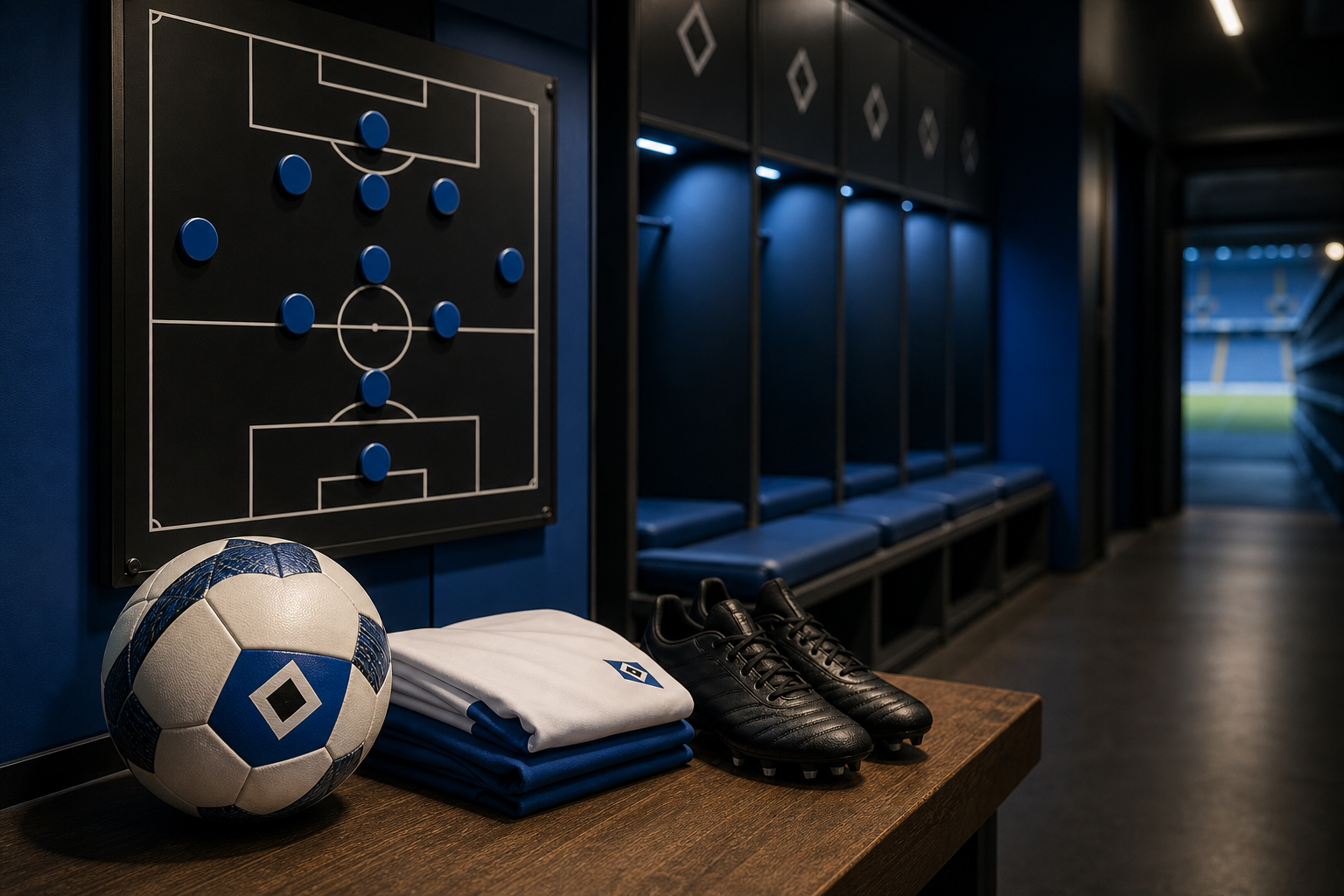
Bundesliga promoted side with many construction sites
HSV facing major squad overhaul: Where Hamburg urgently needs to strengthen now
After promotion to the Bundesliga, HSV is not entering a summer of fine-tuning, but a phase in which several key positions must be reassessed and reinforced simultaneously. Staying in the league is therefore less a question of individual transfers than of the overall structure: Which axis is set, where is reliable top-flight quality missing – and how quickly can depth be created without overloading the system?
The club is sending a positive signal with the personnel of Shafiq Bello Nandja: The central defender (born 2007), with the club since 2018, has signed his first professional contract. Nandja already trained with the first team in the second half of the season and made his Bundesliga debut on May 10 in the 3-2 win against Freiburg. Such steps are important because they show that HSV is keeping its own development pathways open. However, for the acute squad issues, one talent alone is not enough – especially not in a league where mistakes in the center and a lack of efficiency up front can have lasting effects for weeks.
Central defense: A hole in the center – and the question of immediate stability
The need is most obvious in central defense. Luka Vušković was a sporting factor, even scoring six goals in the season, but is returning to Tottenham Hotspur after his loan ends. This means HSV loses not only perspective, but above all minutes, presence, and part of its set-piece threat – a package that cannot be replaced "one-to-one" with a single new signing.
Nandja can play a role in the future, but the demands in the Bundesliga are particularly brutal in this position: timing when stepping out, toughness in duels, clean first passes under pressure. The existing personnel also provide clear indications for squad planning. Daniel Elfadli revealed, according to assessments during the season, limitations in being able to perform consistently at Bundesliga level. Jordan Torunarigha looked more stable on the left in a back three/five than in a central leading role. The bottom line is a compelling conclusion: HSV needs not just additions in central defense, but two reliable solutions – at least one of them as an immediate starter who leads the center and "calms" games when phases turn.
In the background, there is also a personnel issue that can influence planning: Mario Vušković is expected to return in the fall after serving his doping ban. Even if a comeback promises additional options, the transfer strategy cannot be built on this. After such a long break, performance level, rhythm, and resilience are open variables – and precisely this uncertainty is something a promoted team cannot afford in the most central defensive zone.
Attack: Not just a departure – but missing production
The pressure to act is even clearer in attack. Fábio Vieira was a creative linchpin as a loanee from Arsenal, but will not automatically return after the season. With seven goals and five assists, he was HSV's top scorer – and thus statistically directly involved in a large part of what Hamburg managed offensively. In addition, a permanent signing for Albert Grönbaek is still open; both sides want to continue working together, but the talks with Stade Rennes will be decisive.
The bare number shaping HSV's summer plan: 40 goals in 34 matches. For a team that not only wants to survive in the Bundesliga but also needs to pick up points in tight games, this is a warning sign. The internal goal distribution also supports this diagnosis: Ransford-Yeboah Königsdörffer scored five goals, Rayan Philippe also five, Robert Glatzel three, Yussuf Poulsen one. That Vušković, as a central defender, was ahead of several attackers with six goals is less a curiosity than a symptom: HSV was not consistent enough in many phases at creating chances and converting them in the box.
With Königsdörffer's free transfer to Mainz, the situation shifts again. HSV is now ideally looking not just for an "upgrade," but for two reliable attackers who can carry the team's profile. It's not just about finishing quality. Coach Merlin Polzin demands strikers for his playing style who work against the ball, press, and trigger transitions cleanly. Königsdörffer best fulfilled this pressing and work profile according to the coaching staff – so his departure not only leaves a gap in the goal tally, but also in the first pressing line. Whoever comes in must meet this double requirement: deliver goals and organize the defense from the front.
Flanks: Even the best striker is of little help if the crosses are missing
The squad gap is particularly visible on the flanks – and it's directly linked to the attack. On the left, Miro Muheim is considered a viable solution; at the same time, a backup would make sense, as the workload increases in the Bundesliga and absences have a quicker impact. On the right, the situation is much more open: The end of Giorgi Gocholeishvili's loan, William Mikelbrencis' expiring contract, and the recently practiced job-sharing with Bakery Jatta have provided solutions, but no permanently reliable Bundesliga structure. No one was able to establish themselves as a clear linchpin on either side for extended periods, either defensively or offensively.
For Polzin's 3-4-3/3-5-2, this is more than a side issue. This system depends on width, runs, and crosses coming consistently – especially when the attacking center is not occupied by a dominant number ten. If good deliveries and final passes from the wings are too rare, it's not an isolated wing problem, but undermines the entire attack. HSV therefore has to think about the flanks in two ways: A new striker alone solves nothing if the right remains a construction site and the left lacks cover.
Depth and structure: HSV needs more than individual measures
Promotion was also carried by loan players – so the cut is correspondingly large when several of these building blocks disappear again. The goalkeeper position with Daniel Heuer Fernandes and Sander Tangvik is considered comparatively well staffed; beyond that, much is in flux. Kofi Amoako is the first summer signing, a transfer that can bring depth and stability to midfield – but he does not change the core situation: HSV must reinforce several key points in parallel, instead of plugging individual holes one after another.
As things stand, the structure seems rather loose: Heuer Fernandes and Tangvik in goal, plus Nicolas Capaldo, Muheim, Nicolai Remberg, and Lokonga as reference points – and numerous question marks around this axis. This is precisely the task for this summer. After seven years in the 2. Bundesliga, HSV is back in the Bundesliga, but not yet an established top-flight club again. The club does not need a cosmetic overhaul, but immediately viable solutions: at least two central defenders, a clearly strengthened attack with a suitable pressing profile – and a flank plan that ensures quality and availability.
The professional contract for Nandja is a step that can be important in the long term. The real work, however, begins now: with transfers that not only bring names, but give the squad stability, depth, and Bundesliga toughness.
Frequently Asked Questions
Sources
- https://www.ndr.de/sport/fussball/Bundesliga-Hamburg-HSV,hsv-1734.html, 27.05.262026
- https://www.hsv.de/news/hsv-bindet-eigengewaechs-shafiq-nandja, 21.05.2026
- https://www.tottenhamhotspur.com/news/983249/hamburg-loan-for-vuskovic, 29.08.2025
- https://www.hsv.de/en/news/hsv-secure-fabio-vieira-signing, 01.09.2025
- https://www.hsv.de/en/news/hsv-sign-kofi-amoako, 23.05.2026
- https://datencenter.dfb.de/datencenter/bundesliga/2025-2026/33-spieltag/hamburger-sv-sc-freiburg-2398634, 10.05.2026